


Information on In Vitro Anti-Hair Loss Efficacy Testing Service Using 5α-Reductase Inhibition Model in Human Hair Follicle Dermal Papilla Cells
This service evaluates the efficacy of test substances in inhibiting hair loss at the cellular level using a testosterone- or DHT (dihydrotestosterone)-induced hair loss model in Human Hair Follicle Dermal Papilla Cells (HFDPCs). The service includes assessment of cellular protection against androgen effects, quantification of DHT levels using ELISA, and analysis of β-Catenin gene expression using RT-qPCR. It is suitable for brand owners, OEM manufacturers, and R&D teams seeking empirical data to support anti-hair loss claims or to develop scientifically substantiated hair loss reduction products.
Scientific Background
Importance of Anti-Hair Loss Efficacy Testing
Androgenetic alopecia (AGA) is the most prevalent form of hair loss in both males and females, particularly among individuals aged 25–50 years, a demographic with high purchasing power and continuous demand for hair loss prevention products. The anti-hair loss product market in the Asia-Pacific region is valued at several billion dollars and continues to grow rapidly. Products such as anti-hair loss shampoos, scalp serums, hair tonics, and dietary supplements commonly rely on hair loss reduction claims as their primary selling point.
However, anti-hair loss claims are highly sensitive, as consumers often have direct experience with ineffective products and expect credible evidence. Brands seeking differentiation must provide cellular-level test data demonstrating that their formulations can effectively counteract the biological mechanisms responsible for hair loss, rather than relying solely on ingredient-based claims.
In vitro testing using a DHT-induced hair loss model directly reflects the underlying biological mechanism and provides mechanistic insights into how test substances protect hair follicle cells from androgen effects. Such data are sufficiently robust for claim substantiation, R&D support, and preparation for subsequent clinical testing.
Role of DHT and 5α-Reductase in Hair Loss
Dihydrotestosterone (DHT) is the most potent androgen hormone in the human body, produced from testosterone via the enzyme 5α-reductase. High concentrations of this enzyme are found in dermal papilla cells of scalp hair follicles. Research indicates that 5α-reductase activity in dermal papilla cells is at least 14 times higher than in other follicular regions, highlighting their central role in DHT production.
When DHT binds to androgen receptors (AR) on dermal papilla cells, it initiates signaling pathways that lead to hair follicle miniaturization, a hallmark of androgenetic alopecia. This process gradually transforms thick terminal hair into fine vellus hair, eventually leading to permanent follicle inactivity.
At the molecular level, DHT suppresses the Wnt/β-Catenin signaling pathway by increasing GSK-3β activity, which promotes β-Catenin degradation. This weakens hair growth signals. Additionally, DHT activates TGF-β signaling via Smad2/3, accelerating the transition of hair follicles into the catagen (regression) phase. Collectively, these mechanisms result in progressive hair loss.
Therefore, evaluating whether active compounds can inhibit DHT effects on dermal papilla cells is a key indicator aligned with the actual mechanism of hair loss. VISBIO employs testosterone- or DHT-induced models in HFDPCs to simulate hair loss conditions in vitro.
Mechanisms of Inhibition: From Androgen Pathway to β-Catenin Recovery
The core objective of anti-hair loss testing is to determine whether a test substance can interfere with or inhibit DHT-mediated damage to hair follicle health. This involves three primary levels:
Level 1: Inhibition of 5α-Reductase
5α-Reductase catalyzes the conversion of testosterone into DHT, with Type II being predominant in scalp follicles. Substances that inhibit this enzyme reduce DHT production at the source, similar to the mechanism of Finasteride and Dutasteride. VISBIO measures DHT levels using ELISA to evaluate this inhibitory effect.
Level 2: Protection of Dermal Papilla Cells from DHT Effects
Even in the presence of DHT, certain compounds may protect dermal papilla cells by maintaining cell viability and promoting proliferation. VISBIO evaluates this using MTT assays and cell imaging.
Level 3: Restoration of β-Catenin Expression
Since DHT suppresses β-Catenin, compounds that restore its expression indicate potential to reactivate hair growth signaling pathways. VISBIO analyzes β-Catenin expression using RT-qPCR to assess molecular-level recovery.
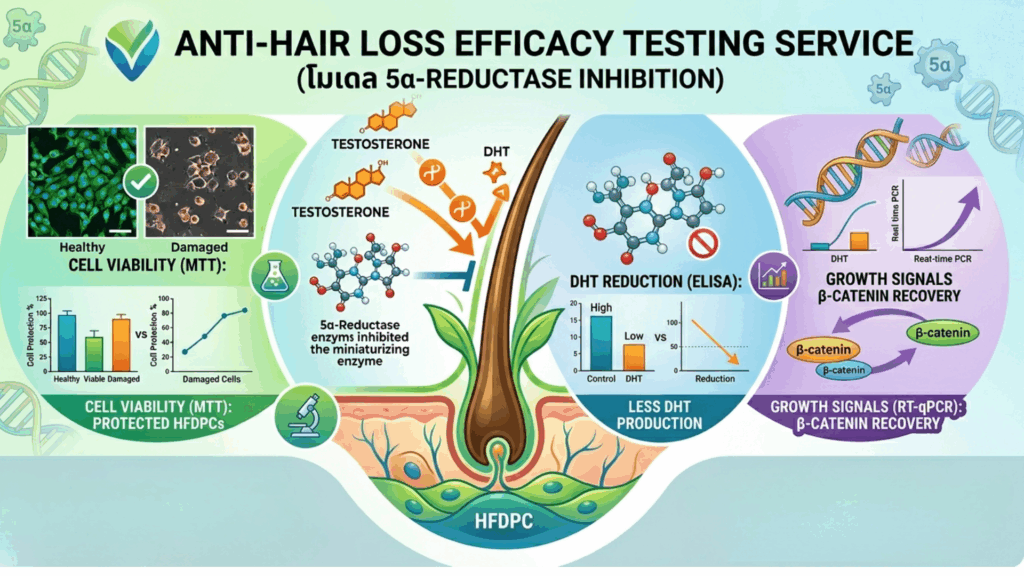
Scope of VISBIO Testing Services
VISBIO provides comprehensive anti-hair loss efficacy testing using testosterone- or DHT-induced models in HFDPCs, comprising four main test categories
Cell Viability & Proliferation Under DHT Stress
This test evaluates the ability of test substances to maintain cell survival and proliferation under DHT-induced stress using the MTT assay. Cells are cultured in 96-well plates, induced with DHT or testosterone, treated with test substances, and analyzed after 24 hours.
DHT Level Analysis Using ELISA
This specialized test assesses the ability of test substances to inhibit the conversion of testosterone into DHT. DHT levels are quantified in conditioned media using ELISA.
β-Catenin Gene Expression Analysis Using RT-qPCR
This advanced test evaluates the ability of test substances to restore hair growth signaling at the gene level. RNA is extracted, converted to cDNA, and analyzed for β-Catenin expression using RT-qPCR.
Cell Imaging
Morphological analysis of HFDPCs is performed using an inverted microscope to compare cell density, morphology, and apoptotic features across treatment groups.
Applicable Product Categories
This service is suitable for various product types in the health and beauty industry, including:
- Cosmetics: Anti-hair loss shampoos, scalp serums, hair tonics, sprays, and products containing 5α-reductase inhibitors such as saw palmetto, pumpkin seed oil, and green tea extract
- Dietary Supplements: Formulations containing DHT-related actives such as saw palmetto, lycopene, zinc, and biotin
- Active Ingredients: Natural or synthetic compounds requiring validation of 5α-reductase inhibition or dermal papilla protection
- Herbal Extracts: Botanical extracts such as Andrographis, ginger, moringa, aloe vera, or other local herbs requiring in vitro validation
Applications of Test Results
- Claim Support Demonstrated reductions in DHT levels, protection against androgen effects, and restoration of β-Catenin expression provide robust scientific supporting data for product claims.
- R&D Data Supports screening of active ingredients, optimization of concentrations, and understanding of mechanisms via ELISA and RT-qPCR data.
- Product Differentiation Mechanism-based evidence such as DHT reduction or β-Catenin upregulation provides a competitive advantage over products relying solely on ingredient claims.
- Pre-Clinical / Clinical Readiness In vitro data serve as preliminary evidence for designing clinical trials, including hair density measurements, hair pull tests, and user satisfaction studies.
Literature:
- Eicheler, W., Happle, R., & Hoffmann, R. (1998). 5α-Reductase activity in the human hair follicle concentrates in the dermal papilla. Archives of Dermatological Research, 290(3), 126–132. https://doi.org/10.1007/s004030050277
- Leirós, G. J., Attorresi, A. I., & Balañá, M. E. (2012). Hair follicle stem cell differentiation is inhibited through cross-talk between Wnt/β-catenin and androgen signalling in dermal papilla cells from patients with androgenetic alopecia. British Journal of Dermatology, 166(5), 1035–1042. https://doi.org/10.1111/j.1365-2133.2012.10856.x
- Kwack, M. H., Sung, Y. K., Chung, E. J., et al. (2008). Dihydrotestosterone-inducible dickkopf 1 from balding dermal papilla cells causes apoptosis in follicular keratinocytes. Journal of Investigative Dermatology, 128(2), 262–269. https://doi.org/10.1038/sj.jid.5700999
- Premanand, A., & Reena Rajkumari, B. (2018). Androgen modulation of Wnt/β-catenin signaling in androgenetic alopecia. Archives of Dermatological Research, 310(5), 391–399. https://doi.org/10.1007/s00403-018-1826-8
- Urysiak-Czubatka, I., Kmieć, M. L., & Broniarczyk-Dyła, G. (2014). Assessment of the usefulness of dihydrotestosterone in the diagnostics of patients with androgenetic alopecia. Advances in Dermatology and Allergology, 31(4), 207–215. https://doi.org/10.5114/pdia.2014.40925
- Dhariwala, M. Y., & Ravikumar, P. (2019). An overview of herbal alternatives in androgenetic alopecia. Journal of Cosmetic Dermatology, 18(4), 966–975. https://doi.org/10.1111/jocd.12930
- Kang, J. I., Kim, S. C., Kim, M. K., et al. (2019). Dihydrotestosterone Regulates Hair Growth Through the Wnt/β-Catenin Pathway in C57BL/6 Mice and In Vitro Organ Culture. Frontiers in Pharmacology, 10, 1528. https://doi.org/10.3389/fphar.2019.01528