
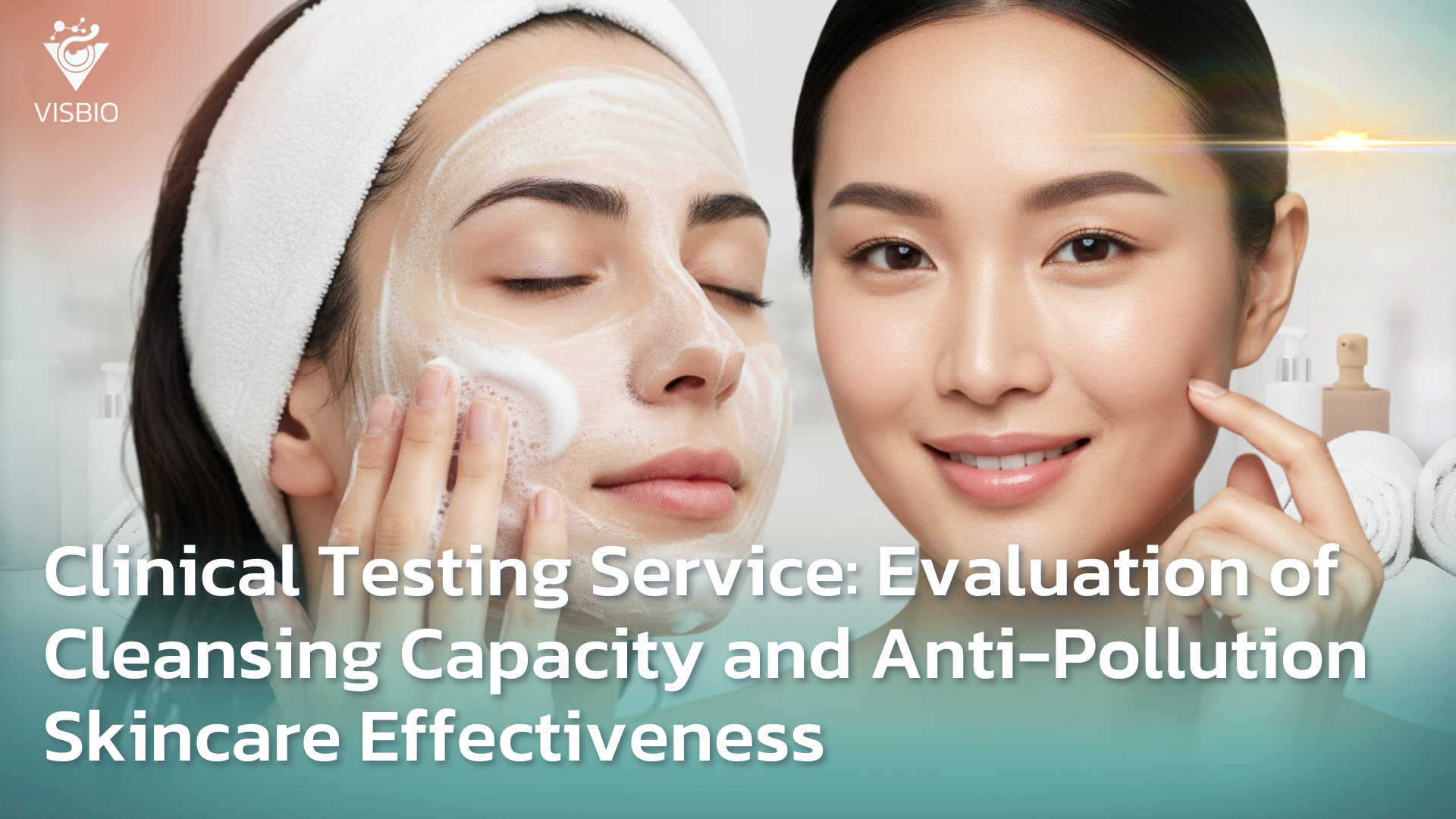
Information on Clinical Trial; Cleansing Efficacy and Anti-Pollution Performance Evaluation
In today’s world, air pollution has become a direct threat to skin health. Clinical research to evaluate the efficacy of skincare products especially cleansing and anti-pollution products has become essential for formulators, manufacturers, and cosmetic brands seeking scientific evidence to support product claims.
Visbio Co., Ltd. provides clinical skin analysis using advanced technologies and standardized methodologies. Our services include the evaluation of cleansing capacity and anti-pollution effectiveness, assessing both visual results and user perception. Study participants include both male and female volunteers, carefully selected and supervised by a professional research team throughout the testing process.
Skin Problems Caused by Pollution and the Need for Clinical Evaluation
Scientific research has shown that air pollutants, particularly fine particles like PM2.5, black carbon, heavy metals, and ozone can disrupt skin balance by triggering reactive oxygen species (ROS). These molecules are primary drivers of chronic inflammation, degradation of structural skin proteins like collagen and elastin, and overproduction of melanin in areas exposed to pollutants.
Pollution also affects tight junction proteins and compromises the skin barrier, increasing transepidermal water loss (TEWL) and reducing moisture retention. This weakened barrier leads to higher vulnerability to microbial invasion and environmental irritants.
Hence, validating that a cleansing product can effectively remove nanoparticles and micro-level pollutants and mitigate their effects on the skin requires both physical and biological evidence through clinical trials.
Mechanisms of Pollution-Induced Skin Damage
- Oxidative Stress When the skin is exposed to pollutants or chemicals, it rapidly triggers the formation of ROS, particularly in keratinocytes and melanocytes, leading to inflammation, collagen degradation, and stimulation of melanin synthesis.
- Disruption of Tight Junctions and Skin Barrier Research has shown that ozone and particulate matter can reduce tight junction proteins such as claudin-1 and occludin, resulting in increased TEWL and a higher risk of pathogen infiltration.
- Inflammaging (Chronic Inflammation-Induced Aging) Long-term exposure to environmental stressors often leads to low-grade, chronic inflammation in the skin, accelerating aging, wrinkle formation, and photosensitivity.
Functional Ingredients in Cleansing & Anti-Pollution Products
Modern skincare products designed for cleansing and pollution protection often incorporate ingredients that either adsorb pollutants or create protective films over the skin. Key active ingredients commonly evaluated include:
- Micellar Technology
Based on amphiphilic molecules, micelles encapsulate oil, dirt, and pollutants without the need for harsh scrubbing, thus minimizing irritation and friction.
- PHA (Polyhydroxy Acids) such as Gluconolactone
These gently exfoliate dead skin cells while enhancing skin hydration. Suitable for sensitive or reactive skin.
- Activated Charcoal
Due to its high surface area, it can efficiently absorb chemical residues and micro-particulate pollutants such as PM2.5.
- Moringa Seed Extract
Shown in studies to inhibit pollutant adhesion on the skin surface and provide antioxidant protection (anti-adhesion and antioxidant effects).
- Niacinamide (Vitamin B3)
Plays a critical role in reducing inflammation, reinforcing the skin barrier, and suppressing melanin production triggered by ROS.
- Biosaccharide Gum-4
A natural polysaccharide that forms a thin, breathable film on the skin, helping reduce adhesion of pollutants and chemical irritants.
Clinical Trial: Cleansing & Anti-Pollution Skincare
The clinical testing process is designed to differentiate both visual and subjective outcomes for cleansing and anti-pollution products. The procedure is as follows:
- Pollution Simulation
A pollutant model (e.g., black carbon, simulated PM2.5 particles, or artificial dirt solutions) is applied to a defined skin area to mimic real-life exposure conditions.
- Product Application and Cleansing
The test product (cleanser or anti-pollution skincare) is applied following the brand’s instructions. The treated skin area is then examined before and after cleansing using Hirox Digital Microscope.
- Questionnaire
Participants complete pre- and post-use questionnaires assessing perceived cleanliness, tightness, irritation, and hydration after using the product.
- Comprehensive Reporting
The final report includes high-resolution before/after images, statistical analysis, and qualitative feedback. This can be used for regulatory submissions, marketing claims, and R&D documentation.
Benefits of Clinical Trial: Cleansing & Anti-Pollution Skincare
In the current market, consumers are increasingly conscious of the impact of environmental stressors, particularly fine particulate matter (PM2.5) and airborne pollutants. Developing products that offer only basic cleansing is no longer sufficient; modern consumer confidence is driven by empirical scientific data and proven results.
The Strategic Importance of Clinical Trials Clinical trials for cleansing efficacy and anti-pollution performance are essential for brand differentiation. Data derived from laboratory testing and human volunteer studies under specialist supervision provide a credible foundation for Key Visuals and Marketing Messages. Quantitative results enable brands to communicate product mechanisms objectively—such as demonstrating a measurable reduction in pollutant adhesion or the reinforcement of the skin barrier function following environmental exposure.
Regulatory Compliance and Sustainable Communication A primary challenge in skincare advertising is avoiding exaggerated claims that may lead to legal complications. Having clinical trial evidence facilitates a smoother content creation process and minimizes Regulatory Compliance risks. By utilizing evidence-based data, brands can use precise, professional terminology to describe skin-enhancing attributes, such as:
“Helps protect skin from environmental stressors” (replacing absolute or curative claims).
“Contributes to reduced adhesion of dust and pollutants” (based on controlled study results).
“Dermatologically Tested” to verify both product gentleness and functional efficacy.
Literature:
- Krutmann J, et al. (2017). Pollution and the skin: From epidemiological and mechanistic studies to clinical implications. Journal of Dermatological Science, 76(3), 163–168.
- Valacchi G, et al. (2002). Ozone-induced damage in human skin. Toxicology in Vitro, 16(6), 629–635.
- Mancebo SE, Wang SQ. (2015). Impact of air pollution on skin: A review. Journal of the American Academy of Dermatology, 72(5), 886–896.
- Draelos ZD. (2018). The use of niacinamide in dermatology. Journal of Cosmetic Dermatology, 17(4), 473–478.