
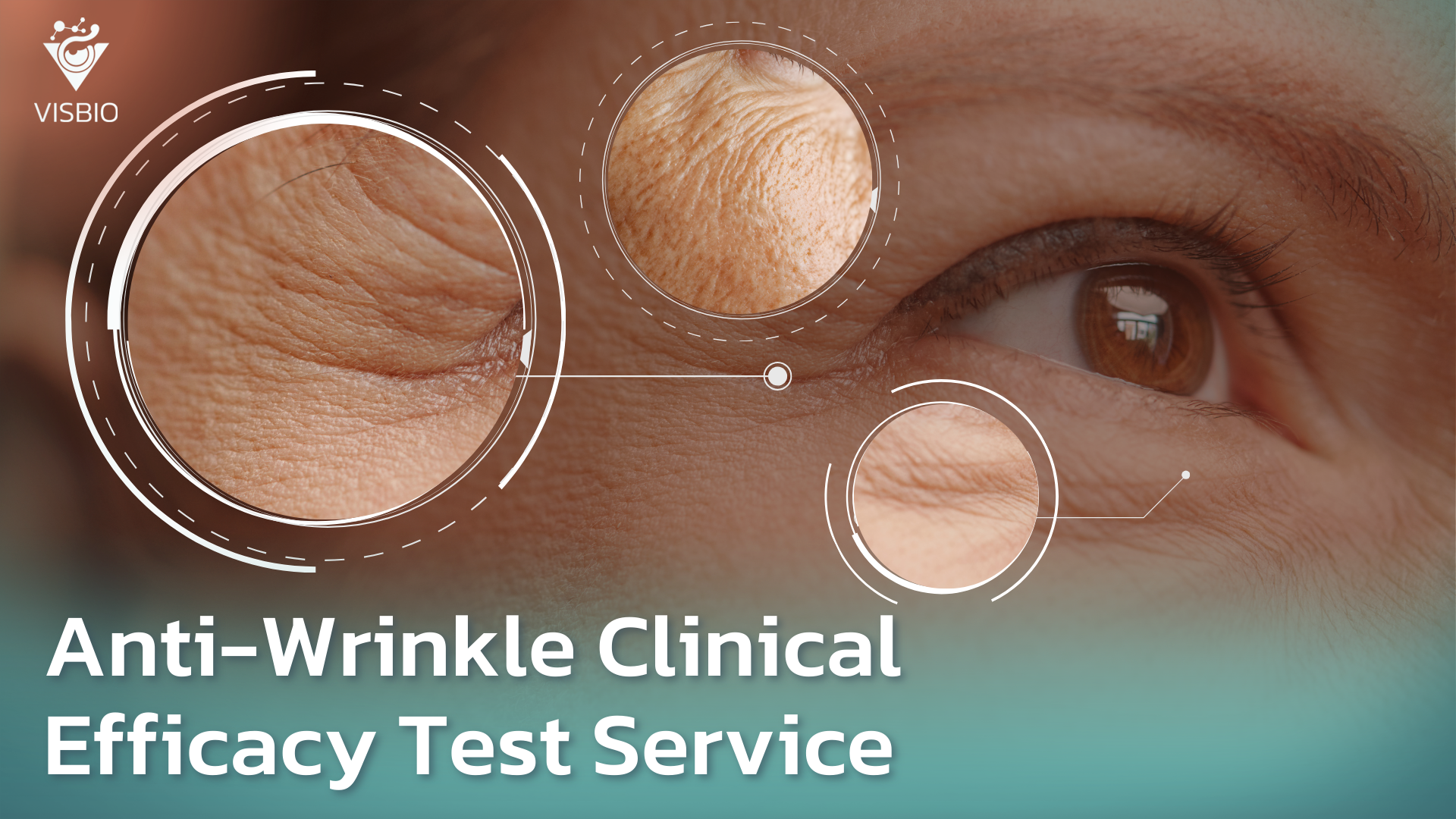
Information on Eye Wrinkle Reduction Efficacy: Clinical Efficacy Testing and Reporting for Skincare
In today’s competitive skincare market, consumers increasingly prioritize the proven efficacy of products before making purchasing decisions, particularly in the category of anti-aging and anti-wrinkle solutions targeting the delicate eye area. Wrinkles around the eyes, commonly referred to as “crow’s feet,” may not directly impact physical health, but significantly affect an individual’s confidence and overall appearance. This has driven strong consumer demand for scientifically substantiated eye creams that effectively reduce crow’s feet and visible signs of premature aging.
Recognizing this critical consumer trend, Visbio Co., Ltd., an expert in clinical research and testing services for cosmetic and cosmeceutical products, offers our specialized Eye Wrinkle Clinical Testing Service. Our comprehensive clinical trials combine advanced scientific measurement technology and real-user experience evaluations, delivering precise quantitative data alongside meaningful user insights. This robust approach ensures credible evidence to substantiate product efficacy claims and enhance market acceptance.
Mechanism Behind Crow’s Feet Formation
Understanding the mechanisms behind crow’s feet formation is crucial to effectively targeting and reducing their visibility. Skin aging involves two primary processes: intrinsic aging and extrinsic aging, each contributing uniquely to wrinkle formation.
1. Intrinsic Aging
Intrinsic aging is the natural process of skin deterioration that occurs with age, driven largely by genetic factors. Over time, the skin’s fibroblast cells which produce key structural proteins such as collagen and elastin decrease in both number and activity. Collagen provides structural support, while elastin enables the skin to return to its original shape after stretching or contracting. With age, the natural production and quality of these proteins decline, leading to reduced skin elasticity, diminished structural integrity, and increasingly noticeable wrinkles, particularly around thinner-skinned areas like the eyes.
2. Extrinsic Aging
Extrinsic aging accelerates the skin aging process due to external factors, predominantly ultraviolet (UV) radiation from prolonged sun exposure. UV rays, specifically UVA and UVB, penetrate the skin layers, stimulating the production of reactive oxygen species (ROS). These highly reactive molecules trigger inflammatory pathways and activate enzymes called matrix metalloproteinases (MMPs), which break down collagen and elastin fibers, further weakening the skin’s support structure. Consequently, skin loses elasticity rapidly, and permanent wrinkles such as crow’s feet become pronounced prematurely.
In addition to UV exposure, lifestyle factors such as repetitive facial expressions (smiling, squinting, or frowning), smoking, inadequate sleep, poor nutrition, chronic stress, and dehydration significantly amplify the formation of eye wrinkles. These factors collectively exacerbate oxidative stress and inflammation in skin tissues, further compounding premature aging symptoms.
Common Active Ingredients in Anti-Wrinkle Eye Creams
Cosmetic formulations targeting crow’s feet and eye-area wrinkles commonly incorporate specific active ingredients, each with distinct mechanisms to address underlying causes of wrinkle formation:
- Retinol: A derivative of vitamin A, retinol stimulates keratinocyte proliferation, increasing epidermal thickness, and enhances dermal collagen and elastin synthesis. Consistent use visibly reduces fine lines and deeper wrinkles.
- Peptides (e.g., Palmitoyl Pentapeptide-4 or Matrixyl): These signaling molecules stimulate fibroblasts to produce new collagen and elastin fibers, improving skin firmness, reducing wrinkle depth, and enhancing structural integrity.
- Hyaluronic Acid (HA): Known for its remarkable capacity to retain water, HA delivers deep hydration, instantly plumping the skin and smoothing wrinkles. Regular use supports long-term hydration and improved skin texture.
- Niacinamide (Vitamin B3): Enhances the skin barrier function, reduces transepidermal water loss (TEWL), diminishes inflammation, and improves skin elasticity, thus significantly reducing fine lines and irritation.
- Antioxidants (e.g., Vitamin C, Vitamin E, Green Tea Extract): These powerful ingredients neutralize free radicals, preventing oxidative damage to collagen and elastin caused by environmental stressors such as UV radiation and pollution, thereby slowing premature aging.
Eye Wrinkle Reduction Efficacy: Clinical Efficacy Testing
1.Clinical Trial Target Population
Our clinical trials focus on female and male volunteers aged between 30–60 years, who exhibit mild to moderate crow’s feet (classified as Crow’s Feet Grade 2–3). The recruitment criteria are meticulously designed to reflect typical product users accurately. Eligibility criteria ensure volunteers have no existing dermatological conditions around the eyes and refrain from using other eye care products during the trial duration, thus maintaining rigorous control over confounding variables.
2.Clinical Trial Timeline and Process
- Baseline Assessment (Day 0): Initial Primos® 3D measurement of wrinkle parameters, skin photography, and subjective questionnaire completion prior to product application.
- Product Application Period: Volunteers apply the tested eye cream consistently as directed for 28 days.
- Final Assessment (Day 28): Re-evaluation using Primos® 3D measurements, along with repeat subjective questionnaire assessments to evaluate changes in both objective wrinkle parameters and subjective user satisfaction.
3. Objective Measurement using Primos® 3D Optical
The state-of-the-art Primos® 3D system utilizes optical fringe projection to capture high-resolution, three-dimensional images of the skin surface around the eyes. It quantitatively evaluates critical parameters, including mean wrinkle depth, skin surface roughness, wrinkle length, and wrinkle volume. This precise, non-invasive technology enables detection and quantification of even subtle improvements in wrinkle reduction, setting the global gold standard in clinical eye wrinkle assessment.
4. Subjective User Evaluation (Before-After Questionnaire)
Complementing objective scientific measurements, Visbio employs subjective evaluation questionnaires to gather insightful user feedback across multiple dimensions, including:
- Perceived skin firmness and tightness around the eye area
- Hydration and smoothness of the skin
- Overall user confidence regarding the eye appearance
- General satisfaction with product effectiveness and usability
Integrating subjective assessments with objective data ensures comprehensive, meaningful, and market-relevant results, reflecting true user experiences alongside measurable clinical improvements.
Benefits of Clinical Testing Service
- Scientifically validates efficacy claims of eye targeting wrinkle reduction around the eye area.
- Provides credible, legally acceptable data to substantiate marketing claims and global regulatory standards for cosmetic product advertising.
- Supplies essential information to guide future product formulation, innovation, and optimization.
- Enables brands to effectively differentiate their products in highly competitive markets, enhancing brand prestige and consumer trust.
Literature:
- Fisher GJ, et al. (1996). Mechanisms of photoaging and chronological skin aging. Archives of Dermatology, 132(11), 1462–1470.
- Mukherjee S, et al. (2006). Retinoids in the treatment of skin aging: an overview of clinical efficacy and safety. Clinical Interventions in Aging, 1(4), 327–348.
- Gold MH, et al. (2020). A novel multi-peptide complex improves the appearance of fine lines and wrinkles. Journal of Cosmetic Dermatology, 19(7), 1535–1542.
- Draelos ZD. (2018). Cosmeceuticals for the treatment of photoaging: current status and future trends. Dermatologic Clinics, 37(2), 147–157.