
Information on Clinical Trials: Efficacy Assessment for Hair Heat-Protection Products
The shift from emotionally driven advertising claims (Emotional Claims) toward “Functional Beauty,” which emphasizes demonstrable outcomes, is a critical lever for building competitive advantage in the cosmetics market. As consumers and business partners increasingly demand transparency, in-depth test results that can demonstrate micro-level changes in hair structure under defined test conditions have become a “new currency” for trust—strengthening brand credibility and deepening consumer loyalty.
This is especially true for Heat Protection products, which face intense real-world use conditions. Heat accumulation from styling tools often affects hair across multiple dimensions, not only at the surface but potentially at deeper structural levels that are not visible to the naked eye. The extent of damage depends on key variables such as temperature, contact time, frequency of exposure, initial moisture within the hair, hair type, chemical treatment history, and individual styling technique.
For this reason, claiming that a product can protect hair from heat should no longer rely solely on “how it feels after use.” Instead, it should be supported by evidence that is verifiable at the structural level through a systematic set of measurable indicators. An IRB-approved clinical study (Clinical Study) reviewed by an Institutional Review Board (IRB) therefore becomes a strategic tool that enables brands to transform formulation hypotheses into objective evidence. This may include quantitative indices reflecting trends in hair porosity (Hair Porosity) and standardized microscopic imaging of cuticle morphology (Cuticle Morphology) conducted under consistent test conditions.
Such evidence does more than reduce risk from consumer complaints and regulatory scrutiny related to exaggerated communication. It also demonstrates that a brand prioritizes manufacturing standards, formulation design, and the delivery of value that can be assessed—serving as a foundation for sustainable growth in the beauty industry.
Impact of High Heat on Hair Health and Keratin Structure
When hair is exposed to high temperatures from flat-ironing or blow-drying, signs of damage are generally more likely to increase as temperature enters a higher range (for example, above ~130°C–150°C, although this varies depending on conditions and contributing factors). The process is often described as thermal degradation—heat-related deterioration of hair structure. Heat can disrupt or reduce surface lipid components such as 18-MEA (18-Methyl Eicosanoic Acid), which are associated with hair smoothness and reduced friction. When the surface lipid layer is compromised, the cuticle may lift, become brittle, and develop irregularities. This can reduce the hair’s ability to retain moisture and reflect light, leading to dryness and frizz (Frizz), particularly under humid environmental conditions.
In some cases—especially when moisture is present within the hair and the hair is subjected to sudden high heat—a phenomenon commonly referred to as “Bubble Hair” may be observed. In this situation, moisture within the cortex can rapidly change phase, creating internal voids or bubble-like spaces. This type of damage may influence the trend in hair porosity (Hair Porosity), reducing the hair’s ability to maintain water balance and increasing the likelihood of brittleness, breakage, split ends, and long-term frizz.
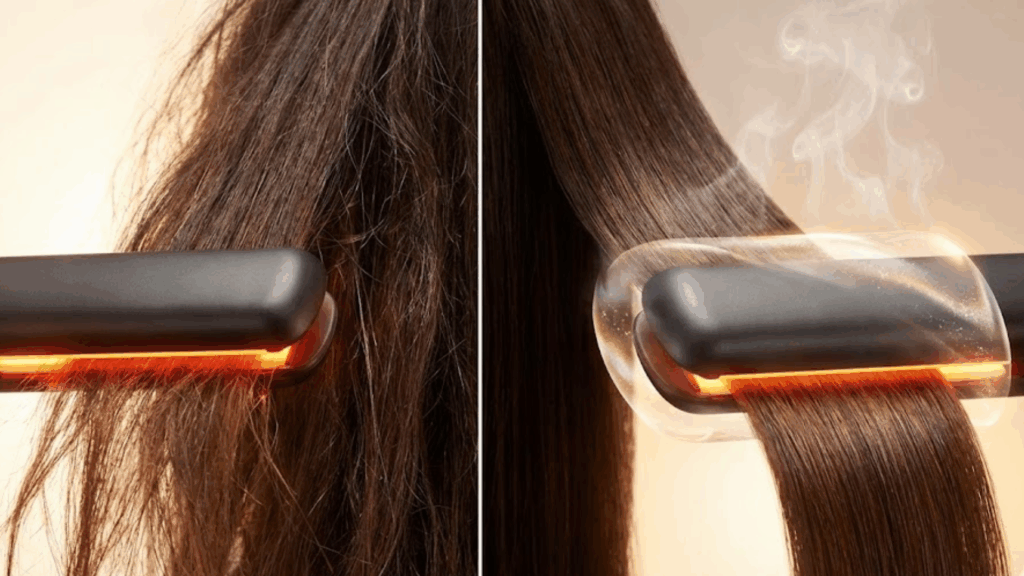
Accordingly, efficacy testing for heat-protection products should focus on whether key actives in the formulation can create a protective film or coating (Heat Shield/Protective Film) under defined test conditions, thereby helping to mitigate heat-related impacts on hair structure, preserve cuticle integrity, and support moisture retention and surface smoothness. This provides brands with clear technical evidence to explain product performance responsibly and credibly.
Product Types for Efficacy Evaluation
Product categories suitable for rigorous heat-protection efficacy assessment include:
- Heat protectant sprays/serums (Heat Protectant Spray/Serum)
- Leave-on treatments (Leave-on)
- Intensive repair products for severely dry or damaged hair
These products are typically designed to fill surface irregularities and form a coating layer that reduces friction. The evaluation approach should therefore use scientific endpoints that are both technically meaningful and communicable from a mechanism-to-outcome perspective.
A “trend in hair porosity” (Hair Porosity) can be evaluated through porosity testing approaches such as a Float Test to assess the hair’s tendency to absorb water and its changes under standardized conditions. When water quality, timing, and specimen preparation are tightly controlled, the reliability of comparative before–after results can be improved. This endpoint serves as a functional indicator associated with hair health and internal water balance.

In addition, high-magnification microscopic imaging (Microscopic Cuticle Picture) can reveal changes in cuticle smoothness and integrity after heat exposure. Comparison between hair with and without product use—under identical test conditions—yields both technical evidence and high-value visual assets for responsible scientific communication.
These objective assessments can be combined with Subjective Evaluation of user perception, focusing on hydration feel, reduced roughness/dryness, and frizz control. All results are processed into a complete research report, providing Claim Support that integrates both measurable scientific outcomes and real-user experience—interpreted within the defined experimental framework and stated conditions of use.
Clinical Trials Service Details: Heat-Protection Efficacy for Hair Products
Our clinical program is designed around real-world usage conditions. We recruit 20 volunteers who regularly flat-iron or blow-dry their hair with heat after every wash. This participant profile is more likely to show cumulative heat-related damage and enables clearer tracking of product-associated changes during continuous use. The study begins with collection of small hair samples (approximately 3–5 strands per volunteer per visit) for porosity testing and cuticle morphology imaging. All procedures follow standardized sample preparation and quality controls to support data precision and meaningful before–after comparisons.
The project is conducted through the following standardized phases:
- Ethics approval: approximately 2–3 months to ensure participant safety in accordance with international principles
- Volunteer recruitment: 1–3 months to obtain a study population meeting specific hair criteria
- Testing phase: 1 month of continuous product use
- Reporting: 1 month for statistical analysis and preparation of the final research report
Scope of Use and Claim Limitations (Scope & Claim Limitation)
To ensure accuracy and responsible consumer communication, study findings are intended to support performance communication under the specific test conditions defined in the protocol, and within the volunteer population that meets the stated inclusion criteria. Results may vary depending on baseline hair condition, chemical treatment history, heat frequency and temperature, environmental factors, and individual product use behaviors. Therefore, any external communication should remain within the “test condition framework” and avoid generalized statements implying identical outcomes for all users in all situations.
Key Benefits of Clinical Trials: Efficacy Assessment for Hair Heat-Protection Products
- Investing in clinical testing creates strategic brand assets. The first is Legal & Ethical Security: IRB-approved research reduces risk related to excessive or misleading communication, and enables brands to communicate within an auditable evidence framework.
- Sales Conversion: objective evidence—particularly microscopic images and quantified indicators demonstrating a trend in hair improvement—can significantly strengthen consumer decision-making by clearly presenting test conditions and scientific rationale.
- Volunteer data including satisfaction metrics and frizz-control perception, becomes actionable R&D insight for formulation optimization and next-generation product improvement. This program is not merely a tool for claim generation; it is a pathway to elevating a brand toward “Clinical-Grade” hair care expertise through transparency, responsibility, and evidence-based communication—supporting sustainable growth built on consumer trust and outcomes that align with expectations.
Literature:
- Marsh, J. M., Gray, J., & Tosti, A. (2015). Healthy Hair: A Scientific Approach. Springer.
- Ruetsch, S. B., et al. (2004). Effects of thermal treatments with a curling iron on hair fiber. Journal of Cosmetic Science.
- Moni, V. V., et al. (2011). Bubble Hair and Other Acquired Hair Shaft Anomalies due to Hot Ironing on Wet Hair.