
Information on Clinical Evaluation Services: Single Patch Test for Skin Irritation
In today’s cosmetic and skincare industry, “Safety” is no longer a mere preference or a secondary attribute—it is the Gold Standard and a primary deciding factor for consumers. Amidst the rising global trend of skin health awareness, brands that can provide empirical scientific evidence through Clinical Trials gain a significant edge in credibility, brand loyalty, and market trust.
Visbio Co., Ltd., a leader in scientific testing and laboratory services, recognizes this vital necessity. We offer specialized Single Patch Test services, conducted under rigorous scientific protocols and international standards. Our mission is to verify the safety of your formulations, ensuring they are market-ready and sustainably positioned for success.
What is a Single Patch Test? Why It Matters for Modern Brands
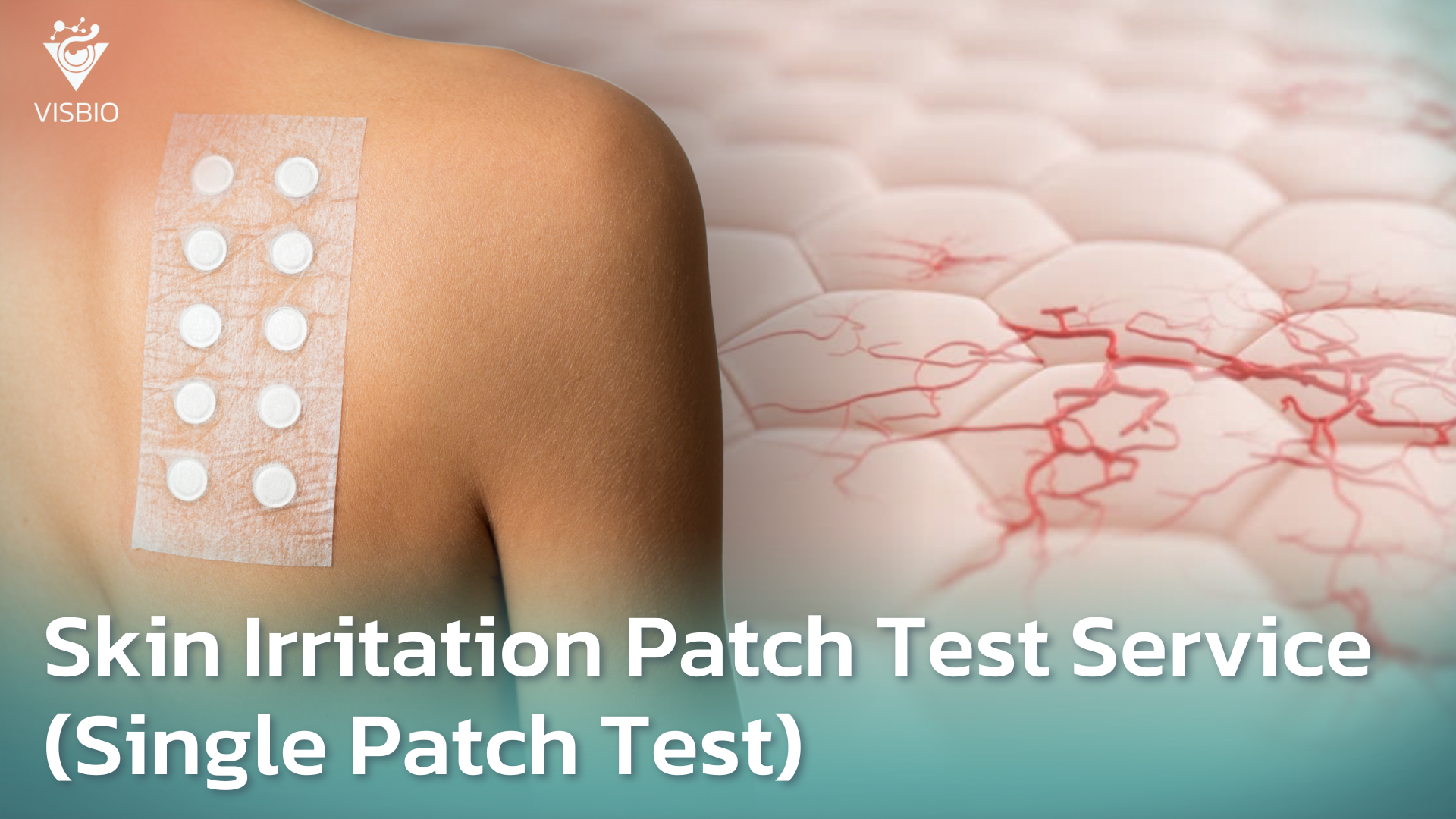
The Single Patch Test (Irritation Test) is a fundamental clinical procedure designed to evaluate the “potential” for Primary Irritation when a product comes into contact with human skin for a specific duration. This test is conducted under the strict supervision of Dermatologists to calculate the Primary Irritation Index (PII) for a specific formulation.
Why Should Brands Invest in a Single Patch Test?
- Maximum Consumer Confidence: Provides scientific validation that the product is non-irritating to normal skin, moving beyond unsupported claims like “gentle.”
- Marketing Differentiation: Clinical data can be leveraged for Content Marketing, attracting consumers with sensitive skin or those who prioritize safety.
- Risk Management: Minimizes legal risks, potential Product Recalls, and brand reputation damage that can arise if widespread irritation occurs post-launch.
Clinical Insights: Irritation vs. Allergy
In skincare development, “skin reaction” is a common challenge. However, in dermatology, “Irritation” and “Allergy” involve entirely different biological mechanisms. Understanding this distinction allows brands to refine their formulas and communicate professionally with their customers.
Skin Irritation (Irritant Contact Dermatitis – ICD)
Irritation is a direct localized reaction caused by damage to the Skin Barrier.
- Mechanism: Triggered by harsh chemicals, imbalanced pH levels, or prolonged exposure, leading to damage in the keratinocytes (outer skin cells).
- Characteristics: Reactions usually occur immediately or within a few hours. The effect is confined to the area of application. Notably, anyone can experience irritation if the concentration of the irritant is high enough.
- Role of Testing: The Single Patch Test is the international benchmark for assessing this reaction, ensuring the product is safe at its intended usage concentration.
Skin Allergy (Allergic Contact Dermatitis – ACD)
An allergy is a more complex, specific reaction involving the Immune System.
- Mechanism: The immune system recognizes a specific ingredient (e.g., fragrance, certain preservatives) as a foreign invader and triggers an inflammatory response.
- Characteristics: Known as Delayed Hypersensitivity, symptoms often do not appear on the first use but manifest after 24–72 hours or repeated exposure. The reaction may spread beyond the application site and is highly individual-dependent.
- Testing Challenge: Assessing allergic potential requires a more intensive protocol, such as the Human Repeat Insult Patch Test (HRIPT).
The Triad of Skin Reaction: Environmental & Formulation Factors
The reaction to a product is determined by the interaction of three primary factors:
Product Factors:
- pH Balance: Optimal skin pH is approximately 4.7–5.7. Extreme acidity or alkalinity triggers irritation.
- Active Ingredients: High concentrations of actives (e.g., AHA, BHA, Retinol) increase risk.
- Formulation Synergy: The interaction between fragrances and preservative systems.
Exposure & Mode of Use: Rinse-off products (cleansers/shampoos) have lower risk due to short contact time, whereas Leave-on products (creams/serums) have higher absorption potential.
Host & Environmental Factors: Individuals with Dehydrated Skin or a Weak Barrier are more susceptible. External factors like heat and humidity also enhance skin permeability.
Methodology and Clinical Protocols
To ensure accuracy and adherence to Ethics in Human Research, Visbio employs a systematic process:
Test Protocol
- Application: The test product is applied to the skin (usually the upper back) using specialized Finn Chambers or occlusive patches.
- Occlusive Condition: The patch remains in place for 24 or 48 hours to simulate maximum exposure.
- Clinical Evaluation: A dermatologist performs readings at two critical intervals:
Immediate Reading: 30 minutes after patch removal.
Delayed Reading: 24 hours post-removal to monitor late-onset reactions.
Subject Selection
- Target Group: Healthy male and female volunteers aged 18–60.
- Skin Condition: Subjects must have normal skin with no history of chronic skin diseases (e.g., Psoriasis or Atopic Dermatitis).
- Ethical Constraints: We strictly exclude vulnerable groups, including children, pregnant women, and lactating mothers.
Client Requirements & Preparation
To facilitate an efficient safety assessment, clients are required to provide the following:
- Quantitative Formulation: A full list of ingredients and their respective percentages for pre-test safety screening.
- Notification Receipt: Reference document of product notification status from the relevant regulatory body (e.g., FDA).
- Sample Volume
Standard Products: 30g x 2 units per test item.
Wipes: 2 packs per test item.
Safe Claims & Market Communication
Upon receiving a “Non-irritating” result in the Clinical Test Report, brands can utilize the following claims to enhance market positioning:
- Dermatologically Tested: Tested under the supervision of a dermatologist.
- Safety Tested: Evaluated for safety through clinical protocols.
- Non-irritating: Proven not to cause irritation under the test conditions.
- Clinically Tested: Backed by standardized clinical trials.
Regulatory Note: Claims must strictly reflect the test report results. Brands should avoid language implying “treatment” or “prevention” of skin diseases to remain compliant with cosmetic regulations
Literature:
- Barthe M, Bavoux C, Finot F, Mouche I, Cuceu-Petrenci C, Forreryd A, Chérouvrier Hansson A, Johansson H, Lemkine GF, Thénot J-P, Osman-Ponchet H. Safety Testing of Cosmetic Products: Overview of Established Methods and New Approach Methodologies (NAMs). Cosmetics. 2021;8(2):50. doi:10.3390/cosmetics8020050
- Spiewak R. Patch Testing for Contact Allergy and Allergic Contact Dermatitis. The Open Allergy Journal. 2008;1(1):42–51. doi:10.2174/1874838400801010042