

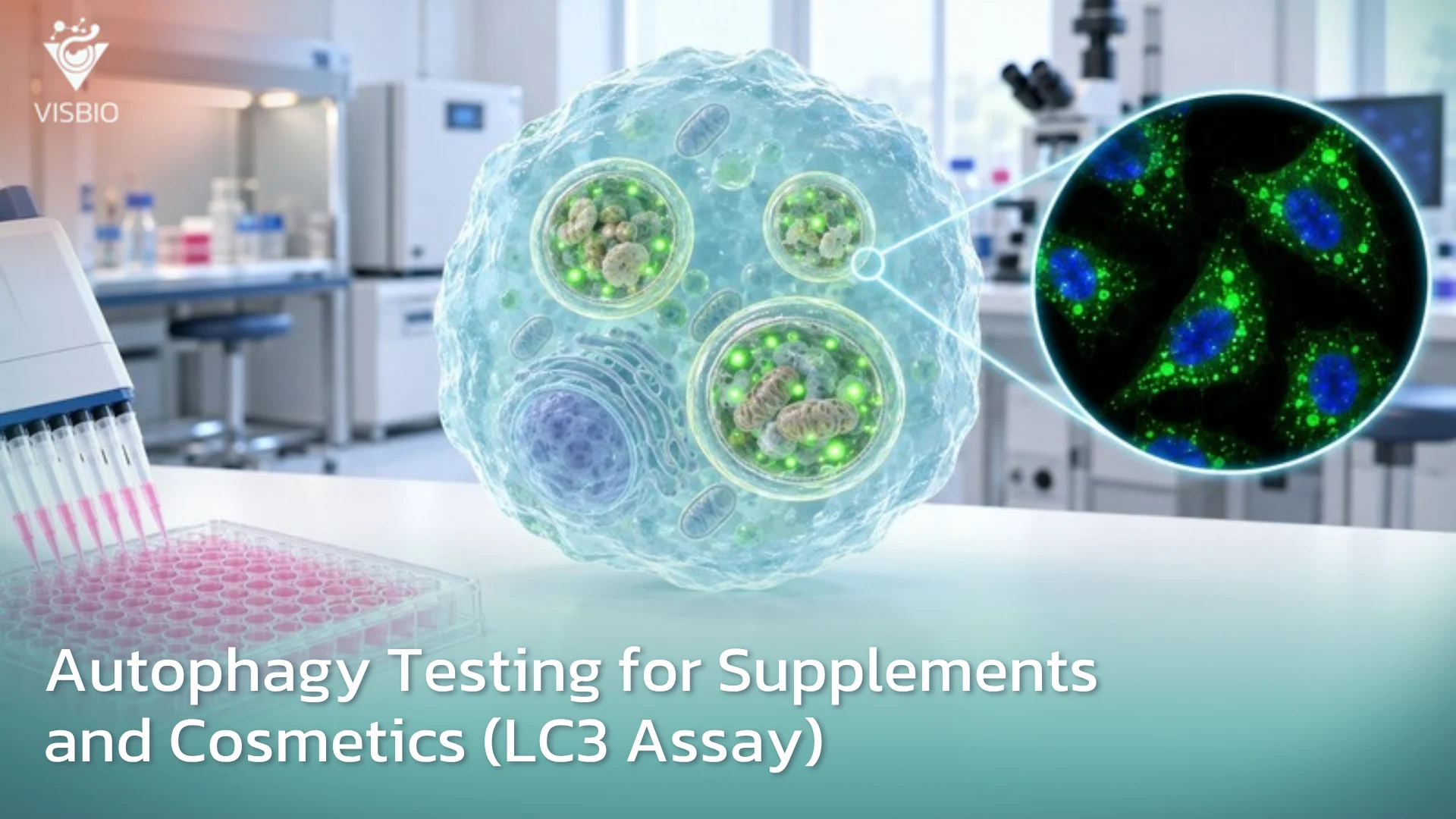
About Our Autophagy Testing
VISBIO Co., Ltd. offers autophagy efficacy testing for all kinds of products in the health and beauty, food and beverage, and pharmaceutical industries.
Autophagy is a key process by which cells remove and recycle damaged or unneeded components. It is important for slowing the aging process, maintaining cellular homeostasis and responding to stresses such as nutrient deprivation. Autophagy has also been linked to diseases such as Alzheimer’s disease, cancer and Crohn’s disease. Testing this mechanism is therefore particularly important when developing effective dietary supplements, especially products containing ingredients claimed to promote autophagy. The test results provide scientific evidence that strengthens the credibility of your product, and they can also support the development of new products or the reformulation of existing ones to improve their performance.
How Autophagy Works
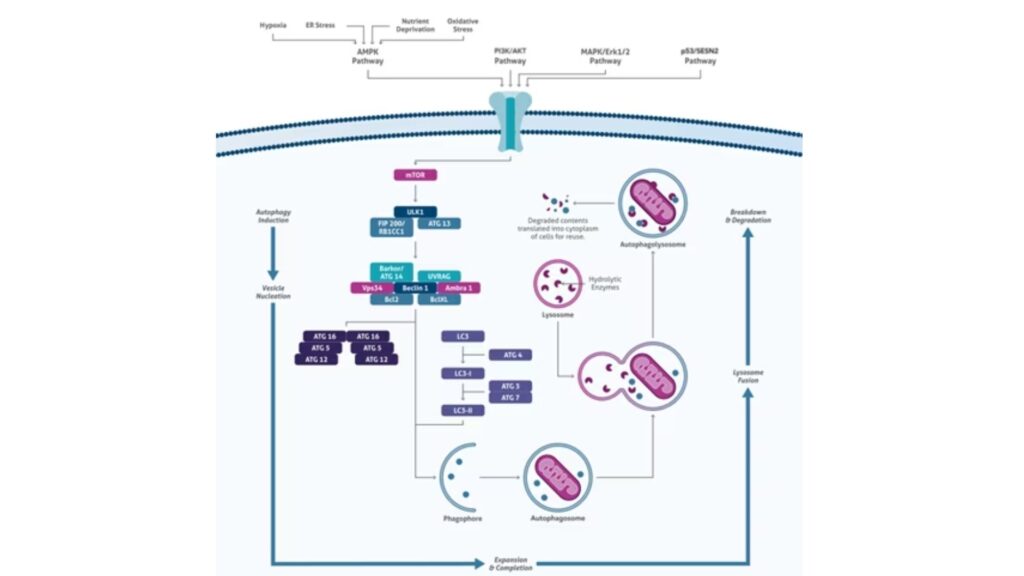
Autophagy is a complex, multi-step process that can be divided into four main stages:
- Initiation ( phagophore formation): When a cell receives stress signals, such as nutrient deprivation or DNA damage, autophagy-related protein kinases are activated, leading to the formation of the phagophore, a pouch-like membrane structure that is the starting point of the autophagosome.
- Elongation ( phagophore expansion): The phagophore expands and engulfs damaged or unneeded cellular components, such as damaged mitochondria or protein aggregates.
- Maturation ( autophagosome formation): When the phagophore has fully expanded, it becomes the autophagosome, a double-membrane structure.
- Fusion and degradation ( autolysosome formation): The autophagosome fuses with the lysosome, an organelle containing enzymes that can break down a wide range of cellular materials, so that the contents of the autophagosome are degraded and can be recycled.
Significance for Health and Beauty
Autophagy is the process by which cells remove damaged or unneeded components, such as damaged proteins or worn-out organelles. It helps cells maintain their balance and viability. During stress or nutrient deprivation, autophagy allows cells to recycle these components to generate energy and building blocks for new cellular structures.
Importance for Health
Autophagy is thought to play an important role in protecting against many diseases, including cancer, diabetes and neurodegenerative diseases such as Alzheimer’s and Parkinson’s. By clearing unwanted proteins and worn-out organelles, autophagy may help reduce the risk of these diseases.
Autophagy also contributes to cell longevity and to maintaining a healthy immune system. Studies in laboratory animals have found that stimulating autophagy can extend lifespan and reduce cellular deterioration.
Importance for Beauty
For skin and beauty, autophagy plays an important role in maintaining skin condition and delaying wrinkle formation. The process helps clear worn-out components from skin cells and supports the renewal of healthy skin cells, which can help the skin look brighter and more youthful.
Research has examined many natural compounds that stimulate autophagy in cells. Autophagy is the biological process that allows cells to remove and recycle damaged or unwanted components, and it is important for maintaining cellular health. Studies have shown that resveratrol, a compound found in red grapes, and epigallocatechin-3-gallate (EGCG), the main catechin in green tea, can effectively stimulate autophagy in cells. These compounds have been reported to reduce inflammation and stimulate collagen production in skin cells, which may help the skin look smoother and firmer. Stimulating autophagy may also help protect against diseases such as cancer, diabetes and neurodegenerative diseases.

Research has shown that resveratrol can inhibit mTOR, a protein kinase that suppresses autophagy, and that resveratrol activates SIRT1, which in turn induces autophagy in cells. EGCG from green tea also stimulates autophagy and can reduce inflammation and promote collagen production in skin cells.
Product Development Guidelines
When developing dietary supplements that support autophagy, the following key points should be considered:
- Ingredient selection: Choose ingredients backed by scientific evidence that they can promote autophagy safely and effectively.
- Formulation design and development: Design and develop formulations with suitable ingredients that are consistent with how autophagy works.
- Quality control: Control the quality of raw materials and the manufacturing process to ensure a high-quality product.
- Efficacy and safety testing: Once the formulation is finalized, the product should undergo laboratory efficacy testing to confirm its efficacy.
Autophagy Testing Method
Autophagy is a key process for removing and recycling damaged or unneeded cellular components and is important for maintaining cellular homeostasis. Our laboratory tests autophagy with an Autophagy LC3-antibody based kit, which measures changes in LC3, a protein involved in autophagy. Under normal conditions LC3 is present as LC3-I, but when autophagy occurs, LC3-I is converted to LC3-II, which binds to the autophagosome, the structure formed during autophagy.
The assay uses a fluorescently labeled LC3-specific antibody to detect LC3-II bound to autophagosomes. LC3-I that is not bound to autophagosomes is washed out during sample preparation, allowing LC3-II to be distinguished from LC3-I.
The purpose is to measure the level of autophagy in the sample: a high LC3-II signal indicates a high level of autophagy, whereas a low LC3-II signal indicates a low level of autophagy.
Literature:
- Danielle Glick, Sandra Barthand Kay F. Macleod, 2010, Auto phagy: cellular and molecular mechanisms. J Pathol. 221(1): 3–12.
- Auto phagy in the Pathogenesis of Disease
- Hae-Suk Kim, Michael J. Quon, Jeong-a Kim. 2014. New insights into the mechanisms of polyphenols beyond antioxidant properties; lessons from the green tea polyphenol, epigallocatechin 3-gallate. Redox Biol. 187–195.