

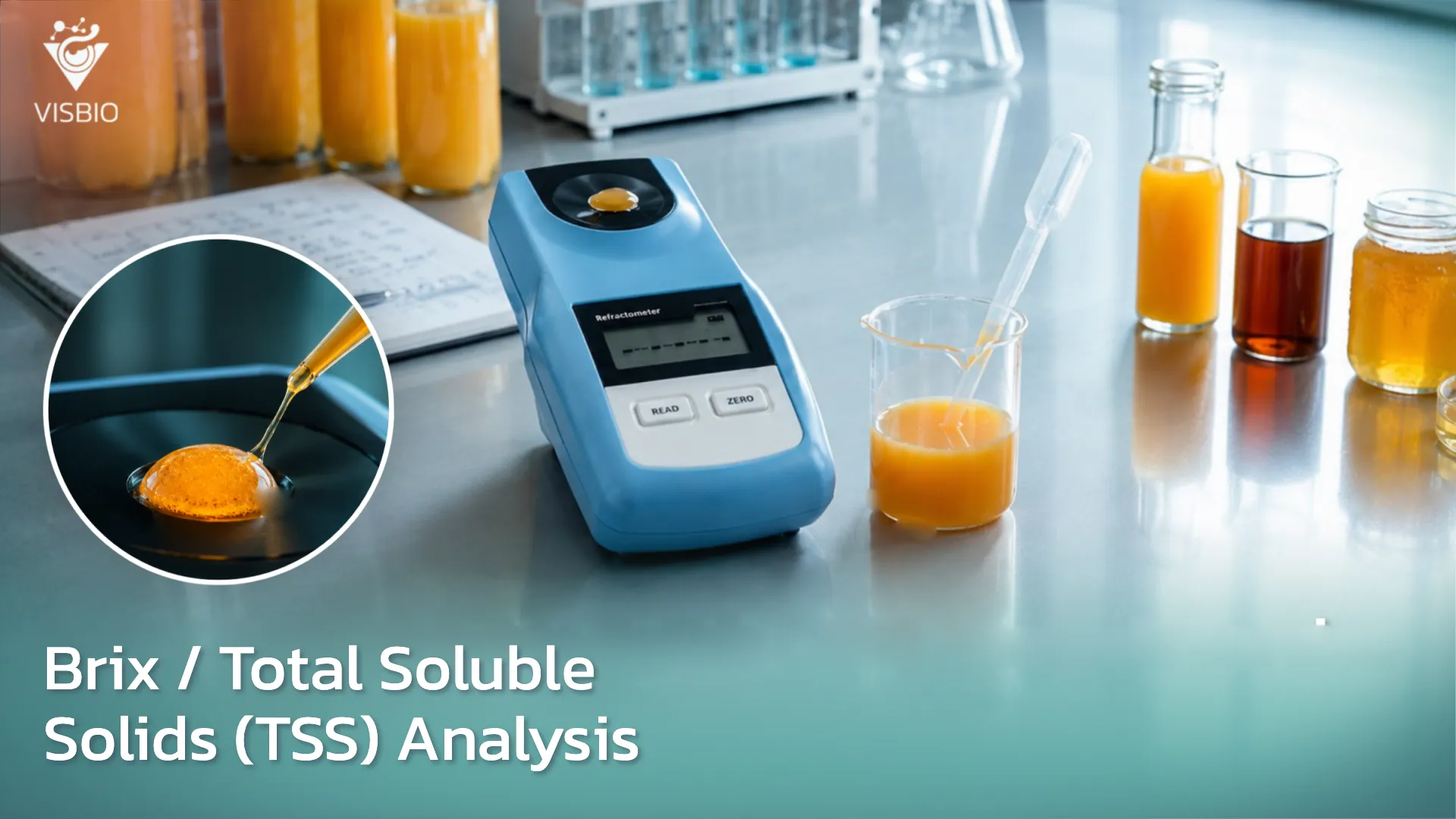
Brix (°Brix) is a unit that expresses the amount of soluble solids in a sample: 1 °Brix equals 1 gram of sucrose in 100 grams of solution when measured in a pure sucrose solution. Real products contain sugars, acids, salts and other water-soluble substances, so the measured value expresses the total amount of dissolved solids (total soluble solids, TSS), not the sugar content alone.
For beverages, fruit juices, herbal syrups, honey and products based mainly on sugar, Brix is a parameter linked to taste, cost and product quality at the same time. A Brix value that is off by only 1–2 units from the value in the specification can mean a taste that is too sweet or too bland, and a sugar cost per bottle that differs from the plan. Brix has long been the standard unit in the fruit juice, syrup, honey, wine and sugar product industries worldwide.
For fruit juices, Brix is also used to check concentration against the minimum values set by buyers or reference guidelines, for example to check whether juice reconstituted from concentrate reaches the required strength. However, Brix alone cannot prove that a fruit juice is authentic, because adding sugar or syrup also raises the Brix value.
VISBIO Laboratory measures Brix and total soluble solids with a refractometer for beverages, fruit juices, herbal syrups, honey, jams, agar jellies, jellies and other sugar-containing products, either as a single measurement for batch release or as repeated measurements during a stability study.
Why Brix is a parameter to check in every batch
In beverage formulation, Brix determines the sweetness that consumers perceive. For example, many beverage formulas are set at around 10–12 °Brix to balance sweetness with refreshment. Formulas above about 14 may be too sweet for health-conscious consumers, while formulas below about 8 may taste so bland that consumers feel they are not worth the price. In fruit juices, perceived sweetness also depends on the amount of acid, so manufacturers commonly look at the ratio of Brix to titratable acidity (Brix/acid ratio) at the same time. Setting a target Brix is therefore part of designing a product’s taste.
In terms of cost, Brix is directly related to the amount of sugar in the formula, a raw material whose price fluctuates with the world market. Keeping Brix consistent from batch to batch therefore helps control the cost per bottle. A batch with a higher Brix than specified has used more sugar than necessary, which reduces the profit per bottle.
In fruit juices, each fruit has an approximate Brix range that the industry uses as a reference, for example around 11–13 °Brix for orange juice, around 12–14 °Brix for pineapple juice and around 16–18 °Brix for grape juice. A juice labeled as 100% fruit juice with a Brix below the expected range may have been diluted with water. In the European market, many buyers refer to the AIJN Code of Practice, which sets a minimum Brix for each type of fruit juice as one of its quality evaluation criteria (European Fruit Juice Association, 2022).
In herbal syrups and honey, Brix is also related to shelf life. Honey has a high Brix of around 75–82 °Brix, which gives it a water activity (aw) low enough that most microorganisms find it hard to grow, so honey keeps for a long time without refrigeration. Honey with a high moisture content, or honey diluted until its Brix falls below the normal range, has a higher aw and is at risk of fermentation by yeasts. Honey adulterated with syrup, on the other hand, may not have a low Brix. Brix measurement can therefore indicate the risk of fermentation, but it cannot prove that honey is authentic. Syrups with a high Brix, for example around 60–70, usually keep for a long time with less preservative.
From a regulatory perspective, statements on fruit juice labels, such as the percentage of fruit juice, must comply with the relevant Ministry of Public Health notifications. Brix is one of the data points that manufacturers use to check that juice concentration is consistent with the label statement and with the reference values their buyers use. Beverages and fruit juices sold in Thailand fall under the Food Act B.E. 2522 (1979), while herbal medicinal syrups fall under the Herbal Products Act B.E. 2562 (2019).
Principles of Brix measurement with a refractometer
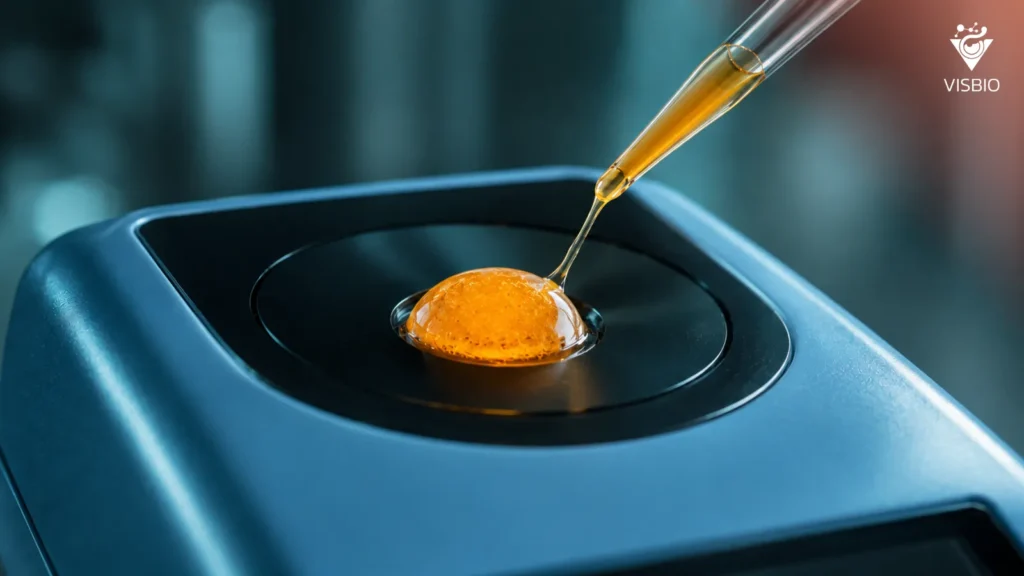
A refractometer measures the refractive index of a sample. When light passes through a solution containing a large amount of dissolved solids, it bends differently from when it passes through pure water. The instrument converts the refractive index reading into °Brix using a standard table based on pure sucrose solutions at 20 °C (International Commission for Uniform Methods of Sugar Analysis, 2000). The method is fast, needs only a small amount of sample, does not destroy the sample and is the AOAC standard method for soluble solids in fruits and fruit products (AOAC International, 2005).
Refractometers fall into two main types. The first is the optical refractometer, read by eye. It comes as a hand-held refractometer, which is inexpensive, durable and needs no power, making it suitable for preliminary checks on the production line, and as a benchtop instrument such as the Abbe refractometer, which gives finer readings and can control the prism temperature. Optical instruments depend on the skill of the person reading them, and the sharpness of the dividing line depends on the surrounding light. The second type is the digital refractometer, which uses an LED light source and a photodetector to take the reading and displays the result as a number. It is easy to use, gives little variation between operators and usually has automatic temperature compensation (ATC), which corrects the result to the value at 20 °C. This compensation is based on the behavior of sucrose solutions, so samples whose composition differs greatly from a sugar solution should be measured at a temperature close to 20 °C.
One caution in interpreting results is that Brix reflects all dissolved solids, not only sugar. In products that contain organic acids such as citric acid and malic acid, salts or proteins, the measured Brix will be higher than the actual sugar content. Results for products with complex compositions must therefore be interpreted with care, which is why some standards use the term “apparent Brix” to make clear that the measured value represents total dissolved solids, not sugar content.
Scope of VISBIO Laboratory's Brix measurement service
VISBIO Laboratory’s service covers several sample groups:
- Fruit juices and fruit drinks: fresh fruit juices, fruit juice concentrates, blended juices, ready-to-drink fruit beverages and fruit juices with added extracts
- Functional drinks: beverages fortified with bioactive compounds, cold-brew teas, herbal drinks, carbonated drinks and sports drinks
- Syrups: herbal syrups, herbal medicinal syrups, coffee syrups, fruit syrups and syrups for beverages
- Honey and sweets: floral honey, honey blended with herbs, jams, jellies and fruit pastes
The report shows the Brix value with the mean and standard deviation of replicate measurements. For stability studies, the report shows the quantitative change over time relative to the starting point (T0). Clients can choose between a single measurement for production batch release and a continuing study throughout shelf life.
Using Brix results
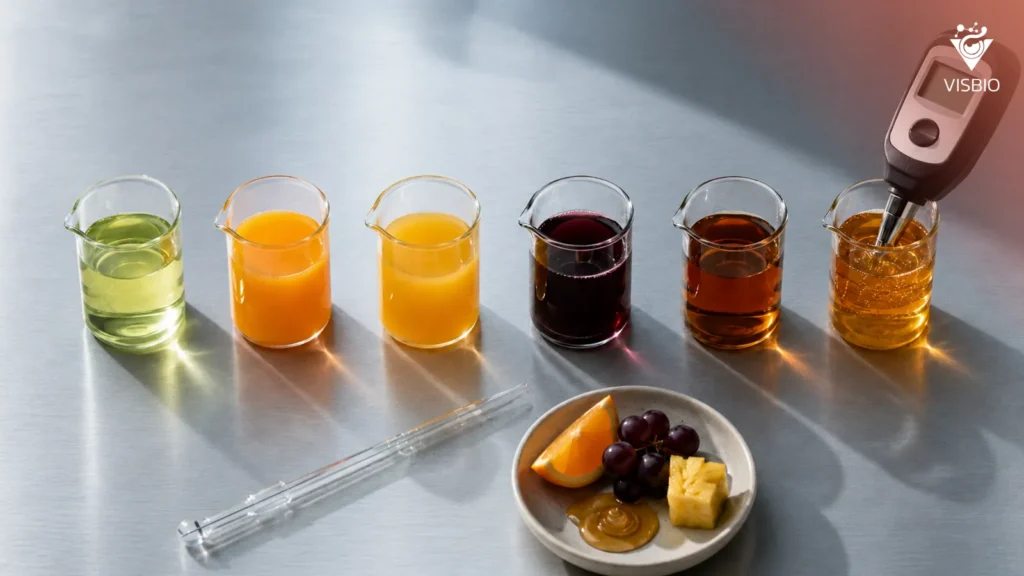
Brix results are useful at several stages of a product’s life. In research and development, they are used to balance the taste of beverages, to test raw materials from several suppliers, especially fruit juice concentrates, whose quality and price vary between producers, and to choose the proportion of sugar in the formula that gives the target taste. When selecting raw material suppliers, they are used to check that the concentration of seasonally imported fruit juice concentrates matches the agreed specification.
Before launch (pre-launch), Brix serves as the baseline for the specification and is used to set acceptable deviation limits. In commercial production, it serves as a batch release criterion that reflects the taste consumers will actually experience. In stability studies, it is used to track changes in Brix throughout shelf life. A rising Brix may signal water evaporating through packaging that is permeable to water vapor, while a falling Brix may signal that microorganisms are consuming the sugar in the product, for example fermentation caused by insufficient heat treatment or an imperfect container seal.
For export, the results can be attached to the certificate of analysis (COA) to support inspections by business-to-business (B2B) buyers in markets where buyers refer to the AIJN Code of Practice or specify Brix in trade agreements.
Frequently asked questions about Brix
What is Brix?
Brix (°Brix) is a unit that expresses the amount of soluble solids in a sample. 1 °Brix equals 1 gram of sucrose in 100 grams of solution when measured in a pure sucrose solution. In real products, this value also includes acids, salts and other water-soluble substances.
How do Brix and total soluble solids differ?
In a solution that contains only sucrose, Brix equals the sugar content. In real products that contain acids, salts and other water-soluble substances, the measured value is the total soluble solids (TSS), which is higher than the actual sugar content. Some standards call this value apparent Brix.
Can Brix prove that fruit juice or honey is authentic?
No. A Brix value below the normal range may indicate dilution with water, but adding sugar or syrup also raises Brix, so a value within the normal range does not confirm authenticity. Brix is suited to checking concentration against a specification and to assessing the risk of fermentation.
How do optical and digital refractometers differ?
Optical refractometers are read by eye. They include inexpensive hand-held models that need no power and benchtop instruments such as the Abbe refractometer, which give finer readings. Digital refractometers display the result as a number, give little variation between operators and usually have automatic temperature compensation (ATC), which corrects the result to the value at 20 °C.
What does a change in Brix during storage indicate?
A rising value may indicate that water is evaporating through the packaging, while a falling value may indicate that microorganisms are consuming the sugar in the product, for example fermentation caused by insufficient heat treatment or an imperfect container seal.
What does a Brix measurement report include?
The report shows the Brix value with the mean and standard deviation of replicate measurements. For stability studies, it shows the change in Brix over time relative to the starting point (T0).
References:
- AOAC International. (2005). AOAC Official Method 932.12: Solids (soluble) in fruits and fruit products — Refractometer method. In Official methods of analysis of AOAC International (18th ed.). AOAC International.
- European Fruit Juice Association. (2022). AIJN code of practice for evaluation of fruit and vegetable juices. AIJN.
- International Commission for Uniform Methods of Sugar Analysis. (2000). Refractometry and tables — Official (ICUMSA Specification and Standard SPS-3). ICUMSA.
- Royal Thai Government Gazette. (1979, May 13). Food Act B.E. 2522 (1979). Royal Thai Government Gazette, 96(79 Kor), 1–24.
- Royal Thai Government Gazette. (2019, April 30). Herbal Products Act B.E. 2562 (2019). Royal Thai Government Gazette, 136(56 Kor), 116–161.