

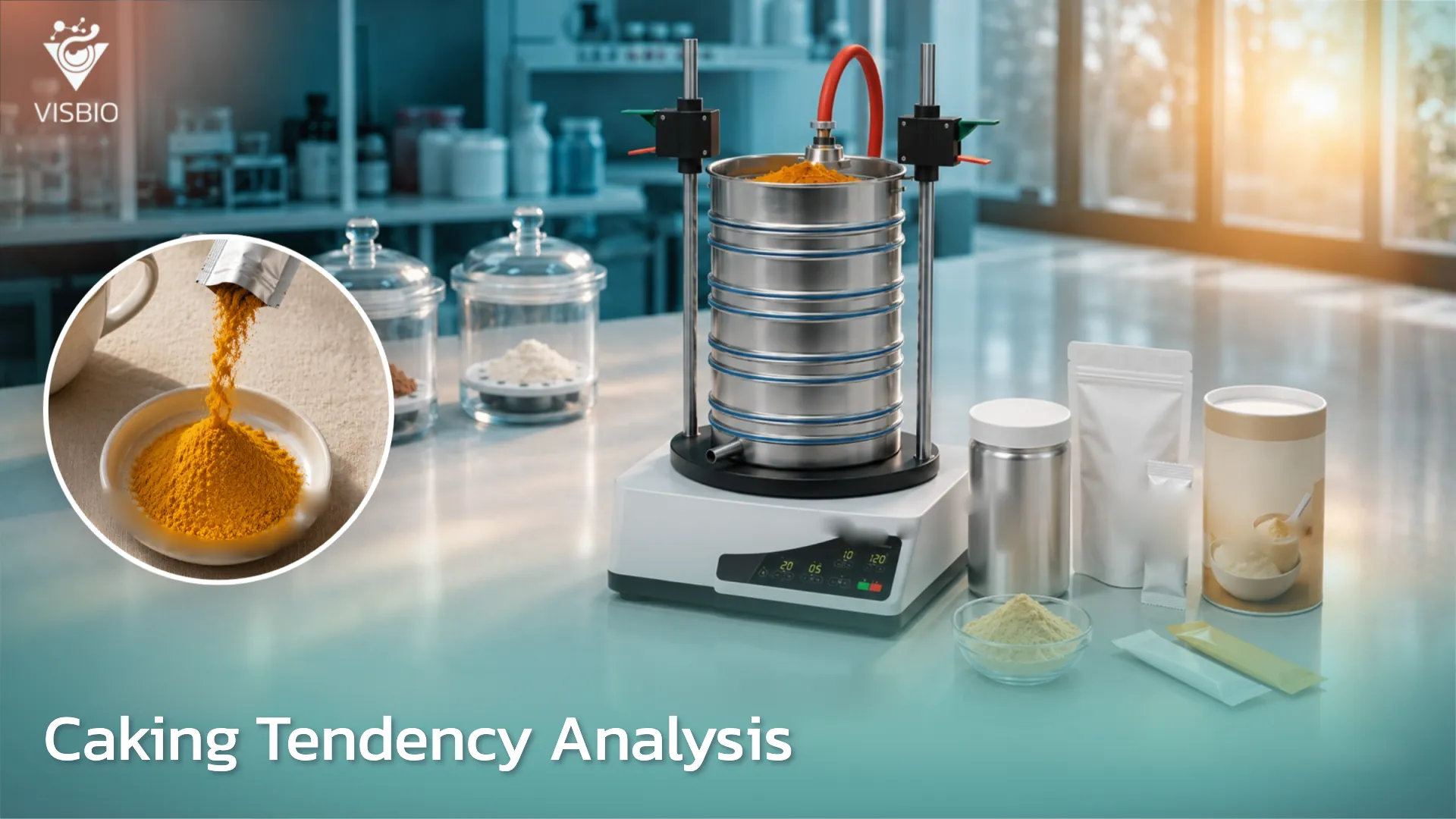
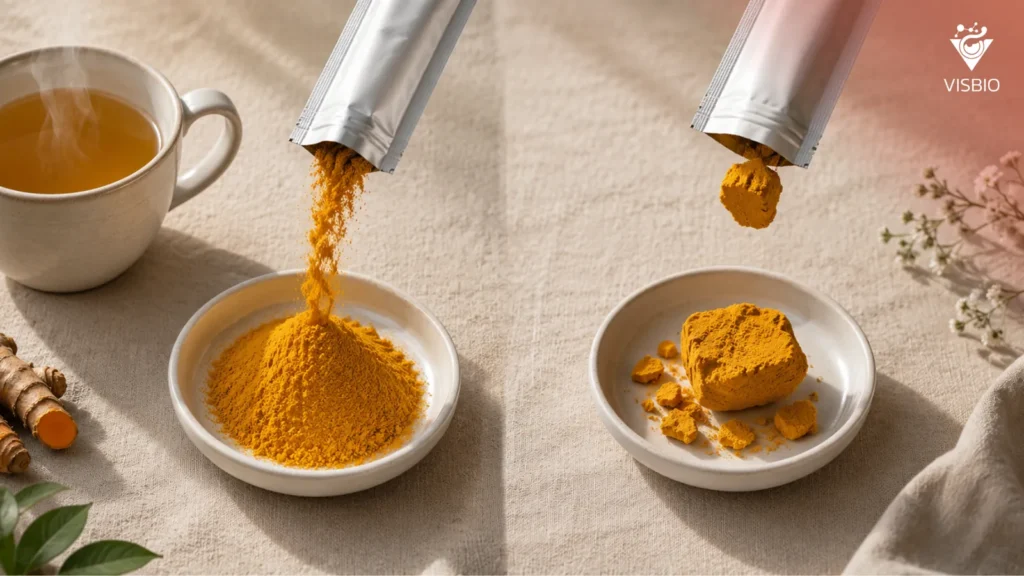
Caking is when a powder that was once loose and free-flowing sticks together into soft or hard lumps during storage. The main causes are moisture uptake from the air and changes in temperature. Caking tendency analysis measures this change as numbers, so that manufacturers can choose the formula, carrier and packaging before the problem reaches consumers.
In Thailand’s market for powdered dietary supplements and instant drinks, caking is a common quality problem that can quickly spoil the consumer experience. A powder that is loose when the sachet is opened but becomes hard or sticky lumps after a period of storage, for example 3–6 months, forces consumers to break it up themselves before use; some stop buying or return the product through distribution channels. Caked drink powders are also harder to dissolve and give an uneven taste, so the brand loses both consumer confidence and repeat sales.
Caking does not happen at random. It is a physical process that can be predicted and measured. The main factors are the hygroscopicity of the powder and temperature changes during transport and storage. A powder that absorbs moisture develops a sticky surface or forms liquid bridges between particles; when the temperature changes and the moisture evaporates, these bridges may harden into solid bridges that bind the particles together. Amorphous powders high in sugar also become much stickier when the temperature rises above the glass transition temperature, which falls as the powder absorbs water (Zafar et al., 2017). Herbal extract powders that use sugar or salt as a carrier therefore tend to cake more than powders that use a carrier that reduces stickiness, such as low dextrose equivalent (DE) maltodextrin, although maltodextrin itself can also absorb moisture (Bhandari et al., 1997).
VISBIO Laboratory, in collaboration with partner laboratories, provides caking tendency analysis by storing samples under controlled humidity and temperature and then assessing them by sieve analysis and visual caking grading, an approach used in the food and dietary supplement industries. The service covers herbal extract powders, powdered dietary supplements, instant drink powders, protein powders and powder products packed in sachets, cans or sealed pouches.
Why caking is a major problem for powder products
From the consumer’s point of view, caking destroys the sense that a product is still fresh from the second or third time it is opened. Consumers may not notice or care as much about other quality problems, such as a slight change in color or odor, but caked powder is plainly visible and is often photographed for online reviews, which damages a brand’s image quickly and is hard to repair. The problem is even more serious for higher-priced products, because consumers pay more and expect consistent quality.
At the formulation stage, controlling caking depends on several factors working together: the purity of raw materials, the choice of carrier, particle size design, the choice of moisture-protective packaging, the addition of anti-caking agents such as silicon dioxide or tricalcium phosphate, and appropriate storage conditions. Accelerated testing at 40 °C and 75% relative humidity shows the caking trend before results from storage under normal conditions are available, so it can be used to screen formulas and packaging early in development.
From a supply chain perspective, caking is one of the common reasons why importers and trading houses in export markets refuse whole batches, especially in very humid markets such as Singapore, Malaysia, the Philippines and Indonesia. Some importers test incoming batches for caking under high humidity before accepting the goods. Numerical data showing that a product has passed a caking test under demanding conditions therefore helps reduce the risk of goods being sent back.
From a regulatory perspective, the Food Act B.E. 2522 (1979) and the Herbal Products Act B.E. 2562 (2019) do not set caking values directly. However, manufacturers of products that state the amount of active ingredient per serving on the label should set scoop uniformity in the product specification, because it is directly related to caking. Caked powder makes scooping uneven, so the amount of active ingredient consumers receive each time does not match the label.
Principles of caking analysis
The basic principle of the analysis is to assess quantitatively how far a powder changes from loose to lumpy after storage under conditions that simulate real storage or accelerated conditions. The main method is sieve analysis: the sample is shaken on a sieve with a set aperture, for example 250 or 500 micrometers, and the weight of powder passing through the sieve is compared with the value before storage. A fall in the proportion of powder passing through the sieve indicates the degree of caking quantitatively.
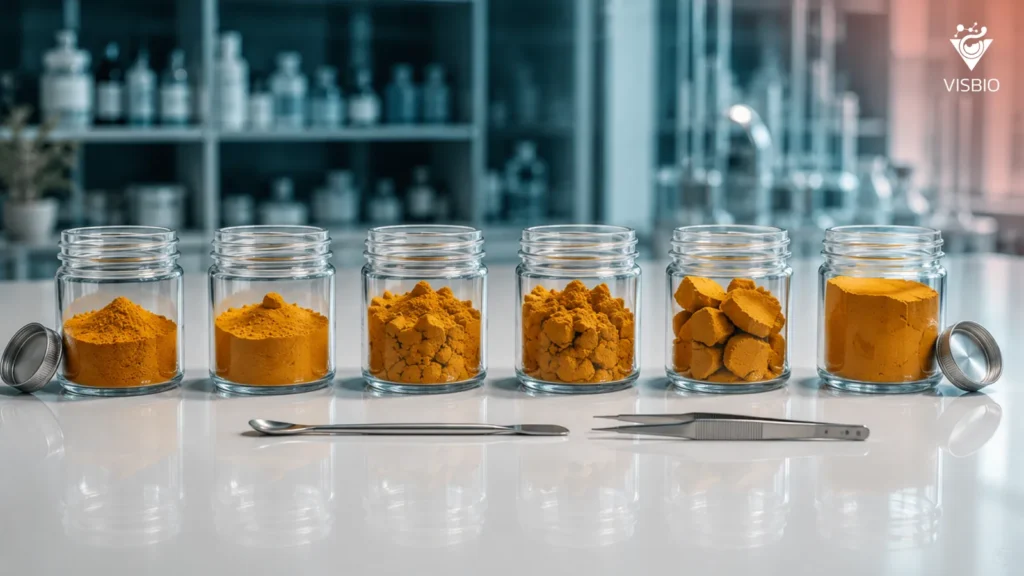
The secondary method is visual caking grading on a 0–5 scale, as follows:
- Grade 0: completely loose powder with no lumps
- Grade 1: small lumps that break apart under light pressure
- Grade 2: medium-sized lumps that need moderate pressure to break
- Grade 3: hard lumps that need force to break; the level at which consumers begin to notice
- Grade 4: most of the powder has caked
- Grade 5: all of the powder has caked into hard lumps and can no longer be used as intended
A commonly used guide is grades 0–1, and no higher than grade 2 throughout shelf life. Actual acceptance criteria should be set in each product’s specification.
Beyond sieve analysis and visual grading, supplementary measurements give further insight. They include bulk density, which, measured before and after storage at high humidity, indicates changes in powder structure (United States Pharmacopeial Convention, 2023a); the compressibility index, calculated from bulk density and tapped density, which indicates the flow tendency of the powder; and the angle of repose, measured from a heap of powder poured through a funnel, which indicates flowability during filling and scooping (United States Pharmacopeial Convention, 2023b).
Scope of VISBIO Laboratory's caking analysis service
VISBIO Laboratory’s service, carried out in collaboration with partner laboratories, covers four groups of samples:
- Extract powders and raw materials: spray-dried herbal extract powders, freeze-dried powders, commercial active raw materials and protein powders
- Powdered dietary supplements: collagen powders, probiotic powders, multivitamin powders, protein powders for mixing, and powders with specific added active ingredients
- Instant drinks: instant coffee, cocoa powder, instant herbal drinks, powdered drinks with added active ingredients and instant functional drinks
- Industrial premixes: bakery premixes, snack premixes, seasoning premixes and ingredient premixes for food and beverage manufacturers
Reported results include the proportion of powder passing through the sieve before and after storage, the caking grade on a 0–5 scale, and the change over time compared with the starting point (T0). Clients can choose a single test for batch release or monitoring at several time points during a stability study. VISBIO Laboratory can also measure bulk density, the compressibility index and the angle of repose on request.
Using caking analysis results
The results can be used at several stages of a product’s life:
- Research and development: select the carrier, anti-caking agent and spray-drying conditions that give the most stable powder, and compare powders from several raw-material suppliers to choose the one that delivers consistent quality.
- Packaging selection: compare several packaging types, such as aluminum sachets, plastic bottles and heat-sealed pouches, to select the one that gives the best moisture protection within budget.
- Commercial production: use as a batch-release criterion, especially for batches made in the rainy season, when humidity in the factory is high.
- Stability studies: combine with other stability parameters, such as moisture content, to confirm that the product stays a loose powder throughout shelf life.
- Export: attach to the Certificate of Analysis (COA), especially when exporting to very humid countries or shipping in containers for long periods.
- Product line extension: use results from an existing formula as reference data when scaling up or developing new formulas with a similar powder structure.
Frequently asked questions about caking
What is caking?
Caking is when a powder that was once loose and free-flowing sticks together into soft or hard lumps during storage. The main causes are moisture uptake from the air and temperature changes during transport and storage.
Why do powders with sugar or salt carriers cake easily?
A powder that absorbs moisture develops a sticky surface and forms bridges between particles. When the moisture evaporates, these bridges may harden and bind the particles together. Amorphous powders high in sugar also become much stickier when the temperature rises above the glass transition temperature, which falls as the powder absorbs water.
How can powder caking be prevented?
It depends on several factors working together: the choice of carrier, particle size design, the addition of anti-caking agents such as silicon dioxide or tricalcium phosphate, the choice of moisture-protective packaging, and appropriate storage conditions.
How is caking measured?
The main method is sieve analysis, comparing the proportion of powder that passes through the sieve before and after storage, together with visual grading on a 0–5 scale, where grade 0 is completely loose powder and grade 5 is powder that has entirely caked into hard lumps and can no longer be used.
Why test at 40 °C and 75% relative humidity?
This accelerated condition shows the caking trend before results from storage under normal conditions are available, so it can be used to screen formulas and packaging early in development.
What types of samples does VISBIO Laboratory accept?
Extract powders and raw materials; powdered dietary supplements such as collagen and probiotic powders; instant drinks such as instant coffee and cocoa powder; and industrial premixes for food and beverage manufacturers.
References:
- Bhandari, B. R., Datta, N., & Howes, T. (1997). Problems associated with spray drying of sugar-rich foods. Drying Technology, 15(2), 671–684. https://doi.org/10.1080/07373939708917253
- United States Pharmacopeial Convention. (2023a). Bulk density and tapped density of powders (USP <616>). USP.
- United States Pharmacopeial Convention. (2023b). Powder flow (USP <1174>). USP.
- Zafar, U., Vivacqua, V., Calvert, G., Ghadiri, M., & Cleaver, J. A. S. (2017). A review of bulk powder caking. Powder Technology, 313, 389–401. https://doi.org/10.1016/j.powtec.2017.02.024
- Royal Thai Government Gazette. (1979, May 13). Food Act B.E. 2522 (1979). Royal Thai Government Gazette, 96(79 Kor), 1–24.
- Royal Thai Government Gazette. (2019, April 30). Herbal Products Act B.E. 2562 (2019). Royal Thai Government Gazette, 136(56 Kor), 116–161.