

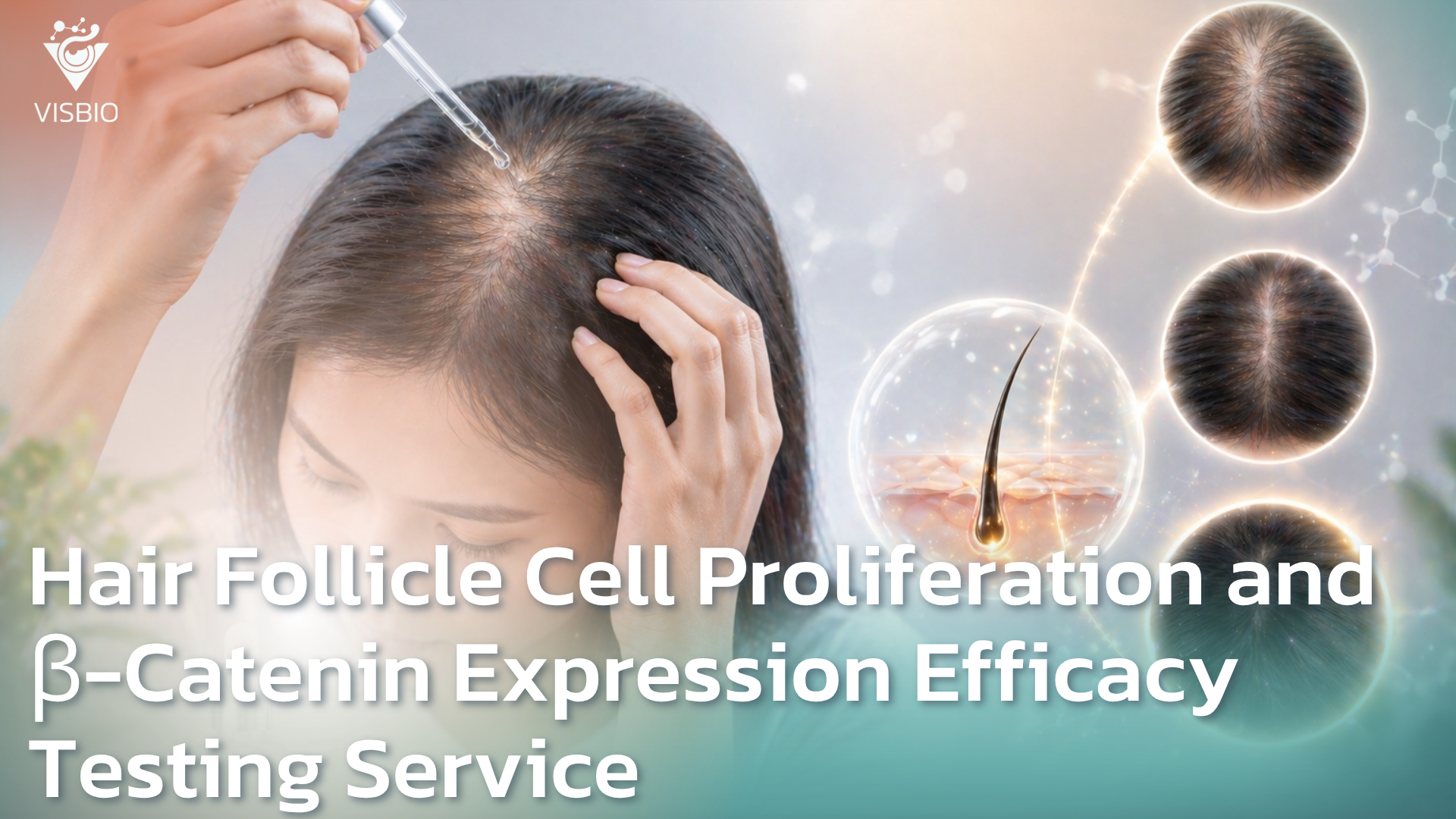
Information about Service for Hair Follicle Cell Proliferation and β-Catenin Expression Efficacy Testing Service
VISBIO offers in vitro Hair Follicle Cell Proliferation efficacy testing on Hair Follicle Dermal Papilla Cells (HFDPCs), the primary cells regulating the human hair growth cycle. This service covers Cell Viability assessment and evaluation of the test substance’s ability to stimulate HFDPCs proliferation. Designed for brand owners, OEM manufacturers, and R&D teams seeking empirical evidence to support hair care product development or substantiate hair follicle nourishment claims.
Scientific Background
Why Is Hair Follicle Cell Proliferation Testing Important?
The hair care market in Southeast Asia is on a continuous growth trajectory. Products such as nourishing hair serums, anti-hair loss shampoos, hair tonics, and hair supplements all rely on hair growth stimulation as a core selling proposition. However, these claims carry credibility only when backed by scientific evidence.
In today’s competitive landscape, brand owners can no longer rely solely on ingredient-level claims. Consumers and trade partners increasingly expect brands to demonstrate that the finished product delivers measurable, verifiable efficacy.
Cell-Based Assays have therefore become an essential standard in modern hair care product development. They provide more specific data than chemical testing alone — identifying how active ingredients interact with hair follicle cells, whether they are safe for cellular use, and to what degree they are capable of stimulating hair growth mechanisms.
The Role of Dermal Papilla Cells in Hair Growth
Hair growth is a complex biological process regulated by a specialized cluster of cells known as Dermal Papilla Cells (DPCs), located at the base of the hair follicle. These cells serve as the signaling hub that governs the hair growth cycle from the growth phase (Anagen), through the regression phase (Catagen), to the resting phase (Telogen).
Hair Follicle Dermal Papilla Cells (HFDPCs) are specialized mesenchymal cells with a unique capacity for Inductive Signaling directing the surrounding Keratinocytes to proliferate and form the structural components of the hair shaft. As Dermal Papilla Cells increase in number and activity, the stimulatory signals they transmit become stronger, directly supporting more robust hair growth.
For this reason, testing whether an active ingredient can stimulate HFDPCs proliferation is one of the most fundamental indicators for evaluating the potential of hair care products. VISBIO uses HFDPCs for all cell-based testing because they are human-derived cells that accurately reflect the biological mechanisms as they occur in the human body.
Wnt/β-Catenin Signaling Pathway and Hair Growth Stimulation
One of the most critical mechanisms regulating hair growth is the Wnt/β-Catenin Signaling Pathway, a signaling cascade that governs both hair follicle formation during embryonic development and the cycling of the hair follicle throughout adult life.
β-Catenin is the central protein of this pathway, acting as a signal mediator into the nucleus of Dermal Papilla cells. When β-Catenin is activated and accumulates in the nucleus, it drives expression of target genes that regulate cell proliferation and the secretion of FGF (Fibroblast Growth Factor) and IGF (Insulin-like Growth Factor) all of which directly promote the induction of the Anagen phase.
Numerous studies have demonstrated that suppression or reduction of β-Catenin in Dermal Papilla cells accelerates entry into the Catagen phase, reduces Progenitor Cell proliferation, and ultimately impairs the follicle’s ability to produce new hair. Conversely, a substance capable of upregulating β-Catenin expression in HFDPCs is considered scientifically meaningful evidence of potential hair growth-promoting activity.
β-Catenin expression analysis by RT-qPCR is therefore one of the primary testing methods VISBIO employs to assess whether a test substance can genuinely activate the Hair Growth Pathway at the gene level.
Scope of VISBIO Testing Services
VISBIO provides a comprehensive testing service for hair follicle cell stimulation efficacy, organized into 3 main testing
Cell Viability and Proliferation Testing
This is the most fundamental step before any mechanistic analysis. VISBIO uses MTT Assay, an internationally recognized standard technique to assess whether the test substance is cytotoxic to HFDPCs and whether it can stimulate cell proliferation beyond the control group. The procedure involves culturing HFDPCs in a 96-well plate, followed by addition of the test substance at multiple concentrations. Absorbance values are measured to calculate % Cell Viability and % Cell Proliferation.
β-Catenin Gene Expression Analysis by RT-qPCR
This advanced test confirms that the test substance not only increases cell number but can genuinely activate the Hair Growth Pathway at the gene level. VISBIO uses Reverse Transcription Quantitative PCR (RT-qPCR) to measure β-Catenin gene expression. The procedure begins with culturing cells in a 6-well plate, adding the test substance, then extracting RNA, synthesizing cDNA, and analyzing by RT-qPCR using primers specifically designed for the human β-Catenin gene.
Results showing upregulation of β-Catenin expression indicate that the test substance has the potential to activate the Wnt/β-Catenin Signaling Pathway, constituting robust molecular evidence in support of hair growth-related claims.
Cell Imaging
In addition to quantitative measurement by MTT Assay, VISBIO provides time-course cell imaging of HFDPCs at 24, 48, and 72 hours to observe growth behavior and Cell Density over time. This provides a clearer overall picture of the cellular response to the test substance, and the images can be used to supplement research reports or product support documentation.
Products Suitable for This Service
This hair follicle cell proliferation efficacy testing service is suitable for a wide variety of products in the Health & Beauty industry, including:
| Product Category | Examples |
| Cosmetics | Hair Serum, Hair Tonic, nourishing shampoo and conditioner, scalp treatment spray, botanical or herbal extract-based products |
| Dietary Supplements | Dietary Supplements with extracts claiming internal hair nourishment — such as herbal extracts, vitamins, or amino acids involved in hair structure formation |
| Active Ingredients | Natural or synthetic extracts requiring efficacy data to confirm proliferation-stimulating activity before incorporation into product formulations |
Benefits of Hair Follicle Cell Proliferation and β-Catenin Expression Efficacy Testing Service
Testing data from VISBIO’s Hair Follicle Cell Proliferation service can be leveraged across multiple business dimensions:
- Research & Development Data: Test results support screening of promising extracts or formulations, comparison of optimal concentrations, and selection of the most effective active ingredient before advancing to production. β-Catenin expression data additionally provides mechanistic insight into how the substance works — valuable for formula optimization and next-generation product development.
- Market Differentiation: In a crowded hair care market, scientific testing data is a powerful differentiator. Brands with supporting test data can communicate with confidence — through product documentation, marketing materials, and presentations to trade partners and distributors.
- Preparing Data for the Next Step (Pre-Clinical / Clinical Readiness): In Vitro test results serve as Preliminary Data for planning subsequent testing stages such as Ex Vivo testing on hair follicle organ culture or Clinical Trials on human volunteers. VISBIO also offers Clinical Testing services for hair care products.
- Marketing Claim Support: In Vitro testing using Hair Follicle Dermal Papilla Cells (HFDPCs) is a critical process for substantiating the efficacy of active ingredients and all categories of hair care products from upstream raw materials to finished products such as hair root serums and cleansing formulations.
The biological indicators our service provides include:
- Cell Viability & Proliferation: Confirms safety to hair follicle cells and demonstrates the potential to promote cell proliferation — a fundamental basis for hair growth.
- β-Catenin Expression (RT-qPCR): Deep-level gene expression analysis within the Hair Growth Pathway to identify the specific mechanism of action of the product.
Having an accurate, verifiable scientific database not only supports operator confidence in selecting the most effective formulation, it also constitutes powerful Scientific Supporting Data for trade partners and distribution channels, translating innovation concepts into tangible scientific fact.
Literature:
- Enshell-Seijffers, D., Lindon, C., Kashiwagi, M., & Morgan, B. A. (2010). β-catenin activity in the dermal papilla regulates morphogenesis and regeneration of hair. Developmental Cell, 18(4), 633–642. https://doi.org/10.1016/j.devcel.2010.01.016
- Choi, B. Y. (2020). Targeting Wnt/β-Catenin Pathway for Developing Therapies for Hair Loss. International Journal of Molecular Sciences, 21(14), 4915. https://doi.org/10.3390/ijms21144915
- Madaan, A., Verma, R., Singh, A. T., & Jaggi, M. (2018). Review of Hair Follicle Dermal Papilla cells as in vitro screening model for hair growth. International Journal of Cosmetic Science, 40(5), 429–450. https://doi.org/10.1111/ics.12489
- Bai, X., Lei, M., Shi, J., et al. (2022). The Molecular Mechanism of Natural Products Activating Wnt/β-Catenin Signaling Pathway for Improving Hair Loss. Life, 12(11), 1856. https://doi.org/10.3390/life12111856
- Tsai, S. Y., Foley, J., & Bhatt, D. K., et al. (2013). Wnt/β-catenin signaling in dermal condensates is required for hair follicle formation. Developmental Biology, 385(2), 179–188. https://doi.org/10.1016/j.ydbio.2013.11.023
- Leirós, G. J., Attorresi, A. I., & Balañá, M. E. (2012). Hair follicle stem cell differentiation is inhibited through cross-talk between Wnt/β-catenin and androgen signalling in dermal papilla cells from patients with androgenetic alopecia. British Journal of Dermatology, 166(5), 1035–1042. https://doi.org/10.1111/j.1365-2133.2012.10856.x
- Chew, E. G. Y., Tan, J. H. J., Bahta, A. W., et al. (2016). Differential Expression between Human Dermal Papilla Cells from Balding and Non-Balding Scalps Reveals New Candidate Genes for Androgenetic Alopecia. Journal of Investigative Dermatology, 136(8), 1559–1567. https://doi.org/10.1016/j.jid.2016.03.032