

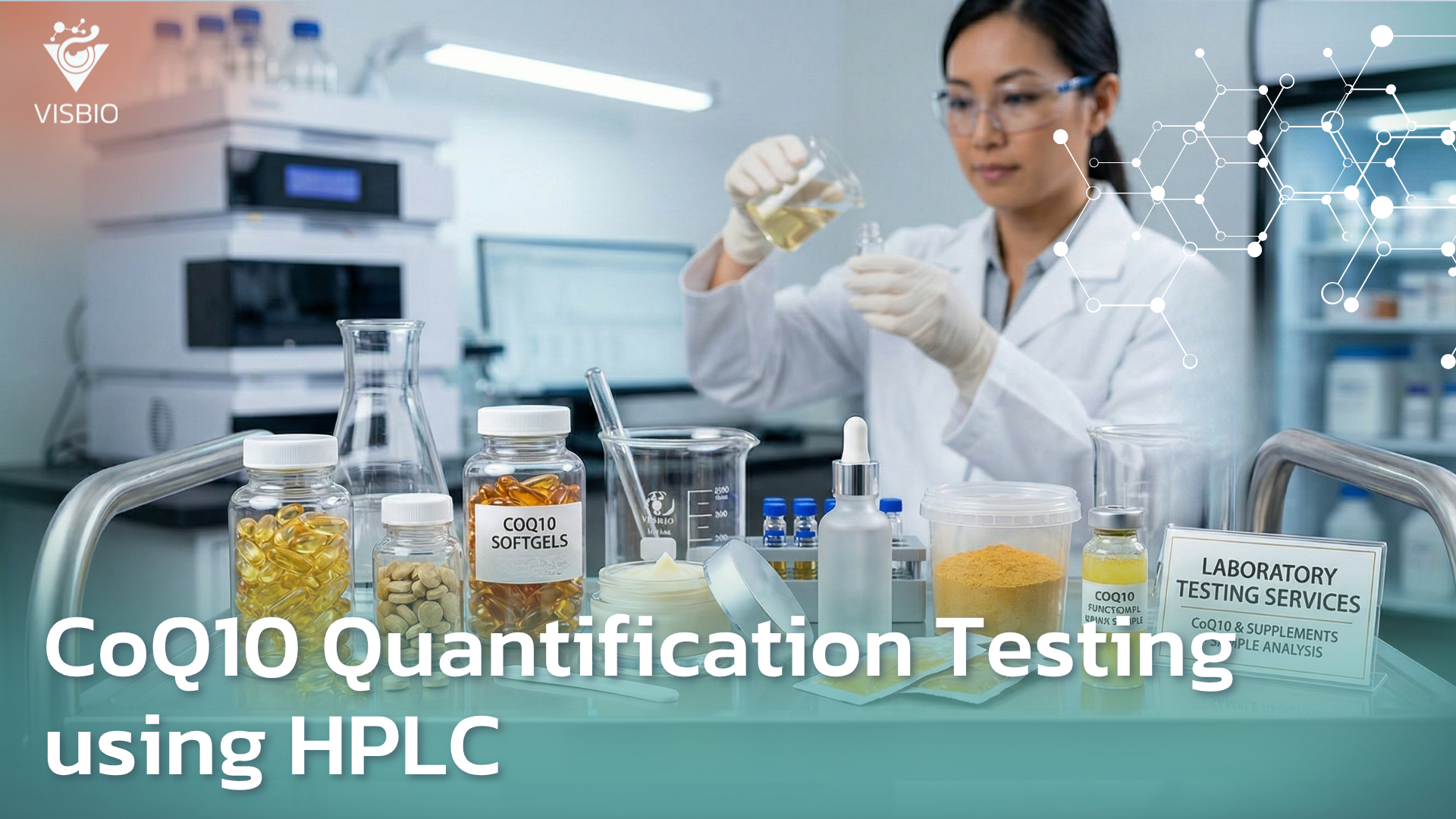
Information on CoQ10 Quantification Testing Using HPLC Technique
Coenzyme Q10 (CoQ10), commonly known as ubiquinone, is a naturally occurring compound found in the human body, with particularly high concentrations in the heart, liver, kidneys, and pancreas. It plays a critical role in cellular energy production through the mitochondrial electron transport chain. In addition, CoQ10 exists in both oxidized and reduced forms, namely ubiquinone and ubiquinol, which can interconvert depending on the redox status of the biological system.
As a result, CoQ10 has attracted considerable interest in both dietary supplements and anti-aging cosmeceutical products. For our analytical service, the reference standard used is Ubiquinone (CoQ10, oxidized form), which is an appropriate standard for calibration curve preparation and quantitative analysis by HPLC in the quality control of raw materials and finished products. Therefore, the analytical results are based on the measurement of CoQ10 in its oxidized form.
From a product development perspective, verification of the actual CoQ10 content is highly important. CoQ10 is a lipophilic compound with poor water solubility, meaning that its dispersion, stability, and detectable content in a product may vary depending on the raw materials, formulation design, and manufacturing process. For this reason, analytical methods with high specificity and reliability, such as High-Performance Liquid Chromatography (HPLC), play an essential role in quality control, label claim verification, and strengthening product credibility.
Importance of CoQ10 in the Body and Product Development
- Role in Cellular Energy Production CoQ10 functions as a key electron carrier in the mitochondrial respiratory chain, transferring electrons between complexes involved in cellular respiration. This process is directly linked to the generation of ATP, the primary source of energy required for cellular activity and repair.
- Antioxidant Function CoQ10, particularly in its ubiquinol form, helps protect against lipid peroxidation and reduces oxidative damage at the level of cell membranes and plasma lipoproteins. This antioxidant role is one of the main reasons why CoQ10 is widely used in active aging and skin wellness products.
- Relevance to Skin and Age-Related Skin Changes Dermatological reviews have reported that CoQ10 levels in the skin decline with age and UV exposure. Topical application of CoQ10 may help support mitochondrial activity and reduce the effects of oxidative stress in the skin, making it a popular active ingredient in anti-aging skincare formulations.
Research: CoQ10
A study by Knott et al., published in BioFactors in 2015, reported that topical application of a CoQ10-containing formulation significantly increased CoQ10 levels on the skin surface and in the deeper layers of the epidermis. This was associated with enhanced cellular energy metabolism, reduced free radicals, and improved antioxidant capacity of the skin. These findings suggest that CoQ10 is not merely a marketing ingredient, but an active compound supported by mechanistic and biologically relevant evidence.
In addition, a randomized, placebo-controlled, double-blind study evaluating oral supplementation of CoQ10 at 50 or 150 mg/day for 12 weeks reported reductions in periorbital wrinkles and microrelief lines, together with improved skin smoothness. Although no significant differences were observed in certain parameters such as skin hydration and dermal thickness, this serves as a useful example of why marketing claims should be aligned carefully with evidence-based outcomes.
Applications of CoQ10 in Health and Beauty Products
- Dietary Supplements for Active Aging and Daily Wellness CoQ10 is widely used in dietary supplements due to its biological role in cellular energy metabolism and antioxidant defense. However, marketing communication should avoid disease-treatment claims and remain fully compliant with the regulatory framework of each target market.
- Multi-Ingredient Formulations CoQ10 is often developed in combination with other ingredients, such as collagen or additional antioxidants, to strengthen product positioning. For example, a clinical study in 34 healthy women receiving a formulation containing water-soluble CoQ10 and fish collagen for 12 weeks reported increased dermal density, reduced periorbital wrinkle area, lower total wrinkle scores, and smoother skin compared with placebo.
- Cosmeceuticals and Anti-Aging Skincare Products CoQ10 is commonly incorporated into creams, serums, and skincare formulations because of its documented potential to protect the skin from oxidative stress and help reduce visible signs of skin aging. Instrumental analytical methods have also been developed specifically for the determination of CoQ10 in cosmetic matrices.
- Beverages or Water-Dispersed Formulations for product formats such as beverages, gels, or emulsions, particular attention should be paid to dispersion and stability, as CoQ10 is lipophilic and poorly soluble in water. Formulation development therefore often requires technologies that improve dispersibility or bioavailability, which further increases the importance of verifying the actual CoQ10 content after production.
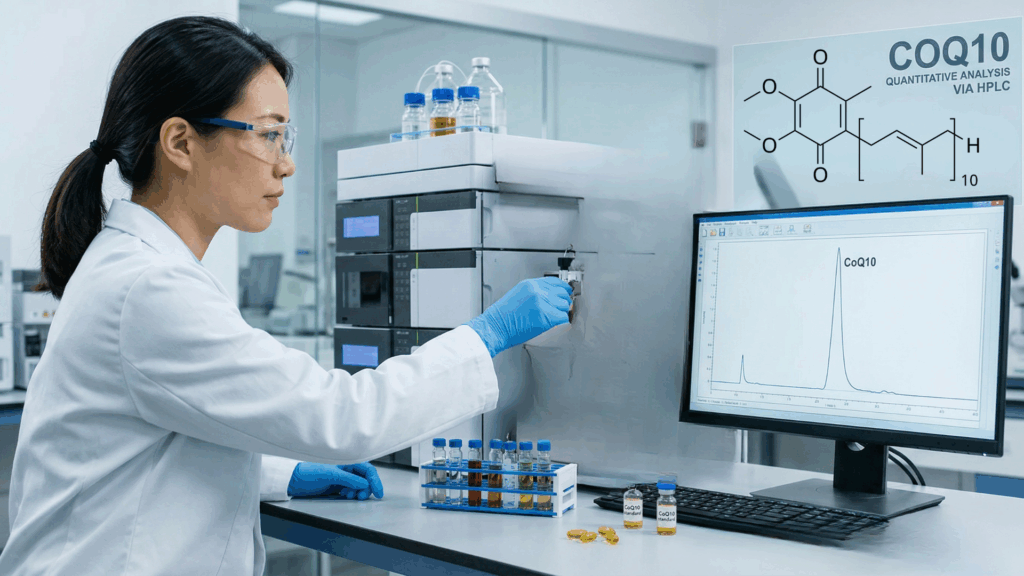
CoQ10 Quantification Service by HPLC
We provide CoQ10 quantification by HPLC for raw materials and products in the health and beauty industries. The analytical reference standard used is Ubiquinone (CoQ10, oxidized form), which is appropriate for quality control and quantitative determination of the active compound in various sample types, including raw materials, extracts, dietary supplements, and product development formulations.
The use of the oxidized-form standard allows for a clear and consistent analytical approach in line with common quality control practices for CoQ10 determination, particularly when the objective is to confirm the content of the active ingredient in a product for formulation development, quality assessment, and technical documentation purposes.
Benefits of CoQ10 Quantification Service
- Verification of active ingredient content
Confirms the actual amount of CoQ10 present in the product compared with the formulation target or label claim. - Support for quality control
Helps assess the consistency of raw materials and finished products across production batches. - Evaluation of formulation and manufacturing suitability
Particularly useful for products containing CoQ10, as this compound may be affected by formulation conditions and processing parameters. - Enhanced technical credibility
Provides supporting data for product development, customer communication, and product technical documentation. - Comparison of raw material or formulation quality
Enables informed selection of more suitable raw materials or formulation approaches based on quantitative data.
Literature:
- Lunetta, S., et al. Determination of Coenzyme Q10 Content in Raw Materials and Dietary Supplements by High-Performance Liquid Chromatography-UV: Collaborative Study. Journal of AOAC International (2008).
- Podar, A. S., et al. An Overview of Analytical Methods for Quantitative Determination of Coenzyme Q10 in Foods. Metabolites (2023)
- Žmitek, K., et al. The effect of dietary intake of coenzyme Q10 on skin parameters and condition: Results of a randomised, placebo-controlled, double-blind study. BioFactors (2017).
- Knott, A., et al. Topical treatment with coenzyme Q10-containing formulas improves skin’s Q10 level and provides antioxidative effects. BioFactors (2015).