


A leak test checks whether sealed packaging has holes or incomplete seals. A drop test lets a fully filled package fall onto a hard surface from a set height, then checks whether the package breaks, deforms or loses its cap, or whether the product leaks out. Together, the results of the two tests show whether the packaging will withstand real transport and handling before the product reaches consumers.
In the supply chain of exported cosmetics and dietary supplements, packaging that looks strong does not always survive real shipping routes. Containers are jolted while they are moved, cartons are stacked on pallets about 1.2 meters high, air freight or transport through high-altitude areas exposes packaging to lower air pressure than at the factory, and parcels still have to pass along conveyors and through automatic sorting machines. Packaging therefore has to withstand many kinds of force before it reaches consumers. Leak and drop tests simulate these conditions in the laboratory to show that the packaging does not leak, break or deform in transit.
This article summarizes what brand owners, quality assurance (QA) teams and packaging development teams should know before ordering tests: the principles of the 3 main test methods, how to choose test methods for each type of packaging, and the scope of VISBIO Laboratory’s service.
Principles of the 3 main test methods
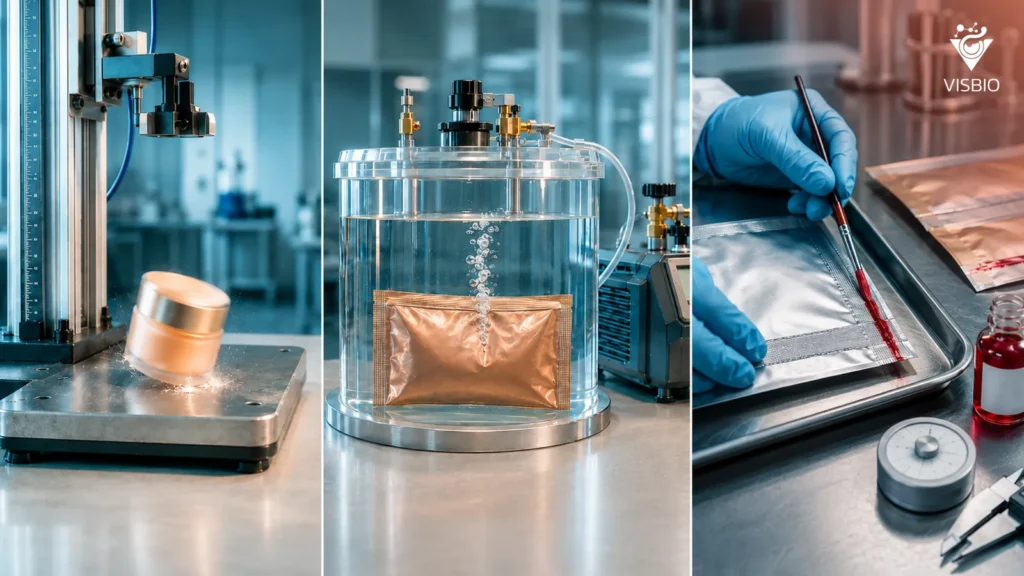
Vacuum leak test. This test detects leaks by immersing a sealed package in water inside a vacuum chamber. As the pressure around the package falls, the air inside the package expands, and if there is a hole, a steady stream of bubbles comes out from that point (ASTM International, 2013). The method is used for flexible packaging such as pouches, sachets and heat-sealed packages. The package must contain enough headspace to produce bubbles, and the method is better suited to finding large leaks than very small ones.
Dye penetration test. A dye solution is applied to the edge of the package seal and left for a set time, then the seal is checked to see whether the dye has penetrated through to the inside (ASTM International, 2015). The method can be used for heat-sealed packaging of food, cosmetics and dietary supplements, including multilayer pouches with a foil barrier layer. The dye penetration test is destructive, so samples that have been tested cannot be used for filling or sold.
Drop test. A fully filled package is allowed to fall freely onto a hard surface (ASTM International, 2019). The height, number of drops and drop orientations are set in the test plan according to the weight and type of the package and the events to be simulated, such as a fall from the edge of a conveyor, a drop during handling or a drop from a consumer’s hand. After the drop, the tester checks whether the package has broken, deformed or lost its cap, or whether the product has leaked out.
What each type of packaging should be tested for
Each type of packaging has different weak points, so the choice of test method starts with the type of packaging.
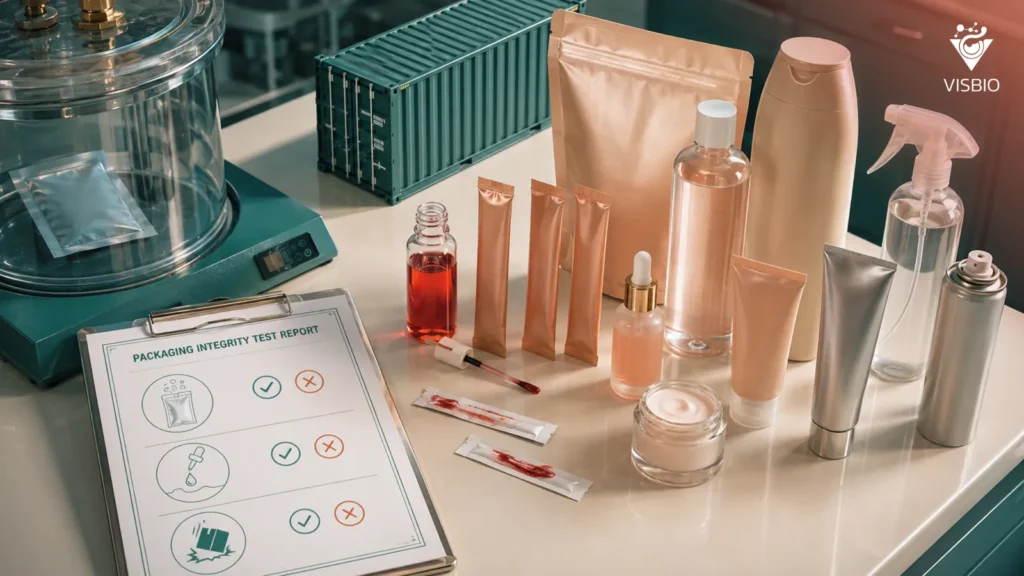
- Flexible packaging such as pouches, sachets and stand-up pouches is at risk of leaking at the seal, so it should undergo both the vacuum leak test and the dye penetration test
- Rigid plastic packaging such as HDPE bottles, PET bottles and PP jars is at risk of breaking when dropped, so it should be drop tested in several orientations: on the base, on the side and on the cap
- Glass packaging such as glass bottles and glass jars is at high risk of breaking, so it should be drop tested
- Tubes, both plastic and aluminum, are at risk of leaking at the end seal, so they should undergo the vacuum leak test
- Spray packaging, both trigger sprays and aerosol cans, is at risk of leaking at the nozzle and valve, and aerosol cans may leak or deform when dropped, so it should be drop tested
- Multilayer foil pouches for products sensitive to light, moisture and oxygen should undergo the dye penetration test to confirm that the seal and the foil layer have no holes; the choice of pouch material should also take water vapor and oxygen transmission rates into account
VISBIO Laboratory's leak and drop testing services
VISBIO Laboratory provides vacuum leak testing, dye penetration testing and drop testing of primary packaging, such as bottles, tubes and sachets, for cosmetics, food and dietary supplements. Both leak test methods are performed at VISBIO Laboratory, while drop testing is carried out in collaboration with partner laboratories. The team handles the work from start to finish, as follows:
- Test plan: choose test methods according to the type of packaging, and set the drop height, number of drops and orientations to resemble the product’s actual shipping route
- Chain of custody: record the receipt, storage and transfer of samples at every step
- Sample conditioning: keep samples at the set temperature and humidity before testing
- Testing and recording: test in a laboratory whose documentation system provides traceability
- Reporting: state the test method, the result for each sample and observations that support decisions about the packaging
The report can be used as supporting information when preparing to open export markets, negotiating with trading houses and answering questions from key accounts overseas.
Frequently asked questions about drop tests and leak tests
What is a drop test?
A drop test lets a fully filled package fall freely onto a hard surface from a set height, then checks for breakage, deformation, loss of the cap and leakage, to simulate drops during transport, handling and use by consumers.
What leak test methods are there?
This article describes 2 methods: the vacuum leak test, which looks for bubbles escaping from a leak while the package is under water in a vacuum, and the dye penetration test, which checks whether dye penetrates through the seal to the inside.
What drop height is used in a drop test?
There is no single height for every type of packaging. The height is set in the test plan according to the weight and type of the package and the event to be simulated, such as a drop during handling or a drop from a consumer’s hand.
Which packaging should be leak tested?
Packaging with seals, such as pouches, sachets, stand-up pouches, multilayer foil pouches and tubes, is most at risk of leaking at the seal, so it should be leak tested. Rigid plastic bottles and glass packaging are at risk of breaking when dropped, so the focus for them is drop testing.
Can tested samples be returned to sale?
The dye penetration test is destructive, so samples that have been tested cannot be used for filling or sold. Samples for testing should be prepared separately from goods intended for sale.
References:
- ASTM International. (2013). Standard test method for determination of leaks in flexible packaging by bubble emission (ASTM D3078-02(2013)).
- ASTM International. (2015). Standard test method for detecting leaks in nonporous packaging or flexible barrier materials by dye penetration (ASTM F3039-15).
- ASTM International. (2019). Standard test method for drop test of loaded containers by free fall (ASTM D5276-19).