

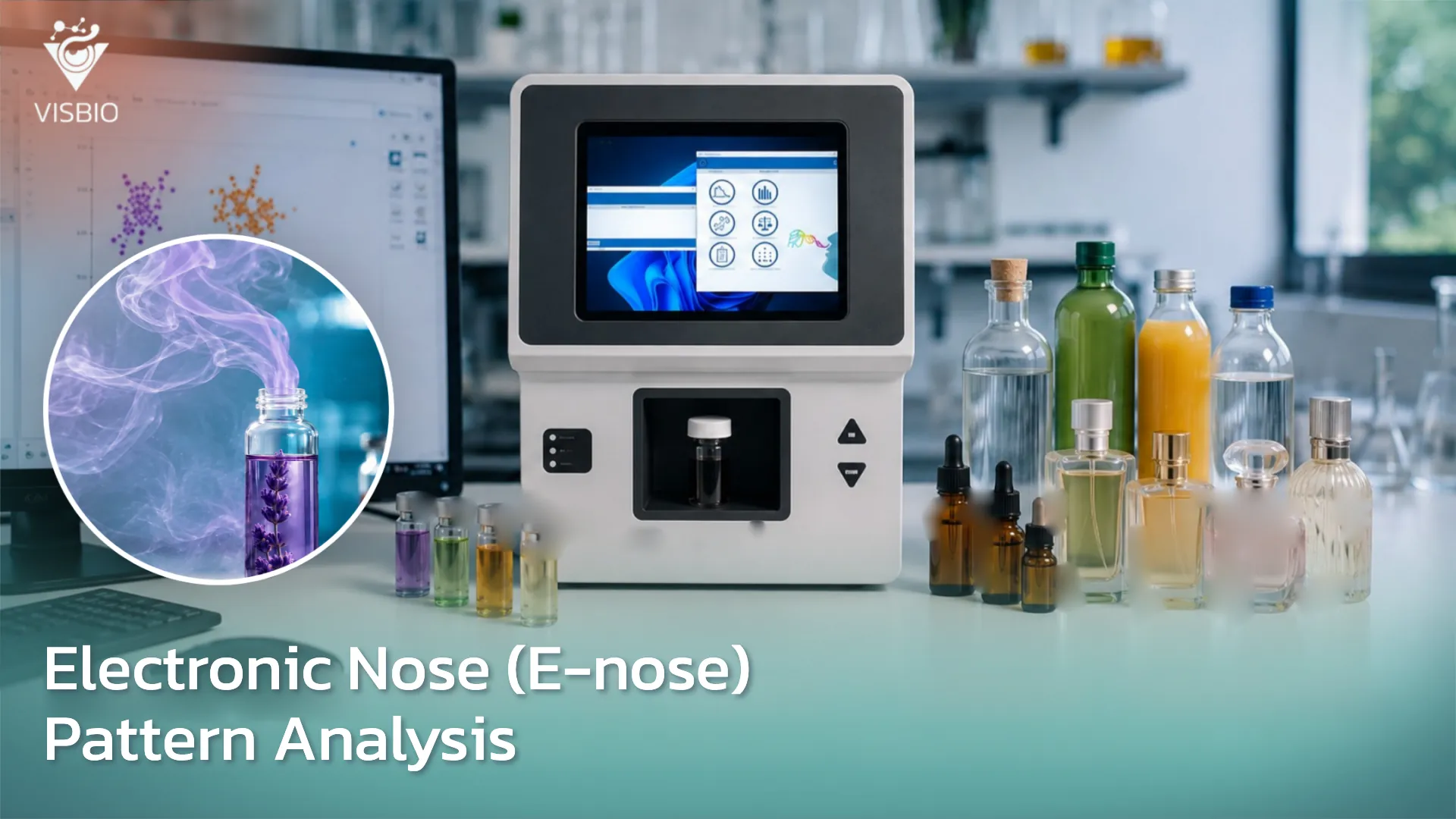
An electronic nose (E-nose) is an instrument that uses several chemical sensors working together as an array (chemical sensor array) to measure the vapor above a sample, and then uses pattern recognition to convert the signals into an “aroma fingerprint” for comparison with a reference sample. An E-nose does not identify which volatile compounds are present; it shows how similar or different a sample’s aroma pattern is from that of a reference sample (Wilson & Baietto, 2009).
In the markets for perfumes, essential oils, functional drinks and cosmetics sold on their scent, aroma is what consumers remember and bond with over the long term. A perfume formula developed over several years can lose customers within a few months if its scent drifts from what consumers remember. Essential oils sold on the distinctive scent of each type, such as lavender or peppermint, must also keep the aroma consumers expect throughout their shelf life. Keeping aroma consistent and verifiable is therefore a tool for building brand confidence.
Conventional instrumental aroma analysis, such as gas chromatography–mass spectrometry (GC-MS), gives detailed information on each volatile compound, but it must separate the compounds one by one and involves more analytical steps, so it is not well suited to releasing large numbers of batches at factory level or to comparing many formulas in research and development. An E-nose measures the whole vapor above a sample at once without separating the compounds, so it suits classifying and comparing the aroma patterns of many samples, and it is used together with GC-MS when it is necessary to know which compounds have changed.
VISBIO Laboratory, in collaboration with partner laboratories, provides aroma pattern analysis with an E-nose, processed by pattern recognition methods, namely principal component analysis (PCA) and linear discriminant analysis (LDA). The service covers functional drinks, perfumes, essential oils, cosmetics sold on their scent, snacks and food products that need batch-to-batch aroma consistency checks.
Why industry uses the E-nose to monitor product aroma
In the development of perfumes and other scent-driven products, an E-nose helps formulation teams compare several prototype formulas and identify which has the aroma pattern closest to the specified reference sample. Measurement needs no complex sample preparation and no separation of compounds, so research and development teams can compare several versions of a formula in the same round of experiments.
In commercial batch release, an E-nose is well suited to checking aroma consistency between batches. Each production batch is compared with a stored master reference. A pattern similarity score above the set limit, for example 0.85 out of 1.00, indicates that the batch’s aroma pattern is close to the reference. The figure of 0.85 is only an example; the actual limit must be set from data for each product. A value below the limit is a signal to check the raw materials and production process before the product enters the supply chain.
In aroma stability studies, an E-nose is used to track changes in the aroma pattern throughout shelf life, under both normal and accelerated conditions. Perfumes and essential oils sold in Thailand and ASEAN face higher temperatures and humidity than in the European and North American markets, so some volatile compounds may evaporate or degrade and change the aroma sooner than developers expected. Numerical data on changes in the aroma pattern help brands set an appropriate shelf life and choose packaging that reduces aroma loss.
At raw-material receipt, an E-nose is used for preliminary screening of whether essential oils or flavor and fragrance materials from suppliers have an aroma pattern that matches a previously accepted reference batch. A different aroma pattern is a signal for further checks, but an E-nose cannot prove whether a raw material is genuine or contains synthetic additions, because it does not identify compounds. Confirmation requires composition analysis by GC-MS and testing against the raw-material specification. Screening at this stage helps reduce the risk of accepting raw materials that do not meet specification, and reduces the chance that the finished product will not match what the brand communicates to consumers.

Principles of aroma analysis with an electronic nose
The basic principle of the E-nose is to mimic the human sense of smell (Persaud & Dodd, 1982). The human nose has many olfactory receptors that respond to each volatile compound with different strengths, and the brain processes the information from all the receptors to recognize and remember odors. An E-nose works in the same way, using several chemical sensors, each of which responds to many volatile compounds to different degrees. When the vapor in the space above the sample (headspace) passes over the sensor array, each sensor gives an electrical signal that reflects the strength of its response, and the signals from all the sensors together form an aroma fingerprint specific to that sample.
Data are processed by pattern recognition. The main method is principal component analysis (PCA), which reduces the data from many sensors to 2–3 dimensions and displays them as a plot in which samples with similar aromas lie close together and samples with different aromas lie far apart. The pattern similarity score is calculated from the distance between samples on this plot. Linear discriminant analysis (LDA) is used to classify samples into predefined groups, such as “pass” or “fail”.
Technically, three factors determine how reliable the results are. The first is a complete database of reference samples for the product being tested: an E-nose gives meaningful results only when there are enough reference samples for comparison, so clients who send a new sample without a reference must start by building a database. The second is control of measurement conditions, including the temperature and humidity of the measuring room, the time allowed for the vapor in the headspace to reach equilibrium (equilibration) and the interval between measurements, because even small changes can skew results. The third is sensor care: sensors must be calibrated and cleaned regularly, because the signals of chemical sensors can shift over time (sensor drift).
The E-nose has limitations that should be understood before its results are used. First, an E-nose does not identify the type or quantity of each volatile compound; the sensor signals can only indicate which group of volatiles is likely to have changed, and GC-MS is needed to know which compound has changed. Second, a sensor signal pattern is not the same as the aroma humans perceive; to assess whether consumers can sense a difference, sensory evaluation by trained panelists is needed (Wilson & Baietto, 2009; Loutfi et al., 2015).
Scope of VISBIO Laboratory's E-nose aroma analysis service
VISBIO Laboratory’s service, carried out in collaboration with partner laboratories, covers three groups of samples:
- Perfumes and essential oils: perfumes; single essential oils such as lavender, citronella, peppermint and chamomile; essential oil blends for aromatherapy; and diffuser oils
- Functional drinks and foods: coffee, tea, herbal drinks, drinks with added extracts, and food products sold on their aroma
- Cosmetics sold on their scent: moisturizing creams, lotions, sunscreens, shampoos and shower creams with a brand’s signature scent
Reported results include the pattern similarity score compared with the reference sample, the pass/fail classification against the set criteria, a PCA plot showing the position of the sample relative to the reference database, the response of each sensor (sensor response profile) for in-depth interpretation, and comparisons between batches or between sampling points in a stability study. Clients can choose a single test for batch release or a continuing study to track aroma stability throughout shelf life.

Using E-nose aroma analysis results
E-nose results can be used at several stages of a product’s life:
- Research and development: compare several versions of a prototype formula and select the one whose aroma pattern is closest to the reference sample, and test the effect of changing the essential oil supplier, since oils of the same type may differ in volatile composition.
- Raw-material receipt: screen whether incoming essential oils and extracts have an aroma pattern that matches the reference batch, and send abnormal samples for confirmatory analysis by GC-MS.
- Commercial production: use as a numerical batch-release criterion for checking aroma consistency between batches.
- Stability studies: combine with other stability parameters to confirm that the aroma pattern stays within limits throughout shelf life.
- Export: attach to the Certificate of Analysis (COA) for buyers who set an aroma pattern similarity limit in their trade agreements.
Frequently asked questions about the E-nose
What is an E-nose, or electronic nose?
An E-nose is an instrument that uses an array of chemical sensors to measure the vapor above a sample, and then uses pattern recognition to convert the signals into an aroma fingerprint for comparison with a reference sample. The principle mimics the human sense of smell, in which many olfactory receptors work together.
How is an E-nose different from GC-MS?
GC-MS separates and identifies each volatile compound in detail, while an E-nose measures the whole vapor at once without separating the compounds, so it suits comparing the aroma patterns of many samples. The two methods can be used together, with GC-MS used when it is necessary to know which compounds have changed.
Can an E-nose tell whether an essential oil is genuine?
Not on its own. An E-nose can screen whether a raw material’s aroma pattern differs from a reference batch, but it does not identify compounds. Confirming whether synthetic compounds have been added requires composition analysis by GC-MS and testing against the raw-material specification.
What does the pattern similarity score show?
It shows how close a sample’s aroma pattern is to the reference sample. A value above the set limit indicates that the aroma pattern is close to the reference, and the limit for each product must be set from data for that product.
Why is a reference sample needed before testing starts?
An E-nose gives meaningful results only when there are enough reference samples for comparison, so products without a reference sample must start by building a database.
What types of samples does VISBIO Laboratory accept?
Perfumes and essential oils; functional drinks and foods such as coffee, tea and herbal drinks; and cosmetics sold on their scent, such as moisturizing creams, lotions, shampoos and shower creams.
References:
- Loutfi, A., Coradeschi, S., Mani, G. K., Shankar, P., & Rayappan, J. B. B. (2015). Electronic noses for food quality: A review. Journal of Food Engineering, 144, 103–111. https://doi.org/10.1016/j.jfoodeng.2014.07.019
- Persaud, K., & Dodd, G. (1982). Analysis of discrimination mechanisms in the mammalian olfactory system using a model nose. Nature, 299(5881), 352–355. https://doi.org/10.1038/299352a0
- Wilson, A. D., & Baietto, M. (2009). Applications and advances in electronic-nose technologies. Sensors, 9(7), 5099–5148. https://doi.org/10.3390/s90705099