

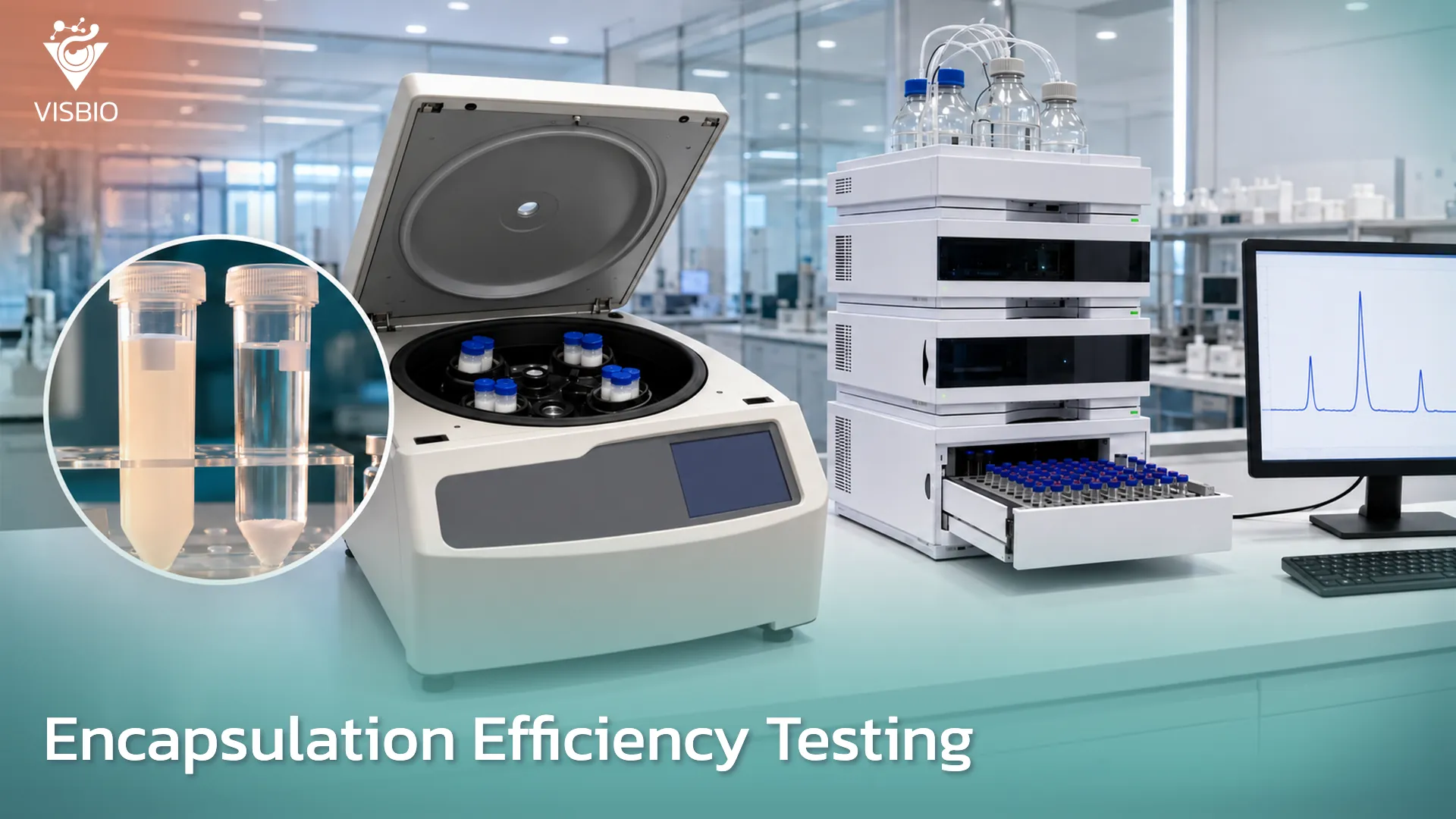
Encapsulation efficiency (%EE) is the percentage of an active ingredient that is held inside its carrier, relative to the total amount of the active ingredient in the system. It shows how much of the active ingredient that was added actually sits inside the liposomes or particles, and how much remains outside the carrier as free active ingredient. Measuring %EE therefore requires separating the free active ingredient from the carrier first, and then quantifying the active ingredient with a quantitative analytical method.
In premium cosmetics and dietary supplements, delivery systems such as liposomes, niosomes, solid lipid nanoparticles (SLN), nanostructured lipid carriers (NLC), nanoemulsions and microcapsules are selling points that brands use to communicate with consumers. Prices higher than those of ordinary products are often justified by high encapsulation efficiency and high drug loading (DL). If these figures are not backed by verifiable analytical results, the claims become a commercial risk when regulators, trading houses or competitors in export markets ask to check them.
This article summarizes what research and development (R&D) teams, quality assurance (QA) teams and brand owners should know before commissioning %EE measurement: the principles of the measurement, techniques for separating unencapsulated active ingredient from the carrier, the choice of quantitative analytical method, method validation, and the types of delivery system that need to be measured.
Principles of encapsulation efficiency measurement
%EE is the proportion of the active ingredient held inside the carrier relative to the total amount of the active ingredient in the system. When it is determined from the separated free active ingredient, it is calculated as follows:
%EE = [(total amount of active ingredient − amount of free, unencapsulated active ingredient) ÷ total amount of active ingredient] × 100
Drug loading (%DL), on the other hand, is the proportion of encapsulated active ingredient relative to the total mass of the carrier particles. The two values cannot replace each other: a high %EE does not mean a high %DL. In commercial terms, %DL is the value used to calculate how much carrier is needed per unit of active ingredient, so it determines the cost of the delivery system.
The measurement has two parts. The first is separating the unencapsulated active ingredient (free drug) from the carrier, using a technique chosen to suit the system: ultracentrifugation, dialysis through a semipermeable membrane, ultrafiltration, or size exclusion chromatography (SEC). The second is measuring the amount of active ingredient in each fraction, most commonly by high-performance liquid chromatography (HPLC), the same technique used for active ingredient analysis in cosmetic products. For compounds with a distinct light-absorbing group (chromophore), UV-visible spectrophotometry may be used, but its specificity is lower than that of HPLC.
Validation of the analytical method
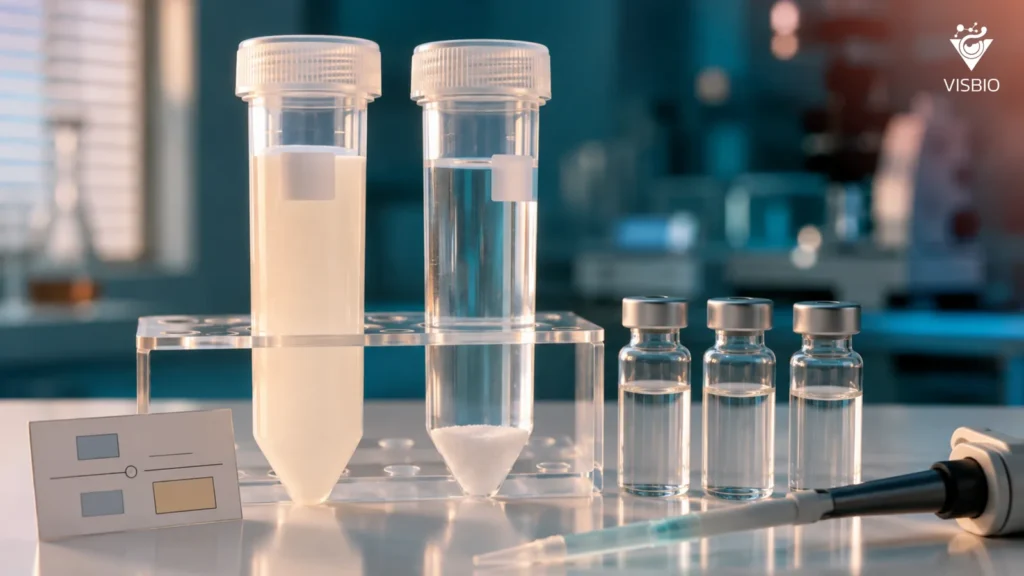
%EE results that will be used for export or marketing communication should come from an analytical method that has undergone method validation, which assesses parameters including specificity, accuracy, precision, linearity, range, limit of detection (LOD) and limit of quantification (LOQ).
What needs particular attention in delivery systems is that the step separating the free active ingredient must not bias the result. If the separation ruptures or leaks the carrier, or fails to remove all of the carrier so that some remains in the separated liquid fraction (Wallace et al., 2012), active ingredient that was inside the carrier is counted as free, and %EE comes out lower than the true value. Conversely, if free active ingredient is adsorbed by the filter membrane, or sediments together with the carrier during centrifugation, %EE comes out higher than the true value.
The laboratory therefore needs to design a spike recovery experiment, in which a known amount of free active ingredient is added to the sample and the separation method is checked to recover close to 100% of the added amount without affecting the carrier. The stability of the sample during analysis must also be assessed, so that the %EE value represents the actual product rather than an artifact of sample preparation.
Delivery systems that need %EE measurement
Several types of delivery system used in cosmetics and dietary supplements need %EE measurement:
- Liposomes: small vesicles whose walls are made of one or more phospholipid bilayers. They can carry water-loving substances in their aqueous core and fat-loving substances in the lipid layer (Akbarzadeh et al., 2013).
- Niosomes: vesicles similar to liposomes, but made with nonionic surfactants instead of phospholipids; they are often more stable than liposomes under many conditions (Marianecci et al., 2014).
- Solid lipid nanoparticles (SLN): use a lipid that is solid at room temperature as the core, suitable for fat-loving substances
- Nanostructured lipid carriers (NLC): use a blend of solid and liquid lipids, which makes the internal lipid crystals less ordered, leaving more space for the active ingredient, so they can carry more than SLN (Müller et al., 2002)
- Nanoemulsions: dispersions of nanometer-sized oil droplets, suitable for fat-loving substances. The size threshold used to define them still varies between sources; McClements (2012), for example, proposes a droplet radius of no more than 100 nanometers, or a diameter of no more than about 200 nanometers.
- Microcapsules: used in solid cosmetic formats and in dietary supplements that need to protect the active ingredient or control its release (controlled release)
- Cyclodextrin inclusion complexes and polymer-based nanoparticles: these encapsulate by different mechanisms from lipid systems, so they require different %EE methods
The separation technique and measurement method for each system must therefore match its physical and chemical properties; no single method works for every system.
Using %EE and %DL values
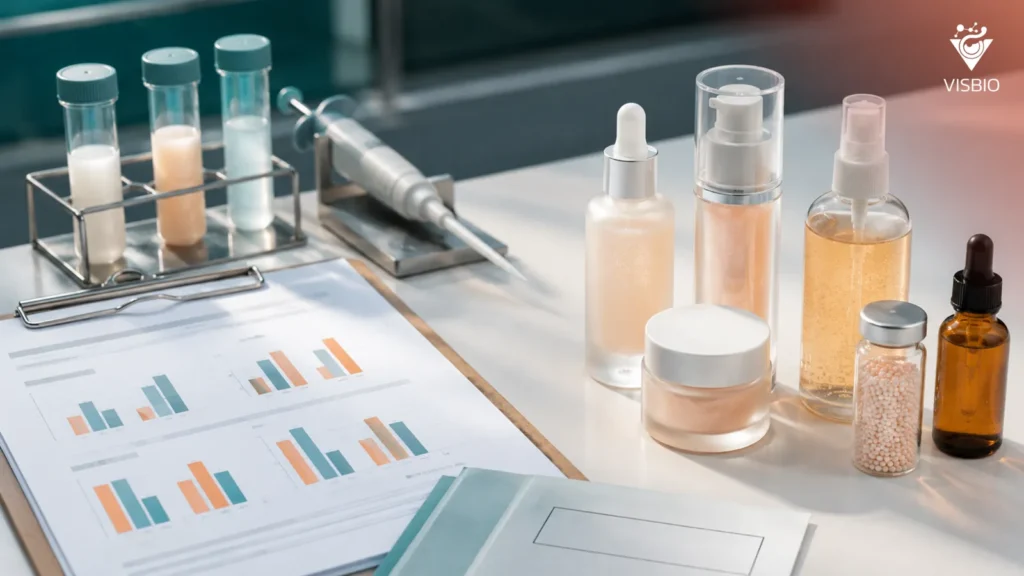
- Formulation: to compare formulas and carrier preparation processes that give different %EE and %DL values, in order to choose the formula that carries the active ingredient best
- Cost calculation: to use %DL to calculate the cost per unit of active ingredient actually delivered
- Marketing communication: as supporting data for %EE claims on labels and in marketing materials
- Stability studies: %EE may fall during storage if the active ingredient leaks out of the carrier. Repeating the measurement at set time points, together with particle size measurement, therefore helps confirm that the claim remains true throughout the product’s life.
VISBIO Laboratory's encapsulation efficiency measurement service
VISBIO Laboratory measures %EE and %DL of liposomes, niosomes, lipid nanoparticles (SLN and NLC), nanoemulsions and microcapsules in cosmetics and dietary supplements. The process covers designing a measurement plan that suits the delivery system, separating the free active ingredient by a technique suited to the system, namely dialysis, ultrafiltration, size exclusion chromatography (SEC) or ultracentrifugation, quantification by HPLC, and reporting that connects the %EE and %DL values to marketing claims and to the cost per unit of active ingredient actually delivered. Separation by ultracentrifugation is carried out in collaboration with partner laboratories, and calculating %DL requires carrier mass data from the client’s formula.
Frequently asked questions about encapsulation efficiency
What is encapsulation efficiency (%EE)?
Encapsulation efficiency (%EE) is the percentage of an active ingredient held inside its carrier, relative to the total amount of the active ingredient in the system. It shows how much of the active ingredient is actually inside the liposomes or particles, and how much remains outside the carrier.
How does %EE differ from drug loading (%DL)?
%EE compares the encapsulated active ingredient with the total amount of active ingredient added, while %DL compares the encapsulated active ingredient with the total mass of the carrier particles. A high %EE does not mean a high %DL, and %DL is the value used to calculate the cost of the delivery system.
How is %EE measured?
First, the unencapsulated active ingredient is separated from the carrier by a technique suited to the system, such as ultracentrifugation, dialysis, ultrafiltration or size exclusion chromatography. Second, the amount of active ingredient in each fraction is measured, most commonly by HPLC, and %EE is calculated.
Why does the method for separating the free active ingredient affect %EE?
If the separation ruptures the carrier or does not remove all of it, active ingredient that was inside the carrier is counted as free, and %EE comes out lower than the true value. If free active ingredient is adsorbed by the filter membrane or sediments with the carrier, %EE comes out higher than the true value. The separation method therefore needs to be checked, for example with a spike recovery experiment.
Which delivery systems need %EE measurement?
They include liposomes, niosomes, solid lipid nanoparticles (SLN), nanostructured lipid carriers (NLC), nanoemulsions, microcapsules, cyclodextrin inclusion complexes and polymer-based nanoparticles. Each system needs a separation technique and measurement method suited to its properties. VISBIO Laboratory’s service covers liposomes, niosomes, SLN, NLC, nanoemulsions and microcapsules.
Can %EE change during storage?
Yes. If the active ingredient leaks out of the carrier during storage, %EE falls. Repeating the measurement at set time points in a stability study therefore helps confirm that the figure on the label remains true throughout the product’s life.
References:
- Akbarzadeh, A., Rezaei-Sadabady, R., Davaran, S., Joo, S. W., Zarghami, N., Hanifehpour, Y., Samiei, M., Kouhi, M., & Nejati-Koshki, K. (2013). Liposome: Classification, preparation, and applications. Nanoscale Research Letters, 8(1), 102. https://doi.org/10.1186/1556-276X-8-102
- Marianecci, C., Di Marzio, L., Rinaldi, F., Celia, C., Paolino, D., Alhaique, F., Esposito, S., & Carafa, M. (2014). Niosomes from 80s to present: The state of the art. Advances in Colloid and Interface Science, 205, 187–206. https://doi.org/10.1016/j.cis.2013.11.018
- McClements, D. J. (2012). Nanoemulsions versus microemulsions: Terminology, differences, and similarities. Soft Matter, 8(6), 1719–1729. https://doi.org/10.1039/C2SM06903B
- Müller, R. H., Radtke, M., & Wissing, S. A. (2002). Solid lipid nanoparticles (SLN) and nanostructured lipid carriers (NLC) in cosmetic and dermatological preparations. Advanced Drug Delivery Reviews, 54(Suppl. 1), S131–S155. https://doi.org/10.1016/S0169-409X(02)00118-7
- Wallace, S. J., Li, J., Nation, R. L., & Boyd, B. J. (2012). Drug release from nanomedicines: Selection of appropriate encapsulation and release methodology. Drug Delivery and Translational Research, 2(4), 284–292. https://doi.org/10.1007/s13346-012-0064-4