

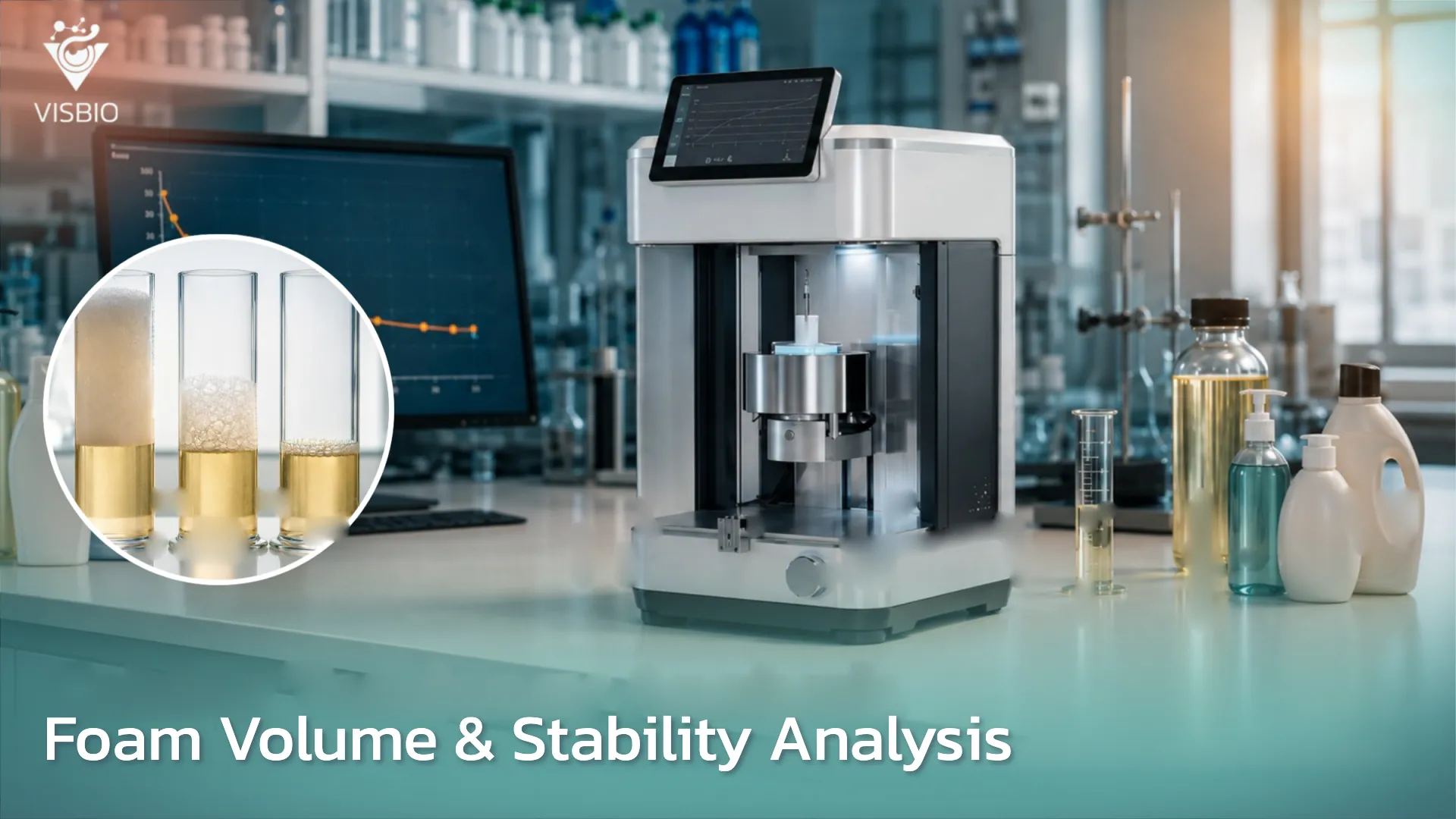
A foam test measures how much foam a surfactant-based product can produce, known as foam volume, and how long that foam lasts, known as foam stability, under controlled conditions. The results are numbers that can be used to compare formulas, release batches and track changes throughout shelf life.
In the market for shampoos, shower creams, skin cleansers and other cosmetics built on a surfactant system, foam is what consumers use to judge quality from the very first use. A shampoo that produces little foam makes consumers feel it does not clean, even though, scientifically, foam volume is not directly proportional to cleansing ability. A shower cream whose foam collapses quickly makes consumers feel the product is diluted and poor value. Foam is therefore a parameter that affects both consumer expectations and repeat-purchase decisions.
Foam does not have to be judged by feel alone. It is a quantity that can be measured with methods the surfactant industry has used since the 1940s (Ross & Miles, 1941). Foam volume is the volume or height of foam a sample produces under set conditions, while foam stability shows how long the foam lasts, usually reported as the amount of foam remaining over time or as the foam half-life, the time taken for the foam to collapse to half. The two values are related but do not always move together: some formulas produce a lot of foam that collapses quickly, while others produce less foam that lasts longer.
VISBIO Laboratory provides foam volume and foam stability testing under controlled conditions using the cylinder shake method, while measurement with a Ross-Miles apparatus or an automated foam analyzer is carried out in collaboration with partner laboratories. The service covers shampoos, shower creams, facial cleansers, liquid soaps and other cosmetics built on a surfactant system.
Why foam is a quality parameter consumers notice immediately
At the formulation stage, foam volume and foam stability show whether the chosen surfactant system matches the product concept. Anionic surfactants such as sodium lauryl sulfate (SLS) and sodium laureth sulfate (SLES) produce a lot of foam quickly, while mild surfactants such as glucosides usually produce less foam but are gentler on the skin. Changing the surfactant system to follow the “sulfate-free” or “mild cleansing” trend therefore often reduces foam volume noticeably, and formulation teams must balance the mildness of the formula against the user experience consumers expect.
When a product is made by a contract manufacturer (OEM), the commercial formula may differ from the trial batch, for example through a change in the type or proportion of surfactants to control cost. As a result, foam volume in production batches may fall compared with the trial batch. Numerical foam data help brands set criteria in the manufacturing agreement and check that the batches they receive follow the agreed formula. For products with complex surfactant systems, such as spa and salon products, consistent foam also affects the confidence of distribution channels and of the hairdressers who recommend the products to consumers.
In stability studies, foam is a parameter that can change over shelf life. Some surfactant systems produce less foam after a period of storage, for example because of hydrolysis of certain surfactants, or because certain humectants and conditioning agents move to the foam surface and destabilize the foam film. Tracking foam values throughout shelf life therefore helps confirm that consumers who buy the product in the first month and near the end of its shelf life get the same user experience.
From a regulatory perspective, the Cosmetic Act B.E. 2558 (2015) does not set foam values, so foam is a quality criterion that manufacturers set themselves in the product specification. If the foam of the actual product does not meet that specification, it is a quality defect. In the ASEAN market, the ASEAN Cosmetic Directive (ACD) requires the person placing a product on the market to keep a Product Information File (PIF), which includes the specification of the finished product (ASEAN Cosmetic Committee, 2008). In international trade, some business-to-business buyers also set a limit on foam volume drift in their trade agreements and use it as one of the conditions for accepting goods.
Principles of foam volume and foam stability measurement
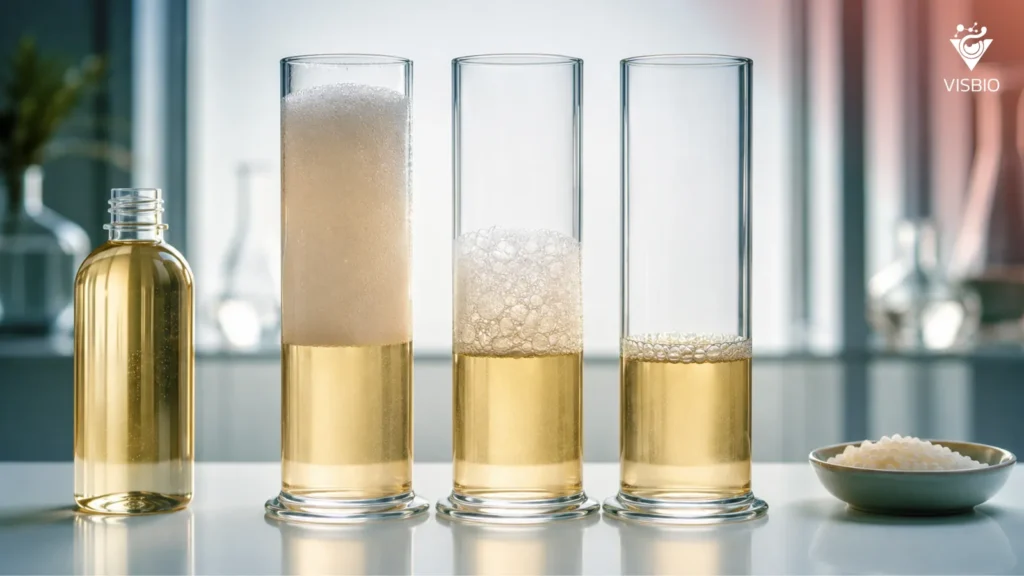
Foam measurement has two steps. The first is generating foam from a solution of the sample by a defined, repeatable method. The second is reading the volume or height of the foam immediately after it forms and then following it over time to assess foam stability. Three groups of foam-generating methods are widely used:
- Ross-Miles method: a sample solution is released from a pipette at a fixed height into the same solution in a temperature-controlled glass column, and the foam height or volume is measured immediately and again after a set time (Ross & Miles, 1941). A modified version of this method is an international standard, ISO 696 (International Organization for Standardization, 1975).
- Cylinder shake method: a sample solution is placed in a stoppered graduated cylinder, shaken a set number of times at a set rhythm, and the foam volume is read over time. This method is simple and suits comparison of several formulas under the same conditions.
- Automated foam analyzer: foam is generated by sparging gas through a filter disc or by stirring, and a camera or optical sensors continuously follow the height and structure of the foam.
Whatever the method, sample concentration, temperature, pH and the hardness of the dilution water must be kept the same every time, because these variables directly affect surfactant performance. Numbers from different methods therefore cannot be compared directly, and comparisons between formulas or batches must use the same method and conditions.
Chemically, the type and amount of surfactant are the main factors in foam formation and foam stability. Analysis of surfactant content by titration or spectrophotometry can therefore help explain whether reduced foam comes from less surfactant than the formula specifies or from other factors. Foam stability also depends on the proteins, polymers and thickening agents in the formula.
VISBIO Laboratory measures foam by the cylinder shake method, controlling concentration, temperature and water hardness, and reads the foam volume or height immediately after shaking and over time. Measurement with a Ross-Miles apparatus or an automated foam analyzer is carried out in collaboration with partner laboratories. The data help formulators improve foam quality and control batch-to-batch consistency. Foam test results describe performance quality in use; they are not used to confirm product safety.
Scope of VISBIO Laboratory's foam testing service
VISBIO Laboratory’s service covers three groups of samples:
- Hair care products: regular shampoos, mild shampoos, sulfate-free shampoos, 2-in-1 shampoos with conditioner and professional hairdressing products
- Bath products: shower creams, body washes, liquid soaps and body cleansers
- Facial cleansing products: foaming facial cleansers, facial cleansing gels, cleansers for oily, dry and combination skin, and micellar waters that contain a surfactant system
Reported results include the initial foam volume in milliliters, or the foam height in millimeters depending on the method used, the foam half-life, the foam decay profile over time, a qualitative description of the foam, such as dense or loose, and a comparison with the criteria in the specification. Clients can choose a single test for batch release or a continuing study to assess changes in foam throughout shelf life.
Using foam test results
Foam test results can be used at several stages of a product’s life:
- Research and development: compare several prototype formulas to select the surfactant system whose foam volume and stability match the product concept, and test the effect of changing a raw-material supplier.
- Pre-launch: set the baseline for the specification and the acceptable change in foam volume for batch release.
- Commercial production: use as a batch-release criterion that reflects the consumer’s experience of using the product.
- Stability studies: combine with real-time and accelerated stability studies to confirm that foaming behavior still meets the specification throughout shelf life.
- Export: attach to the Certificate of Analysis (COA) for buyers who set a limit on foam change in their trade agreements.
- Marketing communication: use numerical foam data as supporting evidence for what the brand communicates, such as foam volume that stays constant throughout the stability study, provided the statements match the measured results.
Frequently asked questions about foam testing
What does a foam test measure?
It measures two main values: foam volume, which is the volume or height of foam a sample produces under set conditions, and foam stability, which shows how long the foam lasts and is usually reported as the foam half-life, the time taken for the foam to collapse to half.
Does more foam mean better cleaning?
Not necessarily. Scientifically, foam volume is not directly proportional to cleansing ability, but foam does affect how consumers perceive quality and whether they buy again.
Why do sulfate-free products usually produce less foam?
Anionic surfactants such as SLS and SLES produce a lot of foam quickly, while mild surfactants such as glucosides usually produce less. Switching to a sulfate-free formula therefore often reduces foam volume noticeably.
Can foam change during storage?
Yes. Some surfactant systems produce less foam after a period of storage, for example because of hydrolysis of certain surfactants. Tracking foam values throughout a stability study therefore helps confirm that the product delivers the same user experience throughout its shelf life.
Which variables must be controlled during a foam test?
Sample concentration, temperature, pH and water hardness must be kept the same every time, and the same method must be used when comparing formulas or batches, because numbers from different methods cannot be compared directly.
What information does the foam test report include?
The report includes the initial foam volume, the foam half-life, the foam decay profile over time, a qualitative description of the foam and a comparison with the criteria in the specification. Clients can choose between a single test for batch release and a continuing study throughout shelf life.
References:
- ASEAN Cosmetic Committee. (2008). ASEAN Cosmetic Directive. ASEAN Secretariat.
- International Organization for Standardization. (1975). Surface active agents — Measurement of foaming power — Modified Ross-Miles method (ISO 696:1975). ISO.
- Ross, J., & Miles, G. D. (1941). An apparatus for comparison of foaming properties of soaps and detergents. Oil & Soap, 18(5), 99–102. https://doi.org/10.1007/BF02545418
- Royal Thai Government Gazette. (2015, September 8). Cosmetic Act B.E. 2558 (2015). Royal Thai Government Gazette, 132(86 Kor), 1–22.