

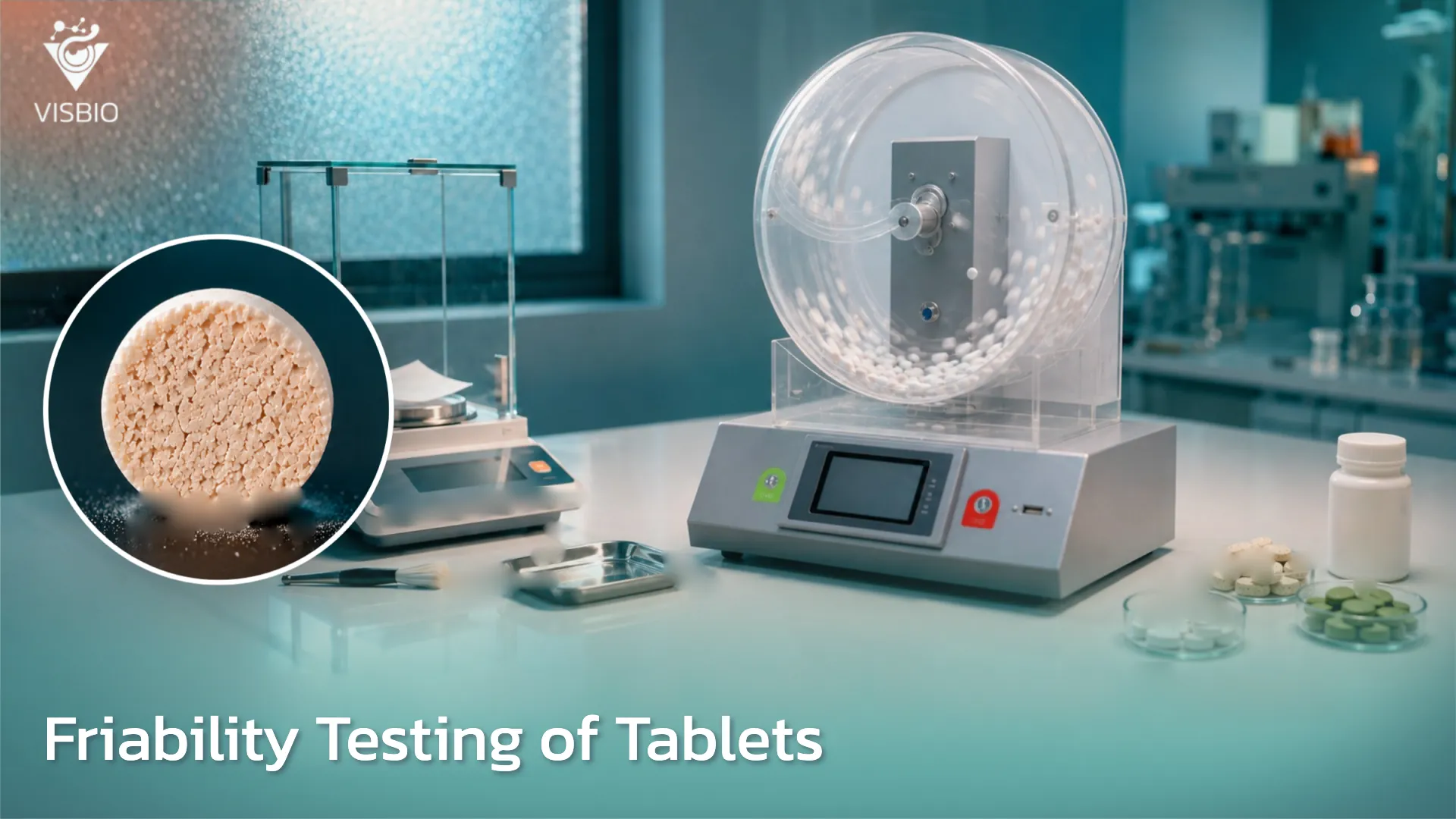
A friability test, which some sources call a tablet abrasion test, tumbles tablets in a test drum for a set number of rotations and then weighs them to find the weight lost through chipping, abrasion and breaking into powder. The result shows whether the tablets are strong enough to withstand coating, packing and transport. The method is designed for compressed uncoated tablets and is used together with tablet hardness testing, which measures the force needed to break a tablet.
Products sold as tablets, including pharmaceutical tablets, dietary supplement tablets, vitamin tablets, herbal tablets, chewable tablets, lozenges and coated tablets, have to go through international shipping, automatic sorting in distribution centers, packing into plastic blisters, warehouse storage and the journey to stores and consumers, while keeping their shape and not breaking into powder or fragments. The integrity of the tablet in the consumer’s hand therefore determines how credible the product is. The friability test simulates the impacts tablets receive during packing and transport and measures, as a number, how much the tablets have worn away.
This article summarizes what brand owners, quality assurance (QA) teams and research and development (R&D) teams should know before ordering tests: the principles of the test method, the acceptance criteria and interpretation of results, the products that should be tested, how to use the results in formulation development and packaging selection, and the scope of the service that VISBIO Laboratory provides in collaboration with partner laboratories.
Principles of the friability test
The widely used friability test method comes from 2 pharmacopeias: the United States Pharmacopeia (USP), used in the US market and in countries that refer to the USP, and the European Pharmacopoeia (Ph. Eur.), used in the European market and in countries that refer to Ph. Eur. The friability texts of the two pharmacopeias have been harmonized, so they use the same principles and the same apparatus (European Directorate for the Quality of Medicines & HealthCare, 2024; United States Pharmacopeial Convention, 2023).
The procedure starts with sample preparation. For tablets weighing up to 650 mg, take whole tablets with a total weight as close as possible to 6.5 g; for tablets weighing more than 650 mg, take 10 tablets. Remove the dust from the tablets before weighing, then place them in the drum of the friability tester (friabilator), which rotates at 25 rpm for 100 rotations, or about 4 minutes. In each rotation, the curved projection inside the drum carries the tablets up and lets them roll or fall against the drum wall and against one another, which simulates the vibration and impacts of packing and transport. After 100 rotations, remove the tablets, dedust them again and weigh them. Friability is then calculated as the percentage of weight lost, as follows:
% Friability = [(W₀ – W₁) / W₀] × 100
where W₀ is the weight of the tablets before testing and W₁ is the weight of the tablets after testing.
Acceptance criteria and interpretation of results
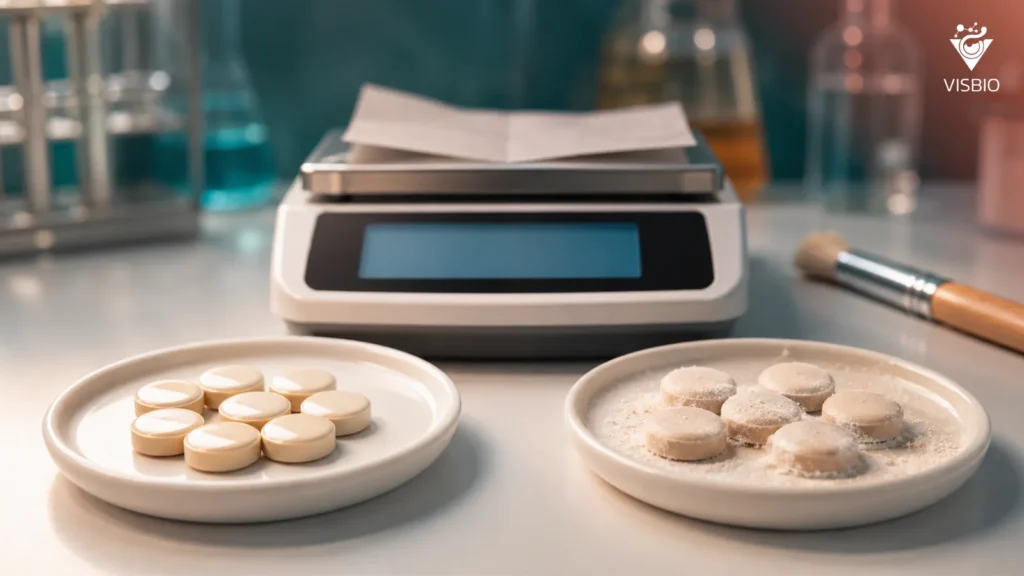
Both pharmacopeias consider a weight loss of no more than 1.0% acceptable for most products, and if tablets are clearly cracked, broken or chipped after tumbling, the sample fails the test. The test is generally run only once, but if the results are difficult to interpret or the weight loss exceeds the target value, the test is repeated twice more and the mean of all 3 tests is used (United States Pharmacopeial Convention, 2023).
Tablets that meet this criterion are generally considered strong enough for normal packing and transport, while friability above 1.0% signals a problem in the formula or the manufacturing process, such as insufficient tablet hardness, too little binder, insufficient compression force or too high a proportion of disintegrant.
Some types of tablets need special consideration:
- Effervescent and chewable tablets: USP states that effervescent tablets and chewable tablets may have different friability criteria from ordinary tablets, so manufacturers should set the criteria for these products in the specification, with a supporting rationale
- Hygroscopic tablets: must be tested under humidity-controlled conditions
- Tablets whose shape makes them tumble irregularly: the pharmacopeias call for the base of the drum to be tilted about 10 degrees from the horizontal so that the tablets can fall freely
- Coated tablets: the pharmacopeial method is designed for uncoated tablets, so manufacturers usually test the friability of the core tablets before coating to confirm that they can withstand the forces of the coating step
When friability results are high, the development team investigates the cause further and chooses a solution, such as adjusting the formula, adjusting the compression force during tableting, adjusting the proportions of excipients, or switching to a coated tablet for greater durability.
Products that should undergo friability testing
- Pharmaceutical tablets: pharmaceutical tablets are tested for friability by the pharmacopeial method, and manufacturers often use this value as an in-process control together with tablet hardness
- Dietary supplement tablets: in Thailand, dietary supplements are regulated under the Food Act B.E. 2522 (1979). Manufacturers of vitamin tablets, mineral tablets, herbal extract tablets and multi-ingredient tablets can use this test to confirm that tablets withstand packing and transport, in the same way as for pharmaceutical tablets
- Herbal tablets: manufacturers of herbal medicine tablets under the Herbal Products Act B.E. 2562 (2019) can use this test to control tablet quality in the same way as for ordinary pharmaceutical tablets
- Chewable tablets: chewable tablets are often larger than ordinary tablets and are flavored for consumer acceptance, so developing chewable tablets that both withstand transport and give a good mouthfeel is a difficult challenge for R&D teams. Friability testing should be used together with sensory evaluation by a trained panel
- Lozenges: lozenges are designed to dissolve slowly in the mouth, so they often need to resist breaking better than chewable tablets, so that they keep their shape until they have fully dissolved
- Gummies: gummies are elastic gel products, not compressed tablets, so the pharmacopeial friability test is not designed for them. Deformation and sticking of gummies can be assessed by texture and hardness analysis
Using the results in formulation development and packaging selection
Friability results are most useful to the business when they are used as a tool from the R&D stage onward and in decisions on packaging. At the R&D stage, the team uses friability values to compare several formulas and choose one that withstands packing and transport while still disintegrating and dissolving as required. The proportions of binder, disintegrant, filler and lubricant directly affect friability. Reliable results at this stage help the development team decide faster and reduce repeated trials during scale-up.
When choosing packaging, some developers use friability as an initial rule of thumb. For example, tablets with low friability (about 0.3–0.5%) are often packed in plastic bottles, where tablets can touch one another without wearing, while for tablets with higher friability (about 0.7–1.0%), blister packs that keep the tablets apart should be considered, to reduce impacts during transport. These figures are practical rules of thumb, not pharmacopeial criteria.
In stability studies, some manufacturers also measure friability again at various time points, because tablets that absorb moisture during storage may become softer or harder.
VISBIO Laboratory's friability testing service
VISBIO Laboratory provides friability testing of pharmaceutical tablets, dietary supplement tablets and herbal tablets in collaboration with partner laboratories. The team handles the work from start to finish, as follows:
- Test plan: set the number of samples and the test conditions to suit the tablets and the target market
- Chain of custody: record the receipt, storage and transfer of samples at every step
- Sample conditioning: keep samples at the set temperature and humidity before testing, especially hygroscopic tablets
- Testing and recording: test in a laboratory whose documentation system provides traceability
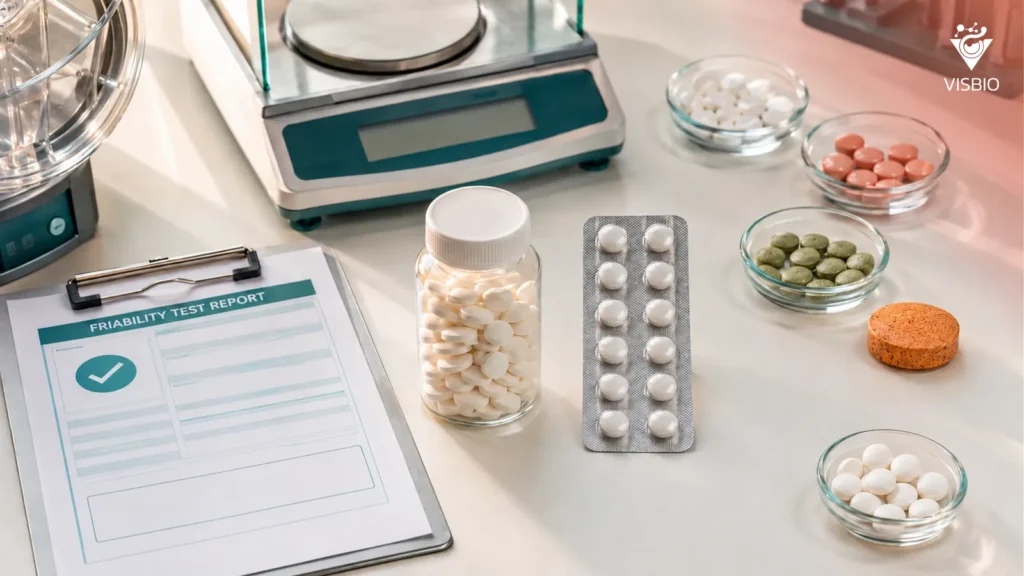
- Reporting: state the weight before and after testing, the percentage friability and any cracked, broken or chipped tablets
The report can be used as supporting information for formulation development, for preparing to open export markets and for answering questions from key accounts overseas.
Frequently asked questions about friability tests
What is a friability test?
A friability test tumbles tablets in a test drum for 100 rotations at 25 rpm and then calculates the percentage of weight lost. The result shows how well the tablets resist chipping, abrasion and breaking during coating, packing and transport.
What is the pass criterion for a friability test?
USP and Ph. Eur. consider a weight loss of no more than 1.0% acceptable for most products. If tablets are clearly cracked, broken or chipped after tumbling, the sample fails; if the result is difficult to interpret, the test is repeated twice more and the mean of all 3 tests is used.
How many tablets are needed?
For tablets weighing up to 650 mg, use whole tablets with a total weight close to 6.5 g; for tablets weighing more than 650 mg, use 10 tablets. If the test has to be repeated, additional samples are needed for each repeat.
How does friability differ from tablet hardness?
Tablet hardness measures the force needed to break a tablet, while friability measures the weight lost when tablets roll and strike one another repeatedly in the test drum. The two values show different aspects of a tablet’s mechanical strength, so they are usually used together.
Do chewable and effervescent tablets have to meet the 1.0% criterion?
USP states that effervescent and chewable tablets may have different friability criteria from ordinary tablets, so manufacturers should set the criteria for these products in the specification, with a supporting rationale.
How does friability help in choosing packaging?
Some developers use friability as an initial rule of thumb: for example, tablets with low friability can often be packed in bottles, while for tablets with higher friability, blister packs that keep the tablets apart should be considered. The figures used are practical rules of thumb, not pharmacopeial criteria.
References:
- European Directorate for the Quality of Medicines & HealthCare. (2024). 2.9.7. Friability of uncoated tablets. In European Pharmacopoeia (11th ed., Suppl. 11.5). Council of Europe.
- United States Pharmacopeial Convention. (2023). 〈1216〉 Tablet friability. In United States Pharmacopeia 46–National Formulary 41.
- Royal Thai Government Gazette. (1979, May 13). Food Act B.E. 2522 (1979). Royal Thai Government Gazette, 96(79 Kor), 1–24.
- Royal Thai Government Gazette. (2019, April 30). Herbal Products Act B.E. 2562 (2019). Royal Thai Government Gazette, 136(56 Kor), 116–161.