

About Our Anti-Inflammatory Testing
VISBIO Co., Ltd. offers anti-inflammatory activity testing by nitric oxide (NO) assay for a wide range of product samples. The test is suitable for products that focus on anti-inflammatory properties.
The inflammatory process is the body’s protective response to harmful stimuli and is part of its immune and repair responses to injury or cell damage. It takes place in several stages, beginning with activation when tissue is injured or cells are damaged, for example through physical injury or infection. Once the process is activated, white blood cells are released into the inflamed area and blood vessels dilate to increase blood flow to it, making it easier for substances and immune cells to reach the site. Products with anti-inflammatory properties act against the factors that trigger inflammation in the body. The body then begins the repair process, and the inflammatory response resolves.
The test measures anti-inflammatory activity in RAW 264.7 macrophage cells by quantifying nitric oxide (NO) production under two-dimensional (2D) cell culture conditions. It is suitable for raw materials, herbs, extracts, cosmetics, dietary supplements and pharmaceutical products with potential anti-inflammatory properties.
Inflammation
Inflammation is a complex reaction of tissues to microorganisms and other harmful agents. It causes biochemical changes in the body and triggers the release of various inflammatory mediators, including nitric oxide (NO) and prostaglandin E2 (PGE2), from white blood cells and macrophages. Both nitric oxide and prostaglandin E2 promote inflammation. Inflammation has been reported to contribute to many diseases, such as cancer, osteoarthritis, atherosclerosis, septic shock, transplant rejection, neurodegenerative diseases such as Alzheimer’s disease and Parkinson’s disease, diabetes, and inflammatory diseases of the stomach and intestines.
The Inflammatory Process
The inflammatory process is the body’s protective response to harmful stimuli and is part of the immune system. The first stage is a non-specific (innate) immune response called acute inflammation: blood vessels dilate to increase the blood supply, allowing neutrophils and macrophages to move out of the vessels into the tissue. These white blood cells engulf foreign material (phagocytosis) and release pro-inflammatory mediators and pro-inflammatory cytokines. When the destruction of foreign material continues over a long period, the condition is called chronic inflammation, which may contribute to diseases such as cancer, osteoarthritis and diabetes.
Inflammation is divided into two types: acute inflammation and chronic inflammation.
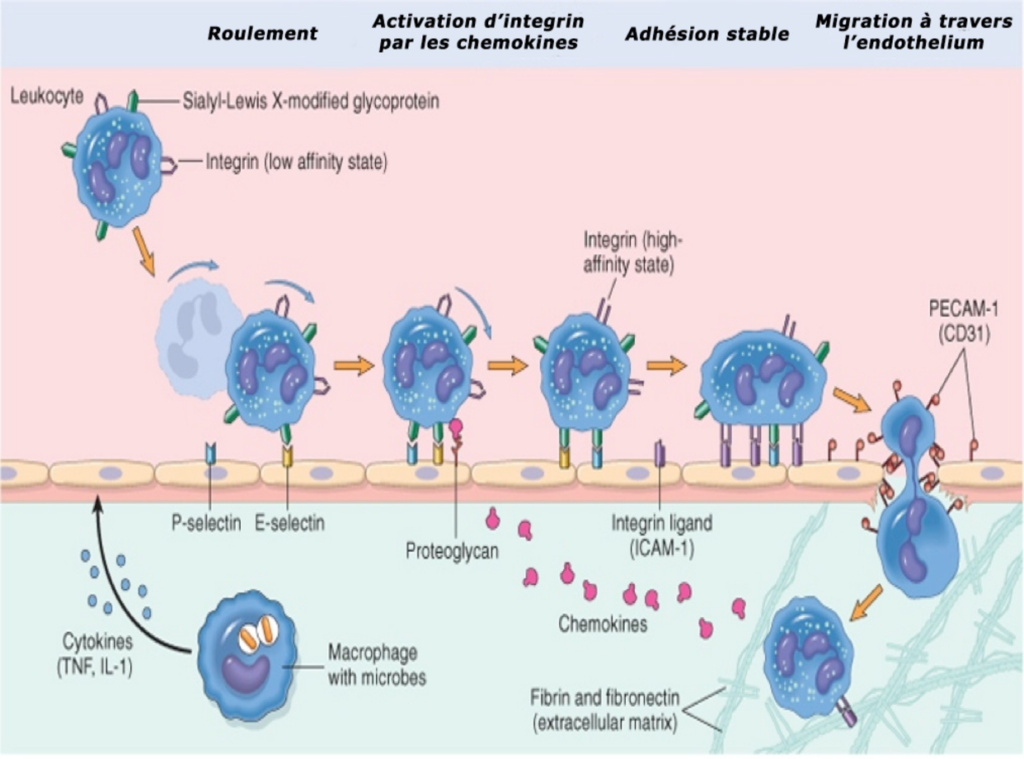
Nitric oxide (NO) is a free radical that acts as an inflammatory mediator. NO is synthesized from L-arginine and molecular oxygen in a reaction catalyzed by the enzyme nitric oxide synthase (NOS). NO produced in this way is associated with inflammatory pathology, such as vasodilation after injury, myocardial ischemia, and acute and chronic inflammation. Excess NO reacts with the superoxide anion radical (O2•-) to form peroxynitrite (ONOO-), a highly reactive oxidant that can kill microorganisms but can also damage tissue cells at the site of injury, further amplifying inflammation. Measuring the inhibition of NO production is therefore a widely used approach for studying anti-inflammatory activity.
Causes of Inflammation
Inflammation has two groups of causes:
External (exogenous) causes
- Mechanical injury: injury caused by physical forces acting directly on tissue, such as surgery, stab wounds, blows, gunshot wounds and collisions.
- Thermal injury: injury caused by heat, such as scalds from hot water or hot oil, and burns from fire.
- Electrical injury: injury caused by electric current, such as lightning, short circuits and electric shock.
- Radiation injury: injury caused by radiation and radioactive substances, such as ultraviolet rays, X-rays and radium.
- Chemical injury: injury caused by chemicals from outside the body, such as strong acids or alkalis, which can cause severe tissue damage.
- Microbiologic injury: injury caused by microorganisms and parasites, such as viruses, bacteria, protozoa and parasitic worms.
Internal (endogenous) causes
- Chemical injury from substances produced in the body, such as bile, pancreatic juice, gastric juice and urine, which can damage tissue if they enter the abdominal cavity or other organs.
- Immune mechanism injury: injury caused by immune reactions, such as hypersensitivity disorders.
- Other causes, such as ischemia (inadequate blood supply) leading to myocardial infarction, or shedding of the uterine lining during menstruation.
Anti-Inflammatory Compounds
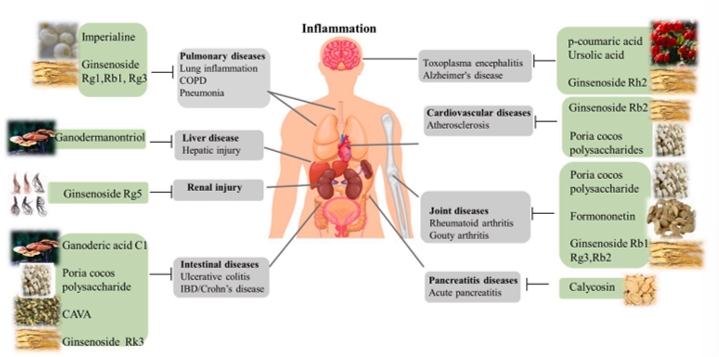
Chemical compounds with anti-inflammatory activity can be classified as follows:
- Alkaloids, which can be further classified as isoquinoline alkaloids, steroidal alkaloids, purine alkaloids, lactam alkaloids, amide alkaloids and indole alkaloids. Herbs containing alkaloids include red spider lily (Lycoris radiata; L’Her.), common purslane (Portulaca oleracea L.), Sichuan fritillary bulb (Bulbus Fritillariae cirrhosae), black pepper (Piper nigrum L.), perilla (Perilla frutescens (L.) Britt) and fish mint (Houttuynia cordata Thunb).
- Terpenoids, which can be further classified as monoterpenoids, sesquiterpenes and triterpenoids. Herbs containing terpenoids include perilla (Perilla frutescens (L.) Britton), lingzhi mushroom (Ganoderma lucidum), patchouli herb (Pogostemonis herba) and poria (Poria cocos).
- Polysaccharides. Herbs containing polysaccharides include lingzhi mushroom (Ganoderma lucidum), poria (Poria cocos), fish mint (Houttuynia cordata Thunb), tiger lily (Lilium lancifolium Thunb), ginkgo (Ginkgo biloba) and jujube (Ziziphus jujuba Mill.).
- Phenolic compounds. Herbs containing phenolic compounds include Chinese licorice (Glycyrrhiza uralansis Fisch), astragalus root (Radix astragali), Mongolian milkvetch (Astragalus mongholicus Bunge), bitter orange (Citrus aurantium L. var. Amara Engl.), fish mint (Houttuynia cordata Thunb), Indian gooseberry (Phyllanthus emblica), ginkgo (Ginkgo biloba), jujube (Ziziphus jujuba Mill.) and Asiatic cornelian cherry (Corni fructus).
- Coumarins. Herbs containing coumarins include Dahurian angelica (Angelica dahurica) and bitter orange (Citrus aurantium L. var. Amara Engl.).
- Essential oils, such as those of Dahurian angelica root (Angelicae dahuricae Radix), bitter orange (Citrus aurantium L. var. Amara Engl.) and Buddha’s hand (Citrus medica L. var. sarcodactylis).
- Volatile oils, such as the oil of Dahurian angelica root (Angelicae dahuricae Radix).
- Ginsenosides, found in Korean ginseng (Panax ginseng) and black ginseng.
Anti-Inflammatory Testing Method
Anti-inflammatory activity is tested in RAW 264.7 macrophage cells by measuring the amount of nitric oxide (NO), that is, the sample’s ability to inhibit NO release, under two-dimensional (2D) cell culture conditions. The cells are cultured in 96-well microplates, and absorbance is measured at 570 nm with a microplate reader. The % inhibition of NO production is then calculated, and a concentration–response curve can be plotted to determine the concentration that inhibits nitric oxide production, expressed as the IC50 (inhibitory concentration at 50%).
Example of an Anti-Inflammatory Activity Report
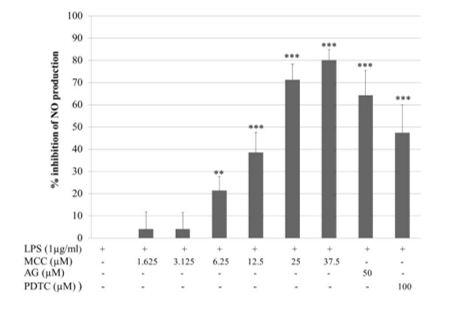
Anti-inflammatory activity of 4-methoxycinnamyl 4-coumarate (MCC) isolated from Etlingera pavieana rhizomes: RAW 264.7 macrophages were incubated with LPS and the test compound at 0.7-37.5 μM, and nitrite in the culture medium was measured. The compound inhibited nitric oxide production, with an IC50 of 14.2±2.3 μM, as shown in the figure. Two positive controls were used: aminoguanidine (AG), an iNOS inhibitor, and pyrrolidine dithiocarbamate (PDTC).
Literature:
- กล่าวขวัญ ศรีสุข และ เอก รัฐ ศรีสุข. “การ ประเมิน ศักยภาพ ของ 4-methoxycinnamyl 4-coumarate ที่ แยก ได้ จาก เหง้า เร่ว หอม ใน การ เป้ น สาร ต้าน อักเสบ ชนิด ใหม่.” (in Thai)
- Lu, Qiuxia, et al. “Ingredients with anti-inflammatory effect from medicine food homology plants.” Food Chemistry 368 (2022): 130610.
- จเร จรัสจรูญพงศ์, ประภาพรรณ เตชะเสาวภาคย์ และ กล่าวขวัญ ศรีสุข, 2557, รายงานการวิจัยฉบับสมบรูณ์การสังเคราะห์และฤทธิ์ต้านการอักเสบของสารไตรเอริลมีเทนแบบไม่สมมาตร, มหาวิทยาลัยบูรพา. (in Thai)
- อนันต์ อธิพรชัย, สุวรรณา เสมศรี และ สุรีย์พร หอมวิเศษวงศา, 2562, คุณสมบัติต้านการอักเสบและความเป็นพิษของสารสกัดสมุนไพร ในกลุ่มที่รักษาเบาหวาน, มหาวิทยาลัยบูรพา. (in Thai)