

Information about Service for Antioxidant Efficacy Testing Service for Hair Follicle Cells Under Simulated Oxidative Stress
VISBIO provides in vitro antioxidant activity testing on Human Hair Follicle Dermal Papilla Cells (HFDPCs) using an H₂O₂ (Hydrogen Peroxide)-induced oxidative stress model, measuring intracellular Reactive Oxygen Species (ROS) levels with the DCFH-DA fluorescent probe. This service is designed for brand owners, OEM manufacturers, and R&D teams who need scientific evidence that their active ingredients or product formulations can genuinely protect hair follicle cells from free radical-induced damage supporting antioxidant protection claims for hair care products.
Scientific Background
Why Is Antioxidant Testing on Hair Follicle Cells Important?
Free radicals (Reactive Oxygen Species: ROS) are a primary driver of hair follicle cell deterioration, progressive hair thinning, and premature hair loss. A growing body of research identifies oxidative stress as a shared pathological basis across nearly all forms of alopecia — including Androgenetic Alopecia, Alopecia Areata, and environmentally induced hair damage. This has driven sustained growth in the market for hair care products with antioxidant protection claims.
However, simply including antioxidant ingredients in a formulation does not guarantee that a product will actually protect hair follicle cells. Antioxidant activity depends on multiple variables — ingredient type, concentration, cellular penetration, and interaction with other components in the formula. Brand owners seeking credible claims therefore need cell-level testing data demonstrating that their product can genuinely reduce intracellular ROS and protect hair follicle cells from oxidative damage.
ROS Assay testing on HFDPCs using the H₂O₂-induced oxidative stress model is the most targeted approach available for evaluating the antioxidant potential of a test substance directly on the cell type relevant to hair care products.
Oxidative Stress and Hair Damage & Loss
Reactive Oxygen Species (ROS) are highly reactive oxygen-containing molecules — including Superoxide Anion (O₂⁻), Hydrogen Peroxide (H₂O₂), and Hydroxyl Radical (·OH). Under normal conditions, cells generate small amounts of ROS as metabolic byproducts, kept in balance by an enzymatic antioxidant defense system (e.g., Superoxide Dismutase, Catalase, Glutathione Peroxidase). When ROS production exceeds the capacity of this system, oxidative stress occurs, damaging the structural integrity of DNA, proteins, and lipids within the cell.
Within the hair follicle, Dermal Papilla cells have a particularly high metabolic rate, making them more vulnerable to ROS exposure than most cell types. Research has shown that oxidative stress drives Dermal Papilla cells into premature senescence — impairing their ability to send growth-stimulating signals and accelerating follicle entry into the regression phase (Catagen). The result is progressively thinner, weaker hair and earlier-than-expected hair loss.
ROS also disrupts multiple signaling pathways critical to the hair growth cycle. In particular, H₂O₂ suppresses the Wnt/β-Catenin pathway — weakening the growth-promoting signals that keep follicles in the anagen (growth) phase. Simultaneously, ROS upregulates TGF-β1 and DKK-1, proteins that accelerate Catagen entry, further shortening the hair growth cycle.
External factors that amplify oxidative stress on hair follicles include UV radiation, air pollution, cigarette smoke, chemical styling agents, and psychological stress — all of which are routine exposures for modern consumers. This has created a sustained and growing demand for hair care products with evidence-backed antioxidant protection.
ROS Mechanisms in Dermal Papilla Cells and Their Impact on the Hair Loss Pathway
When oxidative stress occurs in Dermal Papilla cells, damage cascades simultaneously across multiple pathways, which is precisely why ROS exerts such a profound impact on hair follicle function.
Pathway 1: DNA Damage and Cellular Senescence, ROS directly damages the DNA strands of Dermal Papilla cells, causing accumulative lesions. Once damage reaches a threshold, cells enter a permanent state of senescence (irreversible cell cycle arrest). Research has shown that Dermal Papilla cells from patients with Androgenetic Alopecia exhibit higher levels of oxidative stress and enter senescence significantly earlier than those from unaffected individuals.
Pathway 2: Wnt/β-Catenin Pathway Inhibition, H₂O₂ reduces β-Catenin levels in both the cytoplasm and nucleus of Dermal Papilla cells. Since the Wnt/β-Catenin pathway is the primary regulator of hair growth, this suppression weakens the signal that maintains follicles in the anagen phase — a mechanism analogous to DHT-mediated follicle miniaturization but occurring through a distinct molecular route.
Pathway 3: Lipid Peroxidation and Apoptosis, ROS attacks lipids in the cell membrane, generating lipid peroxides that activate apoptotic pathways within follicle cells. This accelerates Catagen entry and shortens the overall hair growth cycle.
Consequently, any substance capable of reducing intracellular ROS in Dermal Papilla cells has the potential to protect hair follicles from damage across all three pathways simultaneously. VISBIO employs the DCFH-DA fluorescent probe to measure intracellular ROS levels directly enabling precise, cell-level assessment of a test substance’s antioxidant efficacy.
Scope of VISBIO
VISBIO provides antioxidant efficacy testing on hair follicle cells using the H₂O₂-induced oxidative stress model on HFDPCs. The service supports both protective (“Pre-treatment”) and restorative (“Post-treatment”) testing models, structured across three core testing levels as follows
Cell Safety Assessment (Cytotoxicity Assay)
Before commencing any ROS testing, VISBIO always evaluates the cytotoxic profile of the test substance against HFDPCs. This step is essential: if a substance is inherently toxic to cells, the resulting ROS Assay data cannot be interpreted correctly
Cell death from cytotoxicity would produce a low fluorescence signal that has nothing to do with antioxidant activity.
Method: VISBIO uses the MTT Assay
An internationally recognized standard for cell viability assessment. The principle is straightforward: the MTT dye (3-(4,5-Dimethylthiazol-2-yl)-2,5-Diphenyltetrazolium Bromide) is reduced by Mitochondrial Dehydrogenase in living cells to form a purple Formazan compound, measurable by absorbance at 570 nm. Healthy cells generate a high signal; cells compromised by a toxic substance yield a proportionally lower signal.
Outcomes: VISBIO plots a Dose-Response Curve to define the non-cytotoxic. The range at which HFDPCs maintain normal viability (Cell Viability ≥ 80%). These concentrations are then used as the input parameters for the subsequent ROS Assay. The cytotoxicity data also provides formulation value, giving product developers a clear upper-limit reference for safe active ingredient concentrations relative to hair follicle cell tolerance.
Intracellular ROS Measurement via DCFH-DA
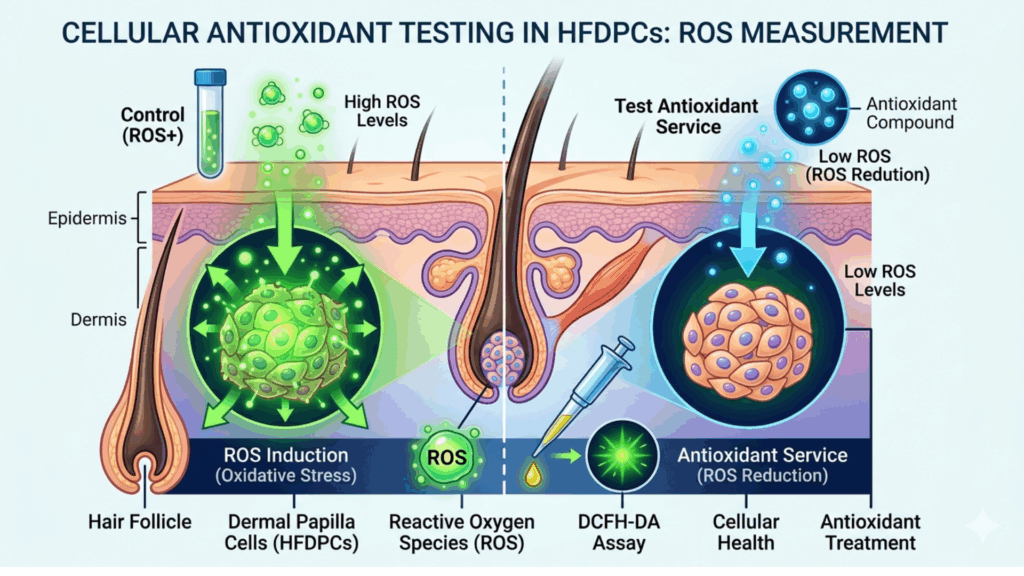
The core assay of this service uses DCFH-DA (2’,7’-Dichlorodihydrofluorescein Diacetate), a cell-permeable fluorescent probe that is oxidized by intracellular ROS to form DCF , a compound that emits green fluorescence under excitation light. The intensity of the fluorescence signal is directly proportional to the level of ROS within the cell.
The testing procedure begins with culturing HFDPCs, followed by addition of the test substance in the selected protocol (Pre- or Post-treatment), incubation at 37°C in 5% CO₂ for 24 hours, induction of oxidative stress with H₂O₂, and final measurement of fluorescence intensity using a Microplate Reader.
A statistically significant reduction in ROS levels in the test substance group compared to the H₂O₂-only control confirms genuine intracellular ROS-scavenging activity in hair follicle cells.
VISBIO designs the testing protocol to support two distinct models, each aligned to a different product claim objective:
Pre-treatment (Protective Activity): The test substance is added before inducing oxidative stress with H₂O₂ to evaluate whether it can protect cells from ROS in advance. This model is suitable for products intended to claim such as “Protects hair follicles from damage before exposure to triggering factors” or “Builds a protective shield for hair follicle cells”
Post-treatment (Restorative Activity): Oxidative stress is induced first, then the test substance is added to evaluate whether it can reduce ROS that has already accumulated in the cells. This model is suitable for products focused on restorative claims such as “Helps restore hair follicle cells damaged by oxidative stress” or “Reduces ROS accumulation in hair follicles”
The VISBIO scientific team is available to advise on selecting the appropriate testing model for your product’s specific claim objectives. Both protocols can be run simultaneously to maximize efficiency in time and sample usage.
Cell Imaging
VISBIO provides cell imaging of HFDPCs using an Inverted Microscope to compare cellular morphology and cell density across treatment groups. Imaging provides a visual, tangible representation of oxidative stress effects and can be incorporated into research reports or product claim documentation.
Products Suitable for This Service
This antioxidant efficacy testing service is applicable to a broad range of products in the Health & Beauty industry, particularly those carrying claims related to antioxidant protection, anti-aging for hair, or pollution protection. Suitable product categories include
| Product Category | Examples |
| Cosmetics | Antioxidant hair serums, anti-pollution shampoos and conditioners, scalp tonics, hair oils, and products containing plant-based antioxidant extracts such as Vitamin E, Green Tea, Resveratrol, and Astaxanthin |
| Dietary Supplements | Hair nourishing dietary supplements containing antioxidants such as Vitamin C, Vitamin E, Selenium, Zinc, Grape Seed Extract, and Coenzyme Q10 |
| Raw Materials / Active Ingredients | Natural or synthetic extracts requiring confirmation of antioxidant activity specifically on hair follicle cells, to support differentiated claims beyond standard antioxidant testing |
| Herbal Extracts | Herbal extracts rich in polyphenols, flavonoids, or carotenoids such as Centella Asiatica, Turmeric, Pomegranate, Rosemary, and Moringa requiring testing data on hair follicle cells prior to commercial application |
Benefits of Antioxidant Efficacy Testing Service for Hair Follicle Cells (HFDPCs) Under Simulated Oxidative Stress
Test reports from VISBIO’s Antioxidant ROS Assay on hair follicle cells delivers multi-dimensional value across business functions:
- Antioxidant Protection Claim Support Measuring intracellular ROS reduction in HFDPCs provides preliminary empirical evidence that is critically important for hair care product development — whether testing active ingredients to assess their potential, or testing finished products such as serums, hair tonics, and scalp treatments to confirm that the formulation retains efficacy in interacting with target cells.
- R&D Data For R&D teams, test results enable precise screening and comparison of antioxidant extracts specifically on hair follicle cells, establish dose-response relationships, and guide selection of the most suitable antioxidant for the final formulation. Pre-treatment vs. post-treatment data also helps position the product as either “protective” or “restorative.”
- Product Differentiation Many products claim antioxidant benefits based on cell-free assays such as DPPH or ABTS, but products backed by antioxidant data tested directly on hair follicle cells can communicate to the market with significantly greater credibility — particularly in the anti-pollution and anti-aging hair care segments.
- The Significance of Cell-Level Testing for Product Development
- Formulation Verification: Confirms that once active ingredients are incorporated into a formulation, the finished product retains its ability to protect cells against oxidative stress under controlled conditions.
- Targeted Interaction: Demonstrates that product components engage in biological interaction with human Hair Follicle Dermal Papilla Cells (HFDPCs), carrying substantially greater credibility than conventional in-tube chemical testing.
- Science-Based Storytelling: Enables brand owners to communicate the “innovative concept” of their product with scientific grounding — focusing on the protection and preservation of hair follicle function against external free radical-inducing factors.
Literature:
- Du, Y., Ye, H., & Li, K. (2024). Oxidative stress in hair follicle development and hair growth: Signalling pathways, intervening mechanisms and potential of natural antioxidants. Journal of Cellular and Molecular Medicine, 28(12), e18486. https://doi.org/10.1111/jcmm.18486
- Trüeb, R. M. (2015). The impact of oxidative stress on hair. International Journal of Cosmetic Science, 37(S2), 25–30. https://doi.org/10.1111/ics.12286
- Upton, J. H., Hannen, R. F., Bahta, A. W., et al. (2015). Oxidative stress–associated senescence in dermal papilla cells of men with androgenetic alopecia. Journal of Investigative Dermatology, 135(5), 1244–1252. https://doi.org/10.1038/jid.2015.28
- Prie, B. E., Voiculescu, V. M., Ionescu-Bozdog, O. B., et al. (2015). Oxidative stress and alopecia areata. Journal of Medicine and Life, 8(Spec Issue), 43–46. https://pubmed.ncbi.nlm.nih.gov/26361509/
- Kim, J., Shin, J. Y., Choi, Y. H., et al. (2024). Phloroglucinol enhances anagen signaling and alleviates H₂O₂-induced oxidative stress in human dermal papilla cells. Journal of Microbiology and Biotechnology, 34(4), 812–821. https://doi.org/10.4014/jmb.2311.11047
- Sekyere, A., Mantey, R. A., & Arthur, J. (2023). Protective activity against oxidative stress in dermal papillae with extracted herbal essential oils. Applied Sciences, 13(6), 3985. https://doi.org/10.3390/app13063985
- Shin, H., Cho, A. R., Kim, D. Y., et al. (2016). Nannochloropsis extract-containing conditioned medium promotes hair growth via Wnt/β-catenin signaling activation and the suppression of oxidative stress in dermal papilla cells. Biomolecules & Therapeutics, 24(5), 525–532. https://doi.org/10.4062/biomolther.2016.004
- Madaan, A., Verma, R., Singh, A. T., & Jaggi, M. (2018). Review of Hair Follicle Dermal Papilla cells as in vitro screening model for hair growth. International Journal of Cosmetic Science, 40(5), 429–450. https://doi.org/10.1111/ics.12489