

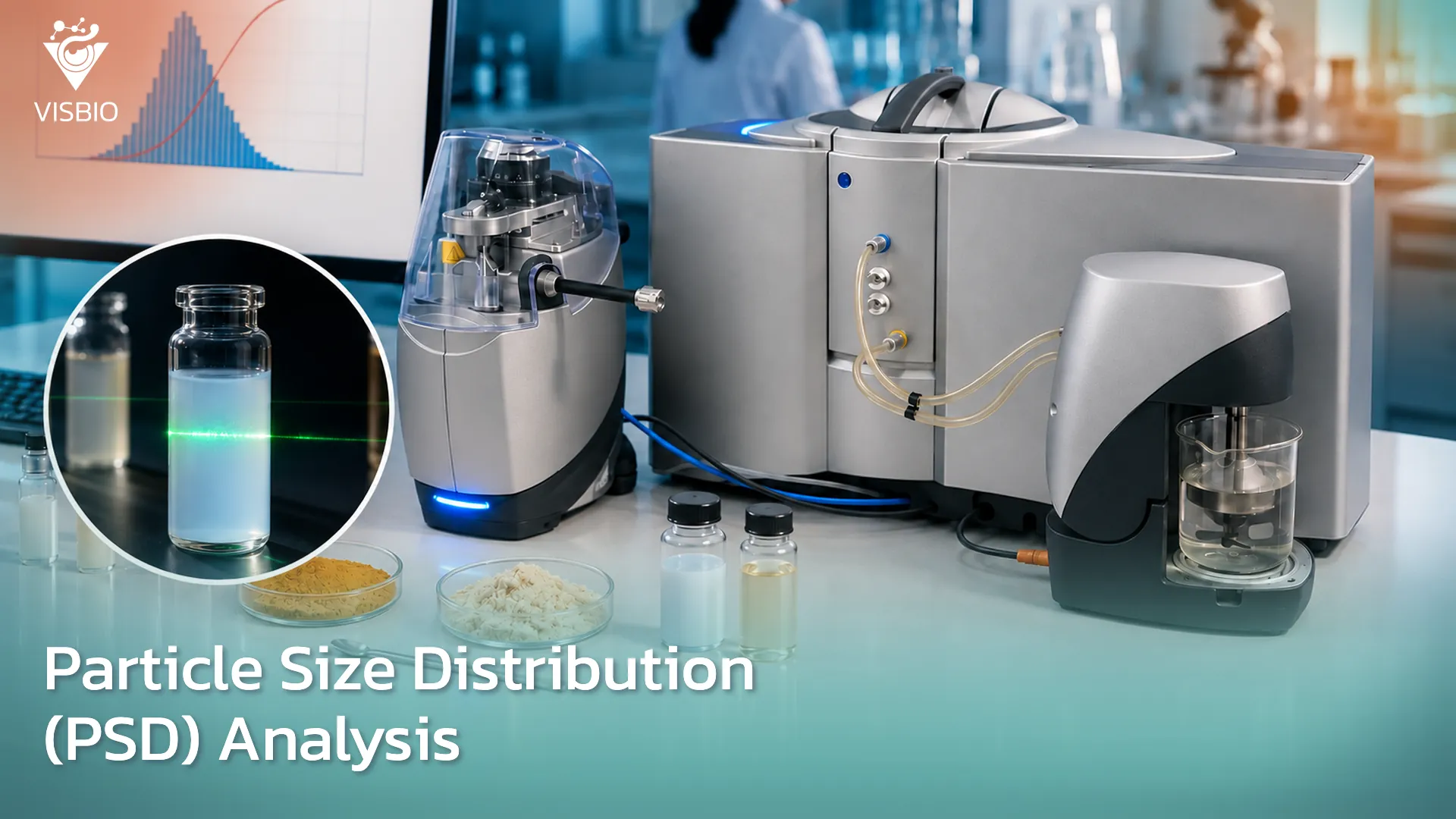
Particle size distribution (PSD) is information that shows what sizes of particles a sample contains and what proportion falls within each size range, rather than a single average size. The results therefore show whether the powder or emulsion system of each batch is the same, and whether particles aggregate or grow during storage.
In premium cosmetics and functional dietary supplements, particle size does not determine appearance alone. It is linked to a chain of other properties: the dissolution rate and release of bioactive compounds, the stability of emulsion systems throughout shelf life, the uniformity of dispersion in suspensions, the solubility of extract powders when prepared as drinks, and the commercial value of encapsulation systems.
A common problem for product development teams in Thailand is that the particle size of a laboratory prototype does not match that of the formula after scale-up to factory production. An extract powder that dispersed evenly in a trial batch clumps in a commercial batch; an emulsion prepared with a laboratory-scale homogenizer may have a different droplet size when made with production-line equipment; and liposome and nanoemulsion systems whose particle size changes after scale-up may have an encapsulation efficiency (%EE) that differs from the trial batch.
VISBIO Laboratory, in collaboration with partner laboratories, provides particle size distribution analysis using two techniques, laser diffraction and dynamic light scattering (DLS), covering herbal extract powders, powdered dietary supplements, emulsions, suspensions, liposomes, nanoemulsions and many types of active-ingredient delivery systems. The service can be used in formulation development, scale-up, batch release and monitoring during stability testing.
Why particle size distribution matters for formulation performance and shelf life
Particle size is a parameter that links several product properties together. In cosmetics, particle size affects skin feel, the clarity or haziness of the product and how evenly the active ingredient is distributed in the formula. How far an active ingredient penetrates the skin depends on many factors, including the type of substance, the composition of the formula and the condition of the skin, so it must be demonstrated by specific testing and cannot be judged from particle size alone. In dietary supplements, encapsulation systems are designed to protect active ingredients during storage and on their way through the digestive tract, and particle size is one of the factors that determine this behavior. Particle size data are therefore basic data for confirming the characteristics of the delivery system that a brand communicates, but they are not evidence of absorption in the body, which must be demonstrated by dedicated studies.
In terms of shelf life, a change in particle size over time signals that the formulation system is deteriorating. An increase in droplet size in an emulsion usually means coalescence of oil droplets, which leads to creaming and phase separation. An increase in particle size in a suspension means aggregation and sedimentation, which cause the active ingredient to collect at the bottom of the package. A change in the span value means the size distribution is becoming less uniform.
For encapsulation systems, which are a key selling point of cosmetics and dietary supplements, the size of liposomes or cyclodextrin inclusion complexes is a stability indicator used together with the %EE value that manufacturers use when communicating with business-to-business (B2B) buyers. For example, if liposomes measured at about 100 nanometers on day one grow to about 250 nanometers by month six, the particles have aggregated or fused, which often happens together with leakage of the encapsulated material, so %EE should be measured again to confirm. Otherwise, what the brand has communicated about its encapsulation system may no longer match the actual condition of the product.
From a regulatory perspective, for products in which particle size affects quality, particle size should be one of the items in the specification that manufacturers use to control quality in line with the law for each product type, such as the Cosmetic Act B.E. 2558 (2015) and the Herbal Products Act B.E. 2562 (2019). For export, the European Union’s cosmetics regulation has specific provisions for nanomaterials: in general, information including particle size must be notified before the product is placed on the market, and the word “nano” must appear in brackets after the ingredient name on the label (European Parliament & Council of the European Union, 2009).
Principles of particle size analysis with two main techniques
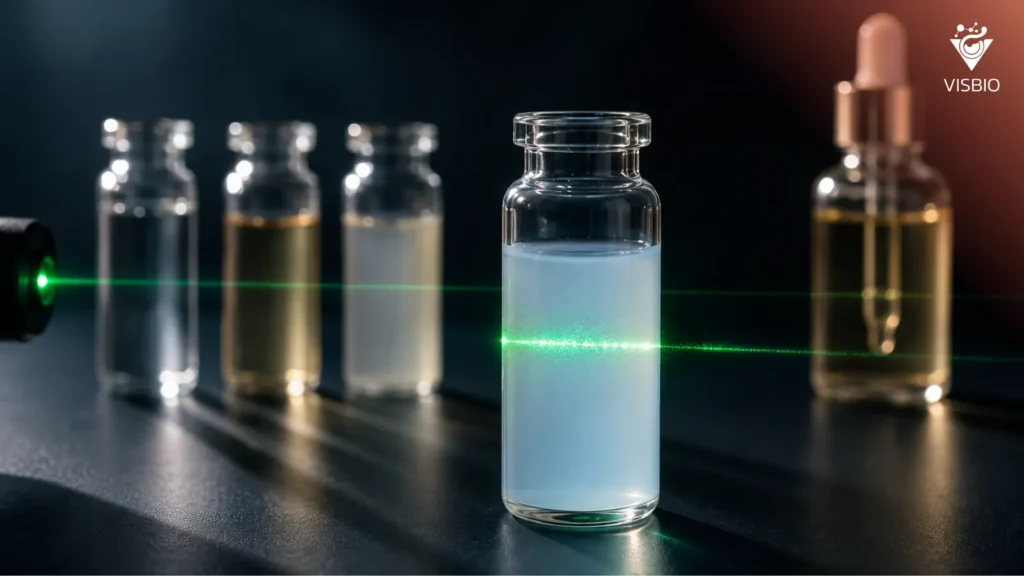
Particle size distribution analysis uses two main techniques that cover different size ranges. The first is laser diffraction, which measures the angular pattern of laser light diffracted as it passes through a group of particles, and then calculates the size distribution back from it using Mie theory for particles close in size to the wavelength of light, or the Fraunhofer approximation for large particles. Results are reported as a volume-weighted distribution, such as D10, D50 and D90, meaning the sizes below which 10%, 50% and 90% of the particle volume lie, and the span, calculated as (D90 − D10)/D50. This technique covers about 0.1 micrometers (µm) to 3 millimeters (International Organization for Standardization [ISO], 2020; United States Pharmacopeial Convention, 2023), so it suits extract powders, powdered dietary supplements, emulsions with large droplets, suspensions and powdered raw materials.
The second technique is dynamic light scattering (DLS), which measures the fluctuation over time in the intensity of scattered light caused by the Brownian motion of particles, and then uses the Stokes-Einstein equation to calculate the hydrodynamic diameter. Results are reported as the Z-average size together with the polydispersity index (PdI), covering about 1 nanometer to 5 micrometers (ISO, 2017). This technique is used for many nanoscale systems, from liposomes, nanoemulsions and polymeric nanoparticles to aggregated proteins and colloidal systems. The size range that can actually be measured with either technique depends on the instrument model.
Technically, the accuracy of the results depends on controlling three points. The first is choosing the refractive index and absorption coefficient that match the type of sample. The second is the dispersion protocol: ultrasonication for too long can break up agglomerates that really exist in the product or fracture the particles, so the result is smaller than the true state, whereas too little dispersion leaves agglomerates unseparated, so the result is larger than the size of the individual particles. The third is controlling the obscuration range for laser diffraction and the sample concentration for DLS.
Scope of VISBIO Laboratory's particle size distribution service
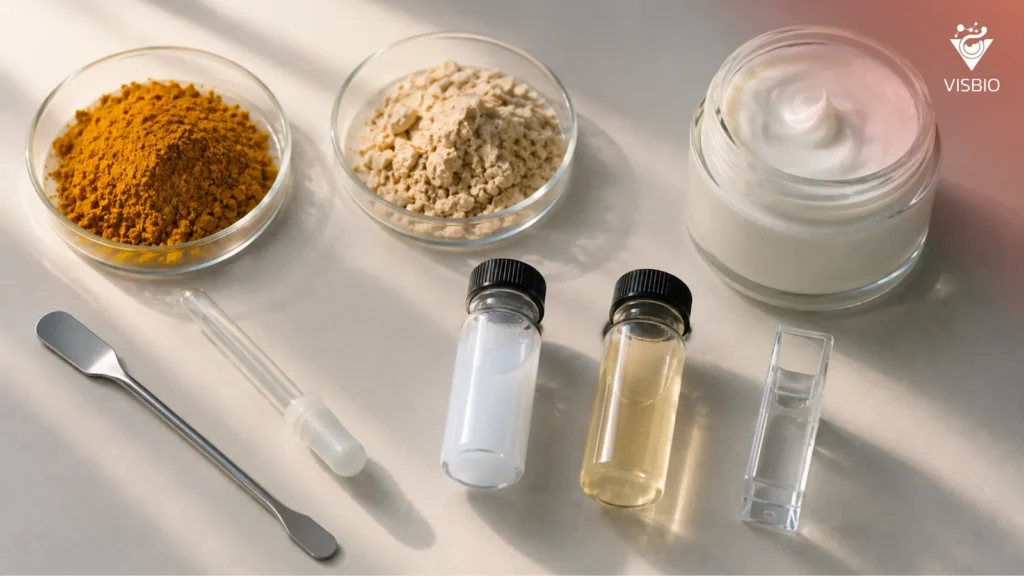
VISBIO Laboratory’s service, carried out in collaboration with partner laboratories, covers three groups of samples:
- Powders and dry materials: herbal extract powders, ready-to-use powdered extracts, premixes for instant drinks, powdered dietary supplements, spray-dried powders, freeze-dried powders and powdered active raw materials
- Emulsions and suspensions: creams, lotions, serums, water-in-oil and oil-in-water emulsions, and suspensions in liquid dietary supplements
- Nanoscale delivery systems: liposomes, niosomes, nanoemulsions, polymeric nanoparticles and solid lipid nanoparticles (SLN)
Using particle size distribution results
Particle size results can be used at several stages of a product’s life:
- Research and development: compare the performance of different mixers, compare different surfactant systems, and compare the size of liposomes prepared by different methods.
- Scale-up: compare the particle size of factory batches with trial batches to confirm that actual production conditions give the same result as in the laboratory.
- Commercial production: use as a batch-release criterion, especially for products that communicate about their delivery system, and combine with stability studies to confirm that particle size still meets the specification throughout shelf life.
- Export: attach to the Certificate of Analysis (COA), especially when exporting to markets with requirements for nanomaterials, such as the European Union.
Frequently asked questions about particle size
What is particle size distribution?
It is information that shows what sizes of particles a sample contains and what proportion falls within each size range, rather than a single average size. It can therefore be used to compare batches and to track particle aggregation during storage.
What is the difference between laser diffraction and DLS?
Laser diffraction measures the diffraction angle of laser light and covers about 0.1 micrometers to 3 millimeters, which suits powders, emulsions with large droplets and suspensions. DLS measures fluctuations in scattered light caused by Brownian motion and covers about 1 nanometer to 5 micrometers, which suits liposomes, nanoemulsions and other nanoscale systems.
What do D50, span, Z-average and PdI mean?
D50 is the size below which half of the particle volume lies. Span is the width of the size distribution, calculated as (D90 − D10)/D50. Both come from laser diffraction. Z-average is the average hydrodynamic size and PdI is the polydispersity index, both of which come from DLS.
What does a change in particle size during storage indicate?
An increase in droplet size in an emulsion usually means coalescence of oil droplets, which leads to phase separation. An increase in particle size in a suspension means aggregation and sedimentation. Liposomes that grow larger often do so together with leakage of the encapsulated material, so %EE should be measured again to confirm.
Do small or nano-sized particles mean that an active ingredient penetrates the skin or is absorbed better?
Not necessarily. Skin penetration depends on the type of substance, the composition of the formula and the condition of the skin, and absorption in the body must be demonstrated by dedicated studies. Particle size data confirm the characteristics and stability of a delivery system, but on their own they are not evidence of penetration or absorption.
What types of samples does VISBIO Laboratory accept for particle size analysis?
Three groups: powders and dry materials such as herbal extract powders and powdered dietary supplements; emulsions and suspensions such as creams, lotions and serums; and nanoscale delivery systems such as liposomes, nanoemulsions and solid lipid nanoparticles.
References:
- European Parliament & Council of the European Union. (2009). Regulation (EC) No 1223/2009 of the European Parliament and of the Council of 30 November 2009 on cosmetic products (recast). Official Journal of the European Union, L 342, 59–209. https://eur-lex.europa.eu/eli/reg/2009/1223/oj
- International Organization for Standardization. (2017). Particle size analysis — Dynamic light scattering (DLS) (ISO 22412:2017). ISO.
- International Organization for Standardization. (2020). Particle size analysis — Laser diffraction methods (ISO 13320:2020). ISO.
- United States Pharmacopeial Convention. (2023). Light diffraction measurement of particle size (USP <429>). USP.
- Royal Thai Government Gazette. (2015, September 8). Cosmetic Act B.E. 2558 (2015). Royal Thai Government Gazette, 132(86 Kor), 1–22.
- Royal Thai Government Gazette. (2019, April 30). Herbal Products Act B.E. 2562 (2019). Royal Thai Government Gazette, 136(56 Kor), 116–161.