

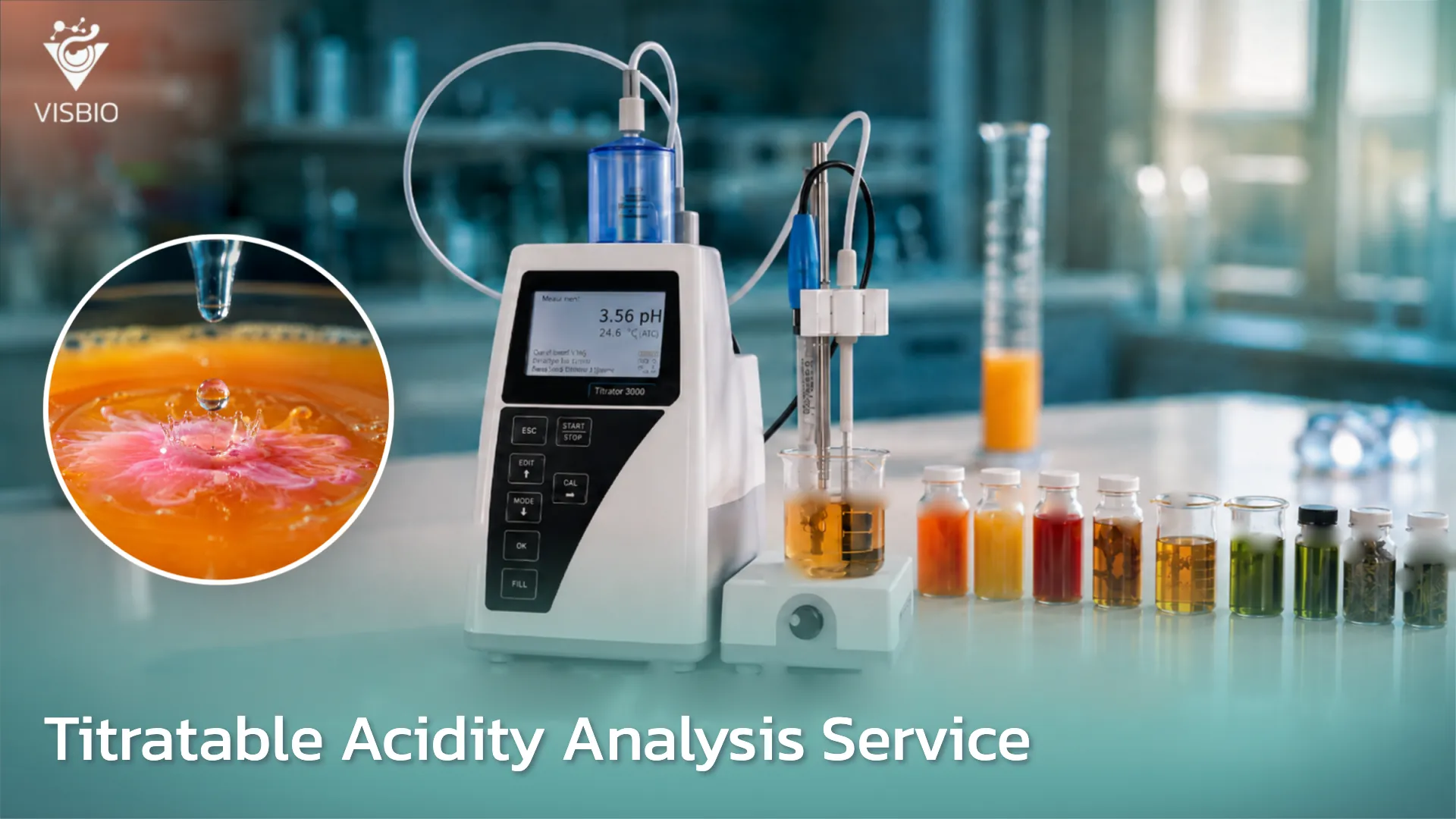
Titratable acidity is the total amount of acid in a sample that can react with a standard base during titration, including both dissociated and undissociated acid. It is usually reported as a percentage of the predominant acid in the sample, such as citric acid in fruit juice or lactic acid in fermented dairy products. This value differs from pH, which indicates only the concentration of free hydrogen ions in a solution.
For functional drinks, fruit juices, fermented products and herbal extracts, titratable acidity affects taste, the stability of the formulation, the performance of the antimicrobial protection system and shelf life. Keeping this value consistent from batch to batch is difficult, because the main raw materials, such as fresh fruit and herbs, contain amounts of acid that vary with season, growing area and storage conditions.
pH and titratable acidity are related but are not the same value. In beverages and fruit juices, titratable acidity usually reflects the sourness that consumers perceive better than pH does, because perceived sourness is related to the total amount of acid, not only to free hydrogen ions. Two products with similar pH values but different acidity may therefore taste noticeably different in sourness.
VISBIO Laboratory offers titratable acidity measurement by titration, in collaboration with partner laboratories, for beverages, fruit juices, fermented products, herbal syrups and liquid herbal extracts.
Why titratable acidity determines the taste and shelf life of beverages
In functional drink formulation, acidity determines the sourness and freshness (tartness) that consumers perceive. A small change in acidity, for example 0.1–0.2%, may shift the taste from “too sweet” to “refreshing and balanced”, or from “pleasantly sour” to “too sour to drink”. Successful beverage formulas therefore often go through several rounds of acidity adjustment to match consumer expectations in the target market. For fruit juices, manufacturers also commonly use the ratio of Brix to acidity (Brix/acid ratio) as an indicator of the balance between sweetness and sourness.
Acidity is also linked to a beverage’s antimicrobial protection system. Weak-acid preservatives such as sorbic acid and sodium benzoate act in their undissociated form, so their effectiveness depends mainly on pH, and they work well in beverages with a pH below about 4.5. The type and amount of acid in the formula, which titratable acidity reflects, affect the formula’s ability to keep its pH stable (buffer capacity), and some organic acids, such as lactic acid and acetic acid, also inhibit microorganisms themselves. Measuring acidity together with pH therefore gives a more complete picture of the antimicrobial protection system than measuring either value alone.
In fermented products such as kombucha, kefir, drinking yogurt and fermented herbal drinks, acidity indicates the fermentation level, which manufacturers use to decide when to end fermentation. If fermentation continues after bottling, acidity rises until the product becomes too sour for consumers to accept. Tracking acidity during shelf life therefore helps confirm the quality and consistency of bottled fermented products.
From a regulatory perspective, beverages and fruit juices fall under the Food Act B.E. 2522 (1979), while herbal liquid medicines and herbal syrups fall under the Herbal Products Act B.E. 2562 (2019). Titratable acidity is quality data that the manufacturer sets in the product specification, and the standards for some foods also set acidity limits, so manufacturers should check the Ministry of Public Health notifications that apply to their products. For beverages classified as acidified foods, the criterion used to prevent the growth of pathogens such as Clostridium botulinum is an equilibrium pH of no more than 4.6. Titratable acidity is therefore not used in place of pH; it is used alongside it to track the amount of acid added and the consistency of the process. In herbal liquid medicines and herbal syrups, manufacturers can likewise use titratable acidity as batch-to-batch quality control data when this value is set in the product specification.

Principles of titratable acidity measurement
Titration is the stepwise addition of a standard base solution of accurately known concentration, such as sodium hydroxide (NaOH), to a sample until all the acid in the sample has reacted with the base. The volume of base used is then converted back into the amount of acid in the sample (AOAC International, 2005). The end point can be found in two ways. The first uses an indicator such as phenolphthalein, which changes from colorless to pink at about pH 8.2–10.0 and suits colorless or lightly colored beverages and fruit juices. The second is potentiometric titration, which uses a pH electrode to follow the pH during titration and continues to the pH set by the standard method, for example pH 8.1 when the result is reported as citric acid (International Fruit and Vegetable Juice Association, 2017). This method suits dark samples, such as red fruit juices and herbal extracts, where the sample’s color masks the indicator’s color change. Fermented milks and yogurt also have their own standard potentiometric method (International Organization for Standardization, 2012).
The main challenge of the measurement is correctly identifying the predominant acid in the sample, because the result has to be calculated with the equivalent weight of that acid. Most fruit juices have citric acid as the predominant acid (equivalent weight 64.04), fermented dairy products use lactic acid (90.08), vinegar products use acetic acid (60.05), and some herbal extracts have tartaric acid or malic acid as the predominant acid; tamarind, for example, contains mainly tartaric acid. Using the equivalent weight of the wrong acid can cause errors of up to around 30–50%. For example, if a sample whose predominant acid is lactic acid is calculated with the equivalent weight of citric acid, the result will be around 30% lower than the true value. Clients should therefore state the predominant acid, or the acid they want the result reported as, before testing.
Carbonated beverages must be degassed to remove carbon dioxide before titration, because the dissolved carbonic acid would otherwise be titrated as well and make the result higher than the acidity of the formula.
Scope of VISBIO Laboratory's acidity measurement service
VISBIO Laboratory’s titratable acidity service, carried out in collaboration with partner laboratories, covers several sample groups:
- Fruit juices and fruit drinks: orange juice, lime juice, pineapple juice, mango juice, grape juice, butterfly pea flower drink, fruit juices blended with herbs and ready-to-drink fruit beverages
- Functional drinks: beverages fortified with bioactive compounds, cold-brew teas, herbal drinks, carbonated drinks and drinks with added probiotics
- Fermented products: drinking yogurt, kombucha, kefir, cultured milk drinks, fermented herbal drinks, pickled vegetables and fermented soybean products
- Herbal extracts and syrups: herbal syrups, herbal medicinal syrups, liquid herbal extracts and honey blended with herbs
Results are reported as a percentage of the predominant acid stated by the client or agreed before testing. The service covers both single measurements for batch release and repeated measurements during stability studies.

Using acidity results
Acidity results are useful at several stages of a product’s life. In research and development, they are used to balance the taste of beverages and fruit juices, to test the effect of changing a main raw material, such as fresh lime juice, lime juice concentrate or powdered citric acid, and to support the choice of a preservative system that suits the pH and acid type of the formula. When selecting raw material suppliers, they are used to check the seasonal consistency of raw materials, especially fresh fruit, whose acid content changes with the harvest period.
Before launch (pre-launch), acidity serves as the baseline for the specification and is used to set acceptable deviation limits. In commercial production, it serves as a batch release criterion that reflects the taste consumers will actually experience. In stability studies, it is used to track changes in acidity throughout shelf life. Rising acidity in a fermented product shows that fermentation is continuing after bottling, while falling acidity in a beverage may signal that certain organic acids, such as ascorbic acid (vitamin C), are breaking down under heat or light.
For export, the results can be attached to the certificate of analysis (COA) to support inspections by business-to-business (B2B) buyers in markets where acidity is specified in trade agreements.
Frequently asked questions about titratable acidity
What is titratable acidity?
Titratable acidity is the total amount of acid in a sample that can react with a standard base during titration, including both dissociated and undissociated acid. It is usually reported as a percentage of the predominant acid, such as citric acid or lactic acid.
How does titratable acidity differ from pH?
pH indicates only the concentration of free hydrogen ions, whereas titratable acidity indicates the total amount of acid. Products with similar pH values can therefore differ noticeably in acidity and sourness.
Why should I state the type of acid before sending samples?
The result has to be calculated with the equivalent weight of the predominant acid in the sample. Using the equivalent weight of the wrong acid can cause errors of up to around 30–50%. Most fruit juices use citric acid, fermented dairy products use lactic acid and vinegar uses acetic acid.
Can the acidity of dark samples be measured?
Yes, by potentiometric titration, which uses a pH electrode to find the end point instead of watching the indicator’s color. It therefore suits red fruit juices and herbal extracts whose color masks the color change of phenolphthalein.
How should carbonated beverages be prepared?
Carbon dioxide must be removed before titration, because the dissolved carbonic acid would otherwise be titrated as well and make the result higher than the acidity of the formula.
How does acidity help monitor fermented products?
Acidity indicates the fermentation level. If it rises during storage, fermentation is continuing after bottling and the product will become too sour. Manufacturers therefore use this value both to decide when to end fermentation and to monitor quality throughout shelf life.
References:
- AOAC International. (2005). AOAC Official Method 942.15: Acidity (titratable) of fruit products. In Official methods of analysis of AOAC International (18th ed.). AOAC International.
- International Fruit and Vegetable Juice Association. (2017). Titratable acidity (IFU Method No. 3, Rev. 2017). IFU.
- International Organization for Standardization. (2012). Fermented milks — Determination of titratable acidity — Potentiometric method (ISO/TS 11869:2012 | IDF/RM 150:2012). ISO.
- Royal Thai Government Gazette. (1979, May 13). Food Act B.E. 2522 (1979). Royal Thai Government Gazette, 96(79 Kor), 1–24.
- Royal Thai Government Gazette. (2019, April 30). Herbal Products Act B.E. 2562 (2019). Royal Thai Government Gazette, 136(56 Kor), 116–161.