

Total Flavonoid Content (TFC) Testing Service
VISBIO Co., Ltd. provides total flavonoid content testing for a wide range of products, including food and beverages, and health and beauty products such as herbal products, dietary supplements and cosmetics. We also test the total flavonoid content of herbal raw materials, vegetables and fruits.
About Flavonoids and Their Sources
Flavonoids are common in foods, especially plant foods such as vegetables, fruits, cereals, legumes, spices and herbs, including stems, branches, flowers and seeds, as well as some beverages such as tea, cocoa, beer and wine. More than 4,000 flavonoids occur in nature, mostly as glycosides. Flavonoids are natural secondary metabolites in the polyphenol group. They are important plant pigments and help filter ultraviolet radiation and support nitrogen fixation.
Classification of Flavonoids
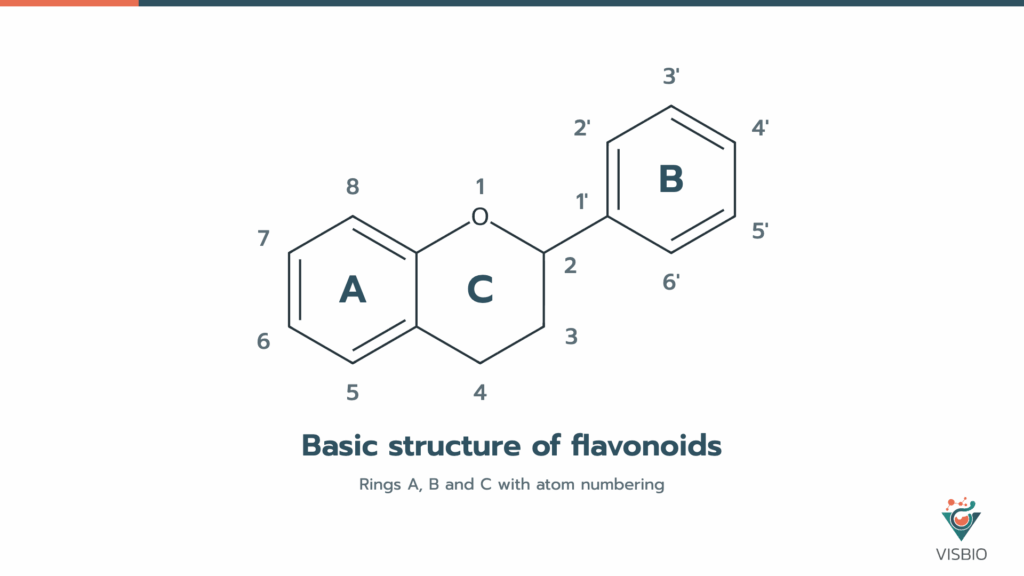
Flavonoids are widespread in vegetables and fruits. Their basic structure is a phenyl benzopyrone, as shown in the figure, and they are divided into seven groups:
- Flavonols, such as quercetin, which is abundant in apples, tea, onions, Chinese kale and cabbage, and is associated with improved blood circulation and anti-inflammatory activity
- Flavones, such as luteolin and apigenin, found in many vegetables and fruits such as onions and apples, which have shown antiproliferative activity against several types of cancer cells
- Flavanones, such as hesperetin, naringenin and eriodictyol
- Flavanols, such as catechin, gallocatechin and epicatechin (found in green tea), epigallocatechin, epicatechin-3-gallate and epigallocatechin-3-gallate (EGCG)
- Flavanonols, such as taxifolin
- Isoflavones, such as daidzein, genistein, glycitein and formononetin
- Anthocyanidins, such as cyanidin, delphinidin, malvidin, pelargonidin, peonidin and petunidin
Benefits and Applications of Flavonoids
Health
Flavonoids are antioxidants found in the water-soluble pigments of vegetables, fruits, cereal grains, leaves and bark. Studies have found that some flavonoids have up to 50 times the antioxidant capacity of vitamin C or vitamin E, and that flavonoids in red grapes can inhibit the oxidation of LDL.
Natural colorants
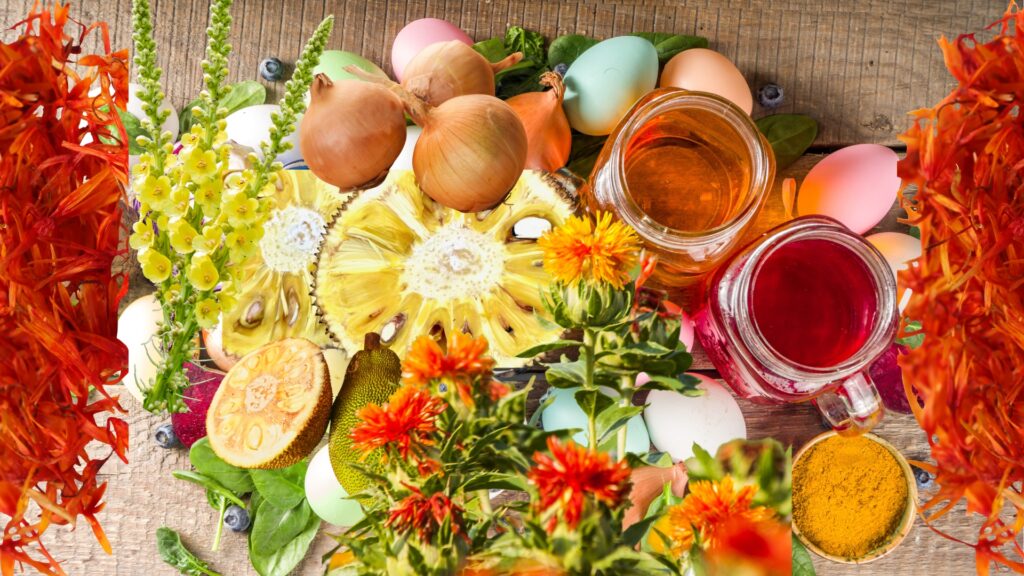
Flavonoids are a source of natural dyes, mostly yellow, orange or reddish orange. Examples include luteolin from weld (Reseda luteola), which gives a yellow color; quercetin from onion skins and morin from jackfruit heartwood, which give a deep yellow; and safflower pigments such as carthamin, which give yellowish-brown to red shades. These colors can be developed into food and cosmetic products.
Medicine
Flavonoids have been investigated in clinical studies as potential anticancer agents. Some inhibit cell growth and induce cancer cell death with less effect on normal cells, and may inhibit processes involved in cancer progression, such as inflammation and the formation of new blood vessels.
Cosmetics
Studies have found that some flavonoids, such as rutin and catechin, inhibit matrix metalloproteinase (MMP) enzymes, and that many flavonoids, such as catechin, quercetin, apigenin and hesperetin, inhibit tyrosinase and have antioxidant activity. Flavonoids are therefore used to develop cosmetics that help reduce the appearance of wrinkles and dark spots and support a brighter complexion.
Methods for Analyzing Flavonoid Content
- Quantifying specific flavonoids Analyzed by HPLC , UV-visible spectrophotometry, and detection with a photodiode array (PDA) or mass spectrometer (MS). Because plant flavonoids usually occur as O-glycosides bound to sugars, only the aglycone part is analyzed, so the sugars are first removed from the molecule by acid hydrolysis, usually with hydrochloric acid.
- Total flavonoid content (TFC) analysis by thealuminum chloride colorimetric method , the most widely used aluminum complexation method for determining total flavonoid content. It is based on the formation of an aluminum–flavonoid complex.
The Al–flavonoid complexation reaction is based on aluminum ions binding to the o-dihydroxyl groups (3′,4′-OH) in ring B and other o-dihydroxyl groups in the flavonoid molecule, which work together to strengthen the binding of aluminum ions.
Example of a Total Flavonoid Content Report
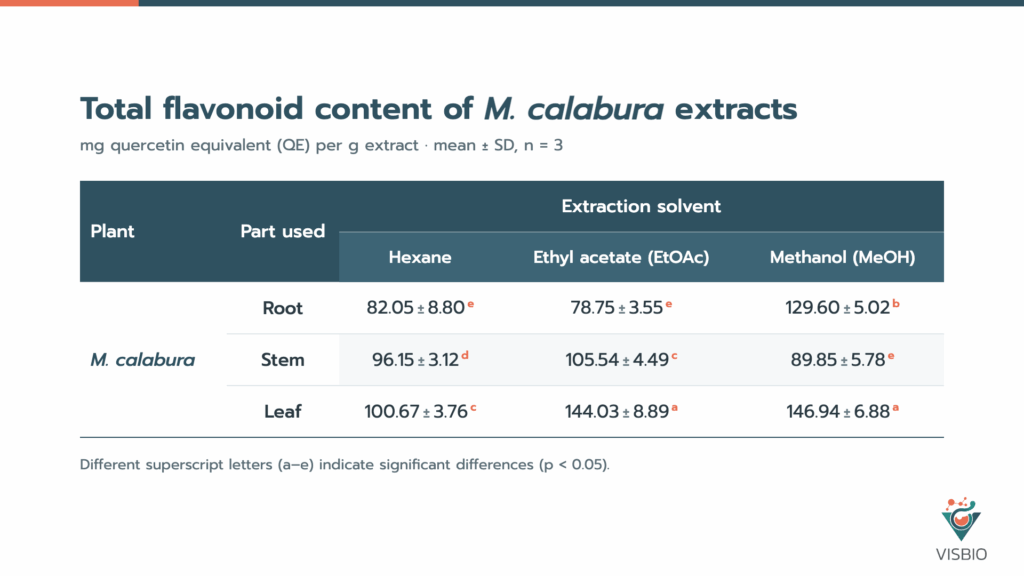
Total flavonoid content of Jamaican cherry extracts (M.calabura) from the roots, stems and leaves, extracted with hexane, ethyl acetate (EtOAc) and methanol (MeOH). Total flavonoid content was determined by the AlCl3 colorimetric assay against a quercetin reference standard. The methanol (MeOH) extract of the leaves had the highest total flavonoid content, as shown in the figure.
Literature:
- สุนันทา ข้องสาย และ ลักษมี วิทยา, 2562, สารประกอบฟีนอลิก สารประกอบฟลาโวนอยด์ และฤทธิ์ต้านอนุมูล อิสระของสารสกัดจากเสม็ดขาวและเสม็ดแดง, คณะวิทยาศาสตร์และเทคโนโลยีการประมง มหาวิทยาลัยเทคโนโลยีราชมงคลศรีวิชัย. (in Thai)
- ลือชัย บุตคุป, 2011, สารประกอบฟีโนลิกและฤทธิ์ทางชีวภาพ, J Sci Technol MSU, Vol 31, No 4, 444-455. (in Thai)
- อรรถพล พันธุ์งาม ,สุรพงศ์ รัตนะและ บรรลือ สังข์ทอง, ฤทธิ์ต้านอนุมลูอิสระ ปริมาณฟีนอลิก และฟลาโวนอยด์ในสารสกัดตะขบฝรั่ง, การประชุมวิชาการ มหาวิทยาลัยมหาสารคามวิจัย ครั้งที่ 13, 563-570. (in Thai)
- รัญชนา ชิตามระ, 2562, การหาปริมาณฟลาโวนอยด์และการทดสอบฤทธิ์ยบั ยงั้การท างานของเอนไซม์คอลลาจีเนส เอนไซม์อีลาสเตสและเอนไซม์ไทโรซิเนสของสารสกัดจากกลีบดอกและเกสรของบัวสายสีเหลือง, บัณฑิตวิทยาลัย มหาวิทยาลัยศรีนครินทรวิโรฒ. (in Thai)