

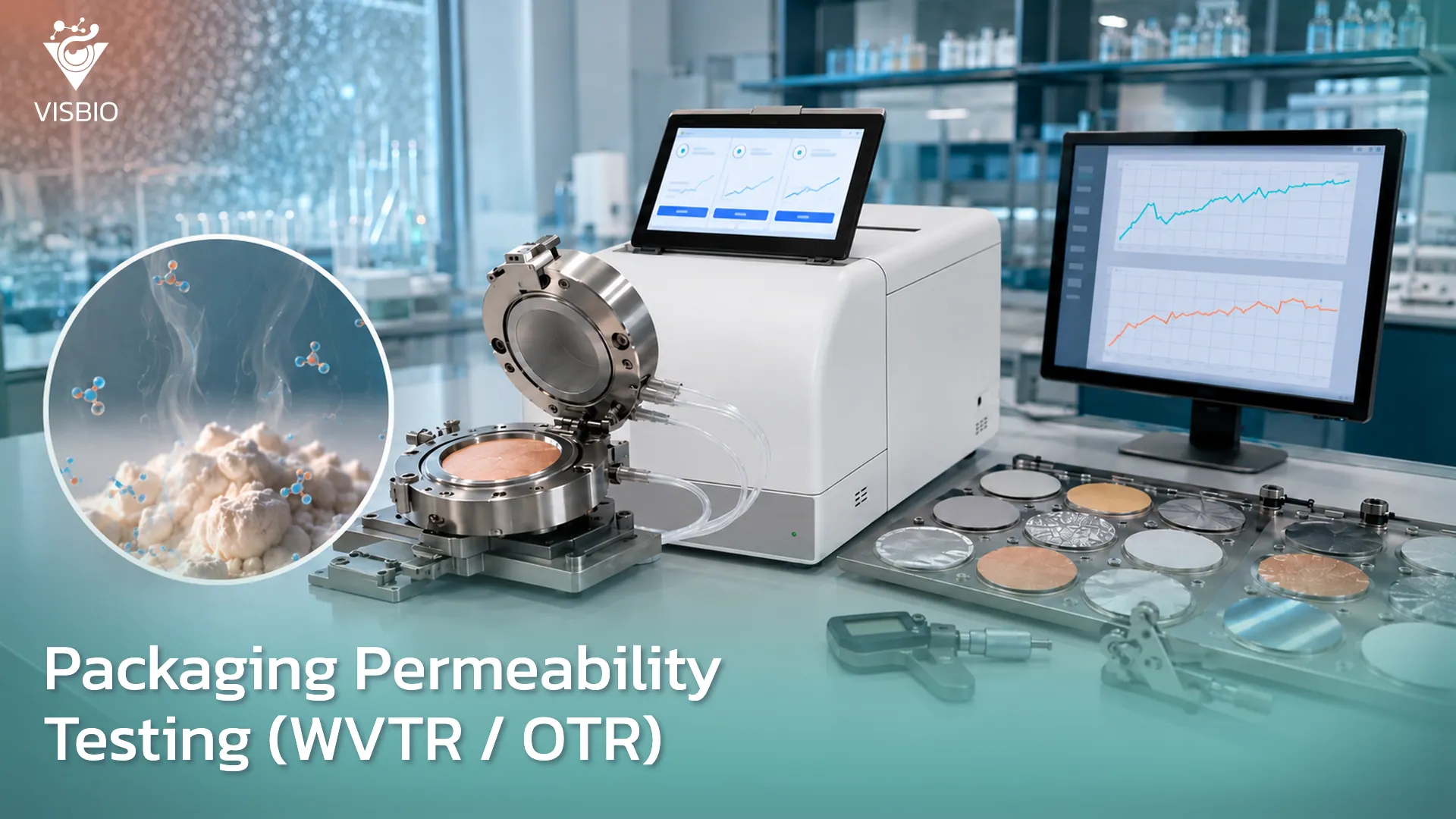
WVTR (water vapor transmission rate) is the rate at which water vapor passes through a packaging material, per square meter per day. OTR (oxygen transmission rate) is the rate at which oxygen gas passes through a material in the same way. Low values mean the material is a good barrier to water vapor or oxygen, so manufacturers use both values to choose packaging materials that suit the product and the shelf life required.
For food, cosmetics and dietary supplements, the shelf life stated on the label depends not only on the preservative system in the formula but also on how well the packaging keeps out moisture and oxygen from outside. Moisture that gets into powdered products can cause caking, speed up the degradation of moisture-sensitive vitamins and create conditions in which microorganisms can grow. Oxygen that gets into products containing oils, vitamin C, vitamin A and polyphenols causes oxidation and a loss of quality. Permeability testing therefore helps assess whether the chosen packaging suits the shelf life to be stated on the label.
This article summarizes what brand owners, quality assurance (QA) teams and packaging development teams should know before ordering tests: the principles of WVTR and OTR, the test methods and conditions, the link to setting shelf life, the product groups that should be tested, and the scope of the service that VISBIO Laboratory provides in collaboration with partner laboratories.
Principles of water vapor transmission rate (WVTR)
WVTR is the rate at which water vapor passes through a packaging material, expressed in grams per square meter per day (g/m²/day). The measured value changes with temperature and relative humidity, so it must always be reported together with the test conditions. There are 2 main measurement methods:
- Cup method (gravimetric): a cup containing water or a desiccant is sealed with the material sample, and the cup is weighed at intervals to find the rate at which water vapor passes through the material (ASTM International, 2024)
- Humidity sensor method: the material sample is placed as a barrier between two chambers at different humidities, and a sensor measures the rate at which the humidity rises in the drier chamber (ASTM International, 2013)
WVTR testing of food and cosmetic packaging is often carried out at 38 °C and 90% relative humidity, known as tropical conditions, to simulate storage in a hot, humid climate.
A low WVTR means the material is a good barrier to water vapor. Materials for highly moisture-sensitive products, such as powdered drink supplements, powdered herbal extracts and dried foods, should therefore have a low WVTR. For example, some developers aim for below about 1 g/m²/day, which generally requires a multilayer material with an aluminum foil barrier layer. The right target for each product depends on that product’s sensitivity to moisture and the shelf life required.
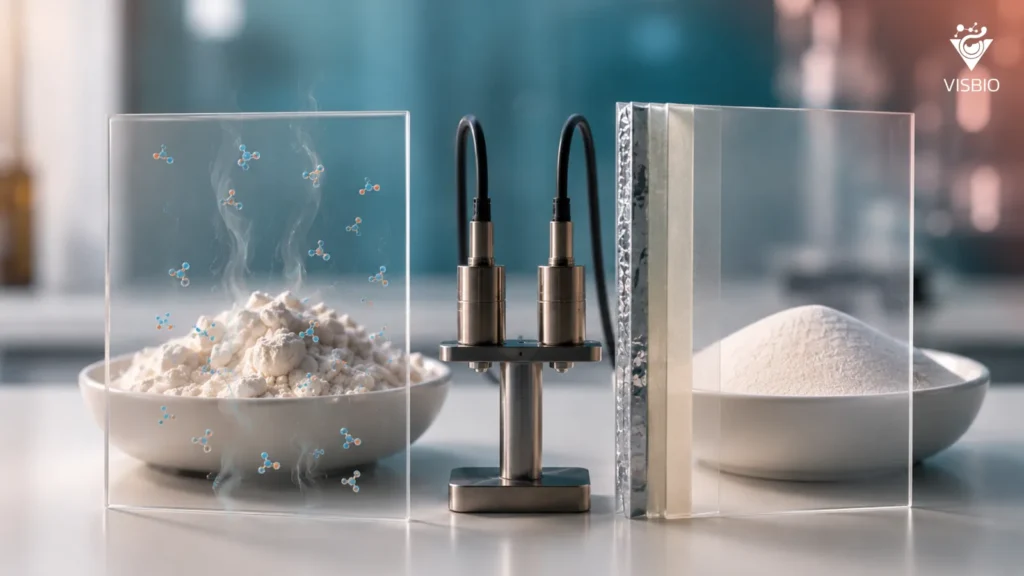
Principles of oxygen transmission rate (OTR)
OTR is the rate at which oxygen gas passes through a packaging material at a set temperature and humidity, expressed in cubic centimeters per square meter per day (cm³/m²/day or cc/m²/day). The widely used method relies on a coulometric sensor: one side of the material sample is exposed to oxygen, while a steady flow of nitrogen gas on the other side carries the oxygen that passes through the material to the sensor (ASTM International, 2017).
OTR testing of food and cosmetic packaging is often carried out at 23 °C and 0% or 50% relative humidity, depending on the type of material, because some gas barrier materials, such as ethylene vinyl alcohol (EVOH), become poorer oxygen barriers at high humidity.
Packaging for oxidation-sensitive products, such as oils and fats containing unsaturated fatty acids, and products containing vitamin C, vitamin A, vitamin E and polyphenol antioxidants, should therefore have a low OTR. For example, some developers aim for below about 1 cm³/m²/day, which often requires a multilayer material with a gas barrier layer such as EVOH or aluminum foil.
How WVTR and OTR relate to shelf life
Commercially, WVTR and OTR values are used to make an early estimate of a product’s shelf life before a full real-time stability test begins. Shelf life prediction uses equations that link the transmission rate to the product’s acceptance criteria. For example, if a powder has an initial moisture content of 4% and starts to cake when its moisture reaches 8%, known as the critical moisture content, it is possible to calculate how long the moisture in the packaged powder will take to reach that point.
This calculation needs several other pieces of data, such as the WVTR at the actual storage condition, the surface area of the package, the product weight and the relationship between the product’s moisture content and the relative humidity of the surrounding air, known as the moisture sorption isotherm. The result is therefore an estimate that must be confirmed with stability testing.
When WVTR and OTR values are used together with real-time stability testing and accelerated stability testing, the two sets of data complement each other. Stability testing confirms that the product keeps its quality in the target packaging, while WVTR and OTR explain the mechanism by which the packaging protects it, and serve as a benchmark when lower-cost alternative materials are considered.
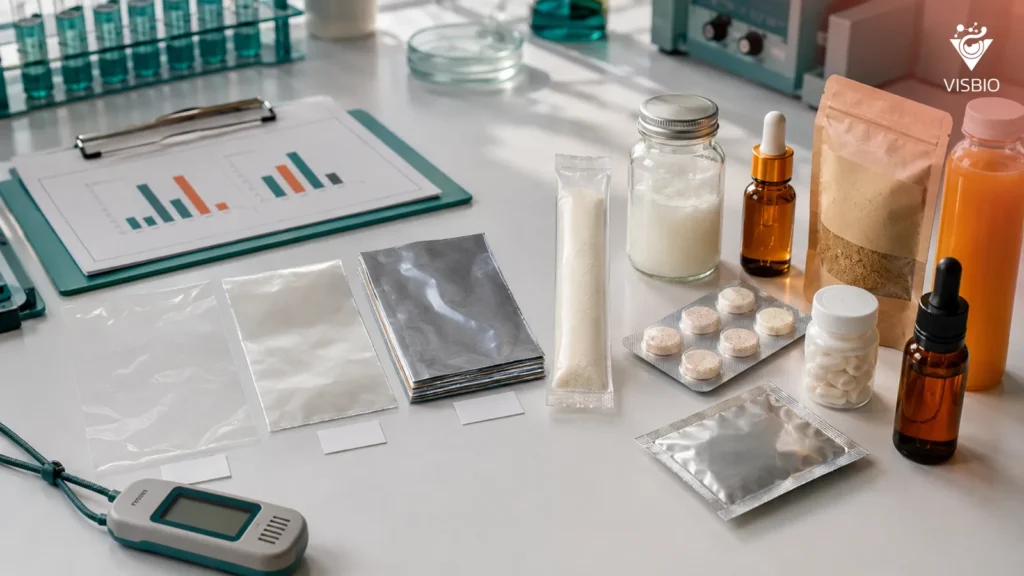
Which products should be tested for WVTR and OTR?
- Moisture-sensitive products: powdered drink mixes, dried foods, powdered herbal extracts, collagen powders, protein powders, moisture-sensitive vitamins such as vitamin C in the form of sodium ascorbate, products that use encapsulation, lozenges, and effervescent tablets, which release gas on contact with water
- Oxidation-sensitive products: products containing unsaturated fatty acids, such as rice bran oil, sesame oil, argan oil and omega-3 oils; vitamin C serums containing L-ascorbic acid; products containing retinol and retinyl esters; products that state a polyphenol content, such as resveratrol and curcumin; and cold-pressed juices and herbal drinks that have not been through high-heat treatment
- Products sensitive to both moisture and oxygen: powdered probiotics, since many strains survive best in dry, low-oxygen conditions; enzyme products that degrade from moisture and oxygen together; and other functional foods containing live microorganisms
VISBIO Laboratory's WVTR and OTR testing services
VISBIO Laboratory provides water vapor transmission rate (WVTR) and oxygen transmission rate (OTR) testing of both material sheets and whole packages, in collaboration with partner laboratories. The team handles the work from start to finish, as follows:
- Test plan: choose test methods and conditions to suit the characteristics of the product, its storage conditions and the target market
- Sample preparation: cut and prepare material sheet samples, or prepare whole packages, then condition the samples (sample conditioning) at the set temperature and humidity
- Testing and recording: test in a laboratory whose documentation system provides traceability, and calculate the transmission rate once permeation has reached a steady state
- Reporting: report the WVTR and OTR values with the test conditions, and a preliminary shelf life estimate from the WVTR value when the client provides the product’s critical moisture content
The report can be used as supporting information for setting the shelf life to be stated on the label, for preparing to open export markets, and for communicating with trading houses and key accounts overseas.
Frequently asked questions about WVTR and OTR
What is WVTR?
WVTR (water vapor transmission rate) is the rate at which water vapor passes through a packaging material, expressed in grams per square meter per day. The lower the value, the better the material keeps out moisture, and the value must be reported together with the temperature and relative humidity used in the test.
What is OTR, and how is it measured?
OTR (oxygen transmission rate) is the rate at which oxygen gas passes through a packaging material, expressed in cubic centimeters per square meter per day. The widely used method relies on a coulometric sensor to measure the oxygen that passes through the material, with nitrogen gas carrying the oxygen to the sensor.
Why must WVTR be reported together with temperature and humidity?
Because the water vapor transmission rate changes with temperature and relative humidity, values measured under different conditions cannot be compared directly. A condition often used for food and cosmetic packaging is 38 °C and 90% relative humidity, which simulates a hot, humid climate.
How do WVTR and OTR help set the shelf life?
WVTR and OTR values are used to make an early estimate of shelf life, for example by calculating when the moisture in a powder will rise from its initial value to the critical moisture content. The calculation needs other data as well, such as the surface area of the package, the product weight and the moisture sorption isotherm. The result is an estimate that must be confirmed with stability testing.
Which products should use packaging with a low WVTR and OTR?
Moisture-sensitive products, such as powdered drink mixes, collagen powders and effervescent tablets, should use materials with a low WVTR, such as multilayer materials with aluminum foil. Oxidation-sensitive products, such as oils containing unsaturated fatty acids, vitamin C serums and retinol products, should use materials with a low OTR, such as multilayer materials with an EVOH layer or aluminum foil.
References:
- ASTM International. (2013). Standard test method for water vapor transmission rate of sheet materials using dynamic relative humidity measurement (ASTM E398-13).
- ASTM International. (2017). Standard test method for oxygen gas transmission rate through plastic film and sheeting using a coulometric sensor (ASTM D3985-17).
- ASTM International. (2024). Standard test methods for gravimetric determination of water vapor transmission rate of materials (ASTM E96/E96M-24).