


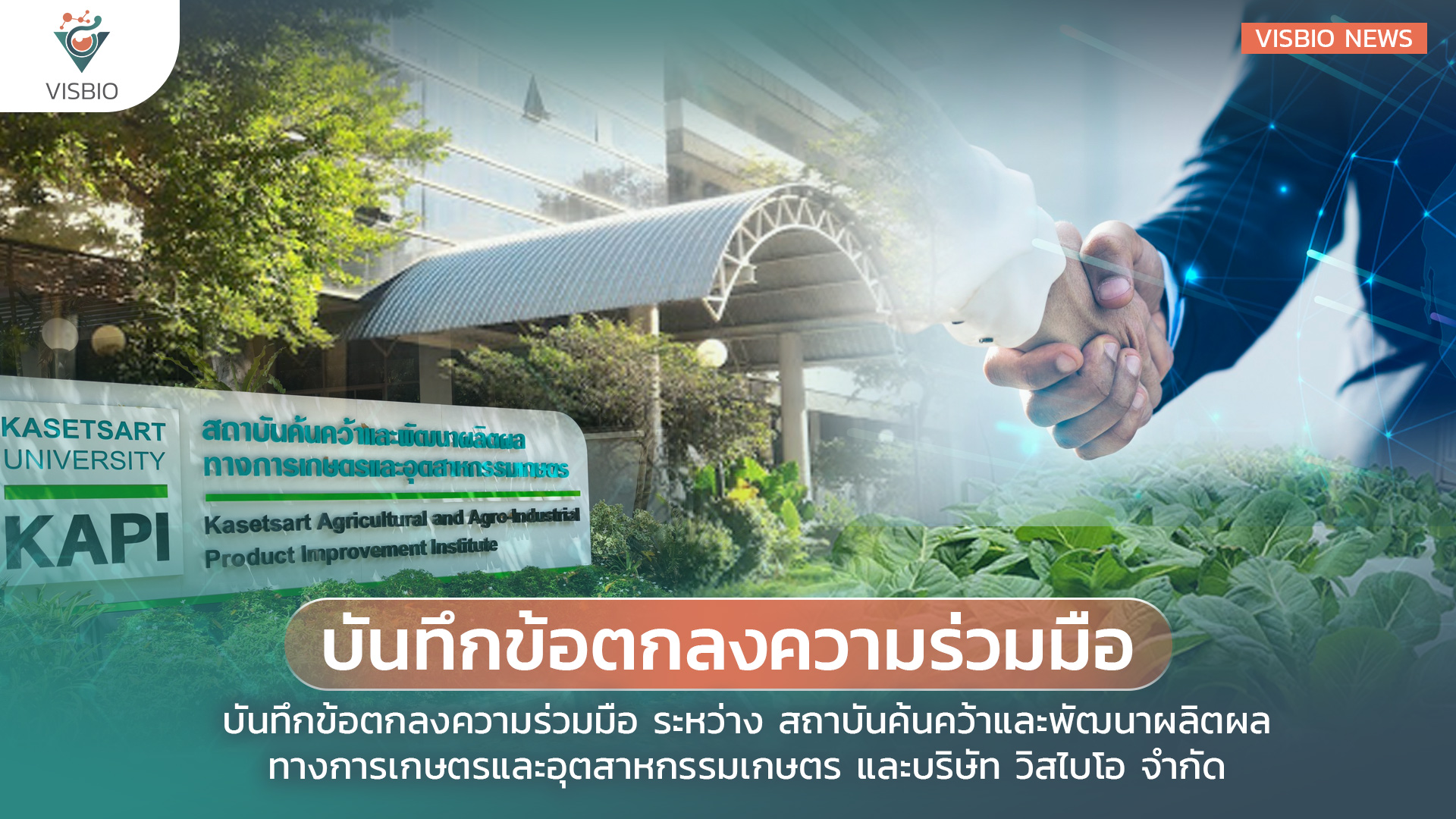
VISBIO Partners with the Kasetsart Agricultural and Agro-Industrial Product Improvement Institute (KAPI), Kasetsart University,
to Advance Extraction and Scientific Testing for the Health and Beauty Industry
Launching a Partnership to Raise Standards in Extraction and Testing
VISBIO Co., Ltd. has signed a Memorandum of Understanding (MOU) with the Kasetsart Agricultural and Agro-Industrial Product Improvement Institute (KAPI), Kasetsart University, to establish a joint framework for study, research and development that links concretely to services and industrial applications. The partnership aims to create a “systematic mechanism” that moves scientific knowledge from the laboratory into real-world use more quickly, with verifiable supporting evidence at every step.
Shared Mission: Turning Knowledge into Market Value
At the core of the partnership between VISBIO and KAPI is promoting, supporting and jointly conducting research on key topics for the health and beauty industry, from extraction, efficacy testing and analysis to other applications, in order to add value to Thai raw materials and products, including processed herbal raw materials, active ingredients, cosmetics, dietary supplements and herbal products, as well as related services. This approach helps businesses develop scientifically credible products and strengthen their competitiveness in markets that increasingly value standards and empirical data.
A Focus on Extraction and Testing That Connects R&D with Product Development
Today’s health and beauty industry competes not only on “concepts” but on “evidence” and on the reproducibility of results. The partnership is therefore designed to cover the key processes that make products credible: quality-controlled extraction, demonstrating efficacy through appropriate testing, qualitative and quantitative analysis, and reporting results that can serve as a data foundation for formulation development, confirming the properties of active ingredients and scientific communication in support of commercial product development.
KAPI Strengthens Research and Testing Under the Partnership
Under the partnership framework, KAPI supports study, research and development and helps drive the testing process on the institute’s side, including joint planning of product-level testing, conducting tests within the institute’s capabilities and preparing systematic test reports. KAPI also promotes knowledge exchange and personnel development by appointing speakers to share knowledge with the network of companies and businesses, helping to build a practical knowledge base and to close the gap between academic research and industry needs for data that is clear, measurable and reliable enough to support confident decisions.
VISBIO Connects the Private Sector and Designs Test Plans Around Product Development Needs
On VISBIO’s side, the key role is to bring the needs of private-sector companies in the health and beauty industry into the partnership framework and to co-design and plan sample testing in line with product development goals, covering chemical composition testing, efficacy testing and cell-based safety testing, as well as reporting results according to the jointly agreed plan. This approach makes testing more than a technical check: it becomes a strategic tool that helps businesses identify which active ingredients need to be controlled, position products on a sound rationale and build data that supports responsible and credible scientific communication.
Sub-Projects: A Flexible, Measurable Working Model
A distinctive feature of this MOU is that it opens the way for “sub-projects” as appropriate, with case-by-case agreements tailored to different types of work, such as in-depth research projects, testing projects for product development or projects aimed at commercial outcomes in the private sector. This model provides a high degree of flexibility while keeping the scope of work, deliverables and management mechanisms clear and auditable, so the partnership does not stop at a declaration of intent but can continuously branch out into work that delivers real results.
A 5-Year Term: A Framework for Continuous, Plannable Development
The MOU sets a 5-year term of cooperation, from May 2025 to May 2030. A medium-term timeframe like this is important for projects that require continuity, whether building data sets, developing testing approaches, raising reporting standards or expanding the business network so that the results are widely put into practice.
A Clear and Transparent Framework for Collaboration
The MOU sets out a clear framework for working together, covering intellectual property, the protection of confidential information, coordination and the public communication of results, so that the collaboration remains transparent, fair and beneficial to all parties.
Conclusion: Building a Verifiable, Scalable Innovation Ecosystem
The partnership between VISBIO and KAPI lays a systematic foundation for turning research into practical value. It uses extraction, efficacy testing, analysis and cell-based safety testing as the core mechanisms for making health and beauty product development highly credible, and extends this to a network of businesses through sub-projects with flexible agreements, all under principles of intellectual property protection, confidentiality and appropriate public communication. The partnership is therefore another important step toward building an innovation ecosystem in Thai industry that is both “verifiable” and “scalable.”
Develop a Project or Design a Test Plan with VISBIO
Organizations, businesses, brand owners and institutions that want to develop extracts, active ingredients and health and beauty products using a scientific approach can contact VISBIO through the contact channels on the VISBIO website to discuss an appropriate test plan (covering chemical composition, efficacy and cell-based safety) and how the work could be developed into a collaborative project under this MOU.