

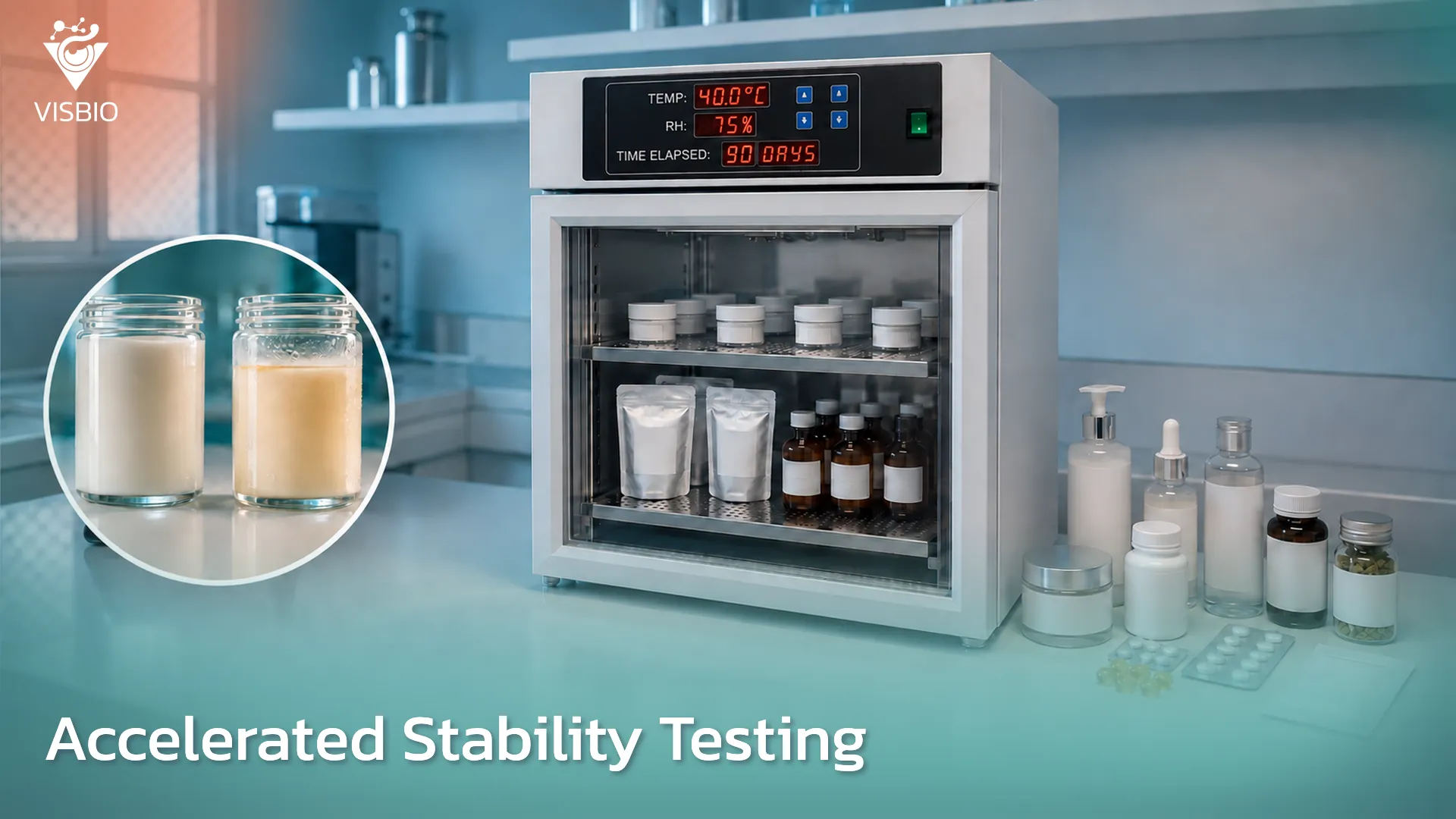
An accelerated stability test is the storage of a product under conditions hotter and more humid than normal storage, so that degradation that would normally take a long time appears sooner. The condition set by ICH Q1A(R2) is 40 °C and 75% relative humidity (40 °C/75 %RH) for at least 6 months. The results are used to predict stability and to support the estimation of shelf life, but they cannot replace real-time stability testing, because the shelf life on the label must ultimately be confirmed with long-term data.
In the development of cosmetics and dietary supplements, the time from development to market (time-to-market) is a key competitive factor. Waiting for a full 24 months of long-term results before launch is commercially difficult, especially for new brands and start-ups. Accelerated testing therefore gives a brand scientific data to support a provisional shelf life, while long-term testing runs in parallel to completion to confirm the results.
VISBIO Laboratory provides accelerated stability testing, from designing the test plan, storing samples under accelerated conditions and measuring parameters at each time point, through to interpreting results against the definition of significant change. This article summarizes what brand owners, quality assurance (QA) teams and research and development (R&D) teams should understand before submitting products for testing: the principles of accelerated conditions, the limits of using accelerated results to estimate shelf life, the products whose results need careful interpretation, and how to interpret significant change.
The science of accelerated conditions
Accelerated testing is based on chemical kinetics, which explains that the rate at which most substances degrade increases with temperature. This relationship is described by the Arrhenius equation, which shows that the reaction rate increases exponentially as temperature rises and depends on the activation energy of the reaction. Storing a product at higher temperature and humidity than normal therefore makes degradation that normally takes a long time appear in a shorter period.
Each reaction has a different activation energy, so the same rise in temperature accelerates each reaction to a different extent. Reviews of accelerated aging of pharmaceutical products therefore consider the methods separately for each degradation mechanism, such as oxidation, hydrolysis, photodegradation and protein denaturation, with the precautions for each method (Waterman & Adami, 2005). This is why there is no single multiplier that converts accelerated results into a shelf life for every product.
ICH Q1A(R2) sets the accelerated condition at 40 °C ± 2 °C/75 %RH ± 5 %RH for at least 6 months, with at least 3 time points including the first and last, for example months 0, 3 and 6. If experience during development suggests that results may approach the significant change criteria, the guideline recommends adding a fourth time point. Many projects therefore test at months 0 (baseline), 1, 3 and 6 (T0, T1, T3 and T6) to see changes from an early stage. The table below summarizes the role of the main conditions under ICH and WHO guidance.
| Study | Condition | Role |
|---|---|---|
| Long-term | 25 °C/60 %RH or 30 °C/65 %RH under ICH · 30 °C/75 %RH for Zone IVb, including Thailand and ASEAN | Sets and confirms shelf life |
| Intermediate | 30 °C/65 %RH | Additional testing when the long-term condition is 25 °C/60 %RH and significant change occurs under accelerated conditions |
| Accelerated | 40 °C/75 %RH for at least 6 months | Predicts stability and supports the estimation of shelf life |

Using accelerated results to estimate shelf life
The cosmetics industry uses a rule of thumb that if a product is stable at 40 °C/75 %RH for 6 months, a 24-month shelf life under normal conditions can be claimed. This rule of thumb is not an ICH rule and does not apply to every product, because how much faster degradation proceeds at 40 °C than at room temperature depends on the degradation mechanism and activation energy of each formula. Passing a full 6 months under accelerated conditions is therefore good supporting data, but it is not the only evidence for setting the shelf life on the label.
For drugs, ICH Q1E and the ASEAN guideline on the stability of drug products allow limited extrapolation of the shelf life beyond the period covered by long-term data, particularly when no significant change is found under accelerated conditions. The maximum is twice the period covered by long-term data, and no more than 12 months beyond that period, when statistical analysis and supporting data are available; for example, with 12 months of long-term data, a shelf life of up to 24 months may be proposed. If the data are not amenable to statistical analysis, the limit falls to 1.5 times, and no more than 6 months beyond that period. If significant change is found under accelerated conditions, the shelf life must be based mainly on long-term data, and any extrapolated shelf life must always be confirmed with long-term data once the results are complete.
For dietary supplements, the ASEAN guidelines state that accelerated data together with ongoing long-term data can be used to set a tentative shelf life, but the actual shelf life must ultimately be based on long-term data. Cosmetics have their own guideline for stability testing, ISO/TR 18811:2018. Although cosmetics are not directly subject to drug guidelines, applying the same principles gives the shelf life on the label a sound rationale.
Products suited to accelerated testing and groups that need caution
Accelerated testing is a predictive tool during research and development and in preparation for launch, but it cannot replace long-term testing in every case. ICH Q1A(R2) itself notes that accelerated test results do not always predict physical changes. Products with components sensitive to high temperature may degrade at 40 °C through mechanisms that do not occur under normal conditions, for example lipids in the particles melting or proteins denaturing. These include products that use delivery systems such as liposomes, nanoemulsions and solid lipid nanoparticles, products that state a probiotic count on the label, products containing enzymes that work only within a limited temperature range, and products containing certain groups of active pharmaceutical ingredients (APIs). Accelerated results for this group must therefore be interpreted with caution, and long-term data should be given more weight.
For general cosmetics such as creams, lotions, serums, toners, masks and shampoos, and for solid dietary supplements such as capsules, tablets and powdered drink mixes, many manufacturers use accelerated results as preliminary data to support the shelf life, then confirm it with long-term data. Products with water as the main component (aqueous systems) often perform well at 40 °C/75 %RH when the preservative system and packaging have been designed for it from the start. Solid products should also be monitored for moisture content, because 75% relative humidity can make powders or tablets absorb moisture when the packaging lets water vapor through.
Oil-based products need attention to oxidation, which speeds up with temperature. The peroxide value (PV) indicates the amount of primary oxidation products and should be interpreted together with odor and other parameters, because as degradation progresses the primary products break down further, so PV may fall even as the oil deteriorates further. VISBIO Laboratory measures PV in collaboration with partner laboratories.
Significant change and interpretation of results
ICH Q1A(R2) defines “significant change” for drug products as follows, and many manufacturers of cosmetics and dietary supplements use this definition as a reference framework:
- A change of 5% or more in active ingredient content from the initial value, or failure to meet the acceptance criteria for potency when measured by biological or immunological procedures
- Any degradation product exceeding its acceptance criterion
- Failure to meet the acceptance criteria for appearance, physical attributes or functionality, such as color, phase separation, resuspendability, caking, hardness or dose delivered per actuation
- Failure to meet the acceptance criterion for pH, where relevant
- Failure to meet the acceptance criteria for dissolution for 12 tablets or capsules, where relevant
This definition does not include microbiological results. For cosmetics, microbiological quality is assessed separately against the microbial limits for the product, such as ISO 17516:2014, and VISBIO Laboratory performs microbial enumeration in-house to assess this. ICH Q1A(R2) also notes that some physical changes, such as a cream melting at 40 °C, can be expected under accelerated conditions, so it is necessary to distinguish changes that are a direct effect of high temperature from changes that indicate a problem with the formula. However, if a semi-solid product shows phase separation under accelerated conditions, the ASEAN guideline calls for testing to continue under long-term conditions.
Finding significant change does not automatically mean the product has “failed”. Under ICH guidance, if the long-term condition is 25 °C/60 %RH and significant change occurs at any point during the 6-month accelerated test, additional testing is carried out at the intermediate condition of 30 °C/65 %RH and evaluated against the same definition. If the long-term condition is 30 °C/65 %RH or 30 °C/75 %RH, there is no intermediate condition, and the shelf life must be based mainly on long-term data.
In practice, significant change as early as month 1 (T1) usually indicates that the formula or packaging must be fixed before launch. If it appears at month 3 (T3) or month 6 (T6), the options depend on the nature of the change: adjust the formula, change the packaging, shorten the shelf life to be claimed, or add testing at the intermediate condition where the conditions for it apply. These decisions are the joint responsibility of the brand’s R&D and QA teams and should be based on complete and verifiable data. Accurate interpretation of results reduces business risk and shortens the time to launch.
Scope of VISBIO Laboratory's accelerated stability testing service
VISBIO Laboratory manages accelerated stability testing from start to finish, as follows:
- Design a test plan to suit the characteristics of the product and the target market, including the choice of time points and parameters to measure
- Receive and handle samples, recording receipt, transfer and storage at every step (chain of custody)
- Measure baseline values at T0 for every parameter in the plan
- Store samples in VISBIO Laboratory’s 40 °C/75 %RH stability chambers, which are calibrated on a regular schedule, with continuous recording of temperature and humidity
- Measure parameters at each time point (peroxide value is measured in collaboration with partner laboratories) and assess significant change according to the ICH Q1A(R2) definition
- Report results that link the scientific data to recommendations on the shelf life that the data support
Frequently asked questions about accelerated stability tests
What is an accelerated stability test?
An accelerated stability test is the storage of a product under conditions hotter and more humid than normal, which under ICH Q1A(R2) means 40 °C/75 %RH for at least 6 months, so that degradation appears sooner. The results are used to predict stability and to support the estimation of shelf life.
After 6 months of accelerated testing, can a 24-month shelf life be claimed straight away?
This is not a rule that applies to every product. How much faster degradation proceeds at 40 °C than at room temperature depends on the degradation mechanism of each formula. For drugs, ICH Q1E allows a shelf life beyond the period covered by long-term data of at most twice that period, and no more than 12 months beyond it, when no significant change is found under accelerated conditions and statistical analysis supports it. The resulting shelf life must still be confirmed with long-term data once the results are complete.
What does significant change mean?
Under ICH Q1A(R2), it means a result that meets any one of the criteria, such as a change of 5% or more in active ingredient content from the initial value, a degradation product exceeding its criterion, appearance or physical attributes failing their criteria, or pH failing its criterion.
Does significant change mean the product has failed?
Not automatically. If the long-term condition is 25 °C/60 %RH, additional testing is required at the intermediate condition of 30 °C/65 %RH. If the long-term condition is 30 °C/65 %RH or 30 °C/75 %RH, the shelf life must be based mainly on long-term data. The brand’s team then decides whether to adjust the formula, change the packaging or shorten the shelf life to be claimed.
Which products need careful interpretation of accelerated results?
Products with components sensitive to high temperature, such as delivery systems like liposomes and nanoemulsions, products that state a probiotic count, products containing enzymes, and certain groups of active pharmaceutical ingredients, because they may degrade at 40 °C through mechanisms that do not occur under normal conditions.
At which time points should samples be tested?
ICH Q1A(R2) requires at least 3 time points, such as months 0, 3 and 6, and recommends adding a time point when results are expected to approach the criteria. Many projects therefore test at T0, T1, T3 and T6.
References:
- ASEAN Consultative Committee for Standards and Quality – Pharmaceutical Product Working Group. (2018). ASEAN guideline on stability study of drug product (Revision 2). Association of Southeast Asian Nations.
- ASEAN Consultative Committee for Standards and Quality – Traditional Medicines and Health Supplements Product Working Group. (2013). ASEAN guidelines on stability study and shelf-life of health supplements (Version 1.0). Association of Southeast Asian Nations.
- International Conference on Harmonisation. (2003a). ICH harmonised tripartite guideline Q1A(R2): Stability testing of new drug substances and products. ICH.
- International Conference on Harmonisation. (2003b). ICH harmonised tripartite guideline Q1E: Evaluation for stability data. ICH.
- International Organization for Standardization. (2014). Cosmetics — Microbiology — Microbiological limits (ISO 17516:2014). ISO.
- International Organization for Standardization. (2018). Cosmetics — Guidelines on the stability testing of cosmetic products (ISO/TR 18811:2018). ISO.
- Waterman, K. C., & Adami, R. C. (2005). Accelerated aging: Prediction of chemical stability of pharmaceuticals. International Journal of Pharmaceutics, 293(1–2), 101–125. https://doi.org/10.1016/j.ijpharm.2004.12.013
- World Health Organization. (2018). Annex 10: Stability testing of active pharmaceutical ingredients and finished pharmaceutical products. In WHO Expert Committee on Specifications for Pharmaceutical Preparations: Fifty-second report (WHO Technical Report Series, No. 1010, pp. 309–352). WHO.