

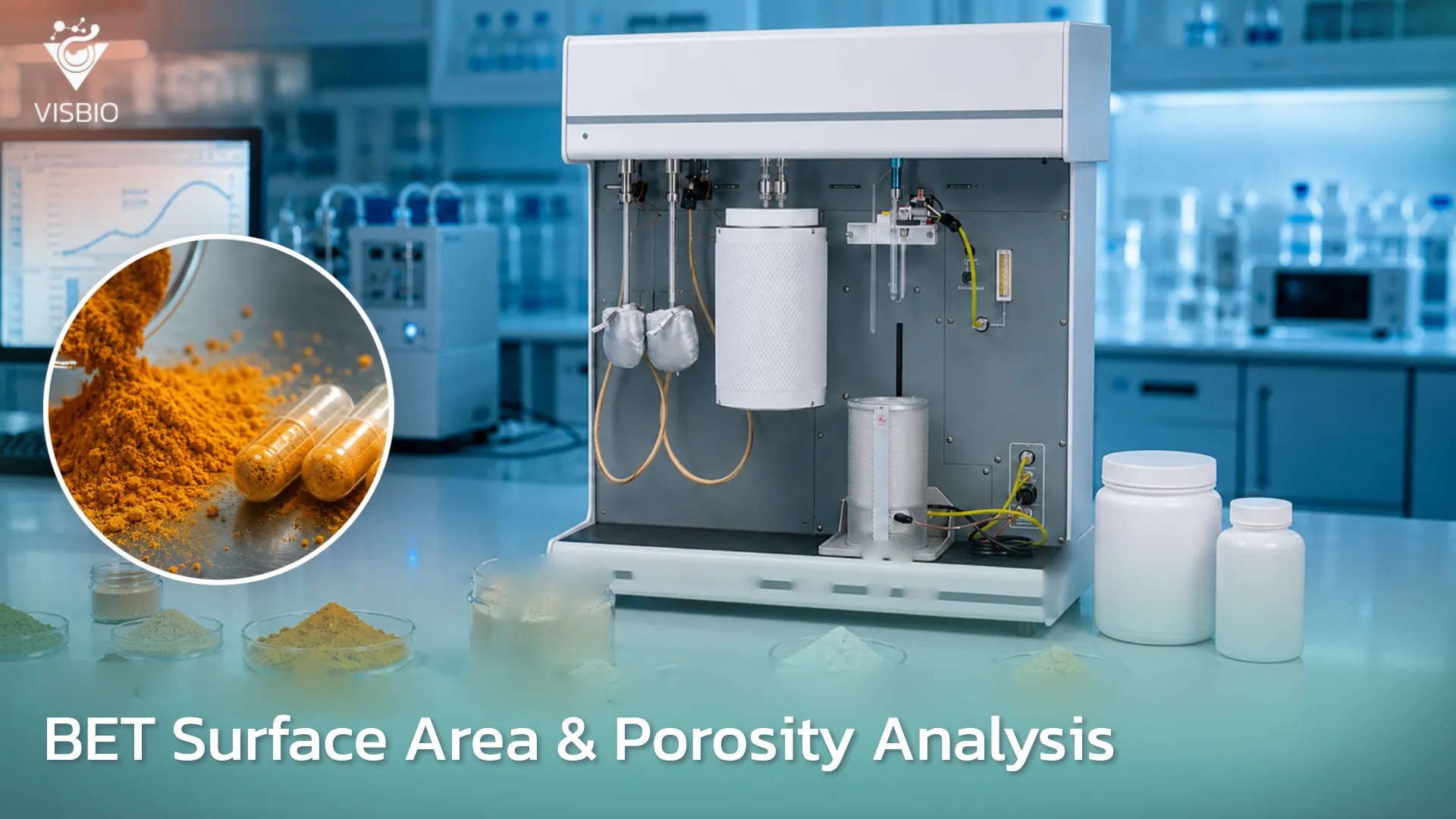
BET surface area is the total surface area of the particles in one gram of material, expressed in square meters per gram (m²/g). It is calculated from the amount of gas that adsorbs onto the surface of a powder, using the theory of Brunauer, Emmett and Teller, from whose names the term BET comes. Porosity describes the volume and size of the voids within and between particles. Together, these two values explain why powders with the same content of key compounds can differ in how they dissolve, compress into tablets and take up moisture.
In Thailand’s dietary supplement and herbal extract market, formulators and brand owners often receive extract powders that look alike from several raw-material suppliers, yet these powders perform clearly differently when made into compressed tablets or capsules or mixed into instant drinks. Some batches dissolve well, disperse smoothly and release all of their active ingredient, while others dissolve slowly, clump and release less active ingredient into solution. In many cases, this difference does not come from a different active-ingredient content but from a different specific surface area and porous structure of the powder.
Powders with a large surface area have more contact with solvents and with fluids in the digestive tract, so they dissolve faster, which is one of the factors that affect absorption. The porous structure determines both the speed of dissolution and the ability to take up moisture from the air. Particle size distribution (PSD) analysis cannot provide either kind of information, because particles of similar size can differ in surface area several times over, depending on surface roughness and internal pores.
VISBIO Laboratory, in collaboration with partner laboratories, provides specific surface area analysis by BET gas adsorption and porosity analysis by mercury intrusion porosimetry (MIP), covering herbal extract powders, powdered dietary supplements, spray-dried extracts, powdered active raw materials and carrier materials used in delivery systems. The service can be used in formulation development, supplier selection, batch release and monitoring of powder structure during stability testing.
Why surface area and porosity determine the behavior of extract powders
At the formulation stage, specific surface area is directly related to the dissolution rate of the active ingredient. According to the Noyes–Whitney equation, the dissolution rate is directly proportional to the surface area in contact with the solvent (Noyes & Whitney, 1897), so an extract powder with a higher surface area releases more active ingredient into solution in the same time. This is one reason why spray-dried extract powders usually dissolve faster than plain ground powders, even with the same content of key compounds. However, faster dissolution in the laboratory is not evidence that a product has a better effect on the body, which must be demonstrated by dedicated studies.
At the commercial production stage, porosity affects tableting behavior. Highly porous powders usually compact easily, need less compression force and give tablets of consistent hardness, whereas powders with low porosity may need high compression force and give tablets that crack easily during transport. In powder-filled capsules, porosity affects the bulk density, or the weight of powder that fits into a given volume, so capsules of the same size may contain different amounts of active ingredient.
In terms of shelf life, powders with a high surface area are usually more hygroscopic, so they cake in the package more quickly and may accelerate the degradation of moisture-sensitive substances such as probiotics or antioxidants. In delivery systems that use porous carrier materials, such as silica nanoparticles or porous polymer carriers, surface area and porosity determine the loading capacity and the release rate, which are key selling points for this group of products.
From a regulatory perspective, Thai laws such as the Cosmetic Act B.E. 2558 (2015) and the Herbal Products Act B.E. 2562 (2019) do not set specific surface area as a mandatory criterion. Surface area and porosity data are therefore used as technical quality data, for example to explain differences in dissolution between batches or between raw-material suppliers, but they are not evidence of absorption in the body. Absorption claims on labels or in advertising must be supported by evidence from dedicated studies and must comply with the law for each product type.
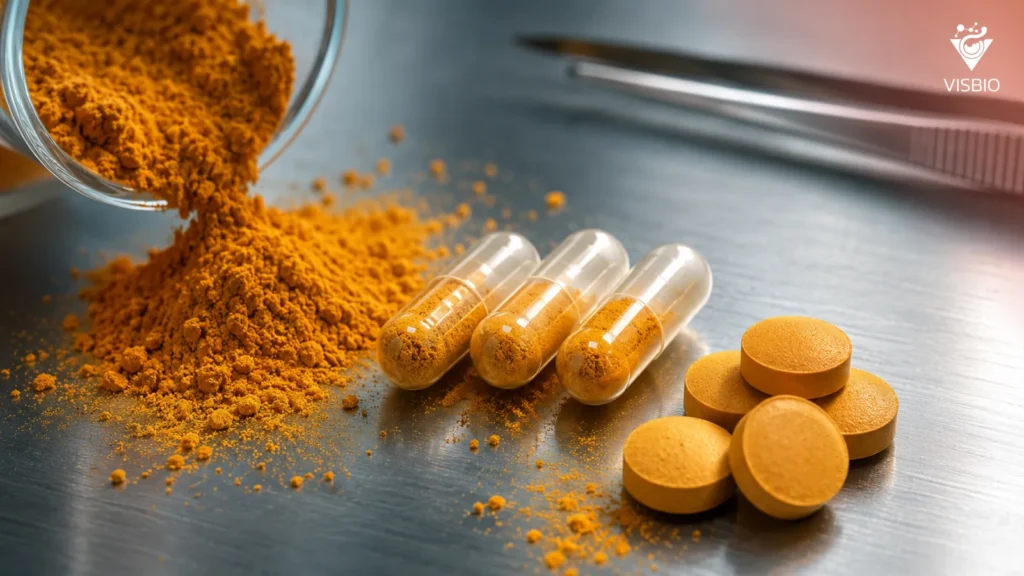
Principles of BET specific surface area and MIP porosity analysis
The main technique for measuring specific surface area is the BET method, which relies on the physical adsorption (physisorption) and desorption of a gas that does not react with the sample, such as nitrogen at the temperature of liquid nitrogen (−196 °C), on the surface of the particles. Before measurement, the sample must be degassed by heating under vacuum at about 60–200 °C to remove water and adsorbed gases, choosing a temperature low enough that the sample does not degrade. The instrument then measures the volume of gas adsorbed at different relative pressures and calculates the specific surface area with the BET equation (Sing et al., 1985). The measuring range is about 0.01 to more than 3,000 square meters per gram, depending on the instrument model and the type of gas.
The reported results include the total specific surface area, the average pore size, the total pore volume and the pore size distribution across micropores (smaller than 2 nanometers), mesopores (2–50 nanometers) and macropores (larger than 50 nanometers). In addition, the shape of the adsorption isotherm, classified according to IUPAC guidance, helps in understanding the internal pore structure of the material (Sing et al., 1985).
The second technique is mercury intrusion porosimetry (MIP). Mercury does not wet the surface of most materials (it is non-wetting), so it does not enter pores by itself and must be forced in under pressure, and the pressure required is inversely proportional to the pore size according to the Washburn equation. Increasing the pressure step by step and measuring the volume of mercury entering the sample therefore gives pore-size data from about 3 nanometers to more than 100 micrometers. Results are reported as cumulative pore volume, apparent density and total porosity (United States Pharmacopeial Convention, 2023). This technique suits materials with large pores, which lie outside the range that gas adsorption measures well.
Scope of VISBIO Laboratory's surface area and porosity service
VISBIO Laboratory’s service, carried out in collaboration with partner laboratories, covers three groups of samples:
- Herbal extract powders: extract powders of turmeric, mangosteen, black ginger, black pepper, gotu kola leaf, Derris scandens and other Thai medicinal plants
- Commercial active raw materials: active ingredient powders, both imported and locally produced, protein powders, collagen powders, probiotic powders and multivitamin powders
- Powders for cosmetics and food: loose powders, powders for tableting, powders for capsule filling and instant drink powders
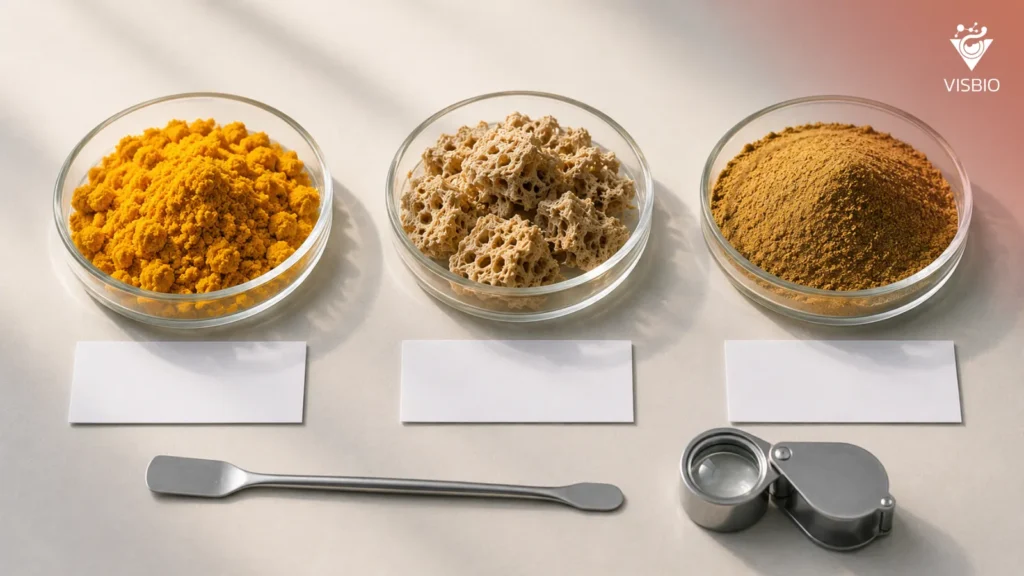
Using surface area and porosity results
The results can be used at several stages of a product’s life:
- Research and development: compare powder production processes such as spray drying, freeze drying and micronization to select the process that gives a powder with properties that match the product’s goals.
- Supplier selection: compare extract powders from several manufacturers to confirm that the price paid reflects the quality actually received.
- Pre-launch and commercial production: set the baseline for the specification and the acceptable deviation for batch release.
- Stability studies: track changes in powder structure during storage, especially for hygroscopic products and products in packaging that is not vacuum-sealed. A falling surface area is often an early warning of caking and poorer dissolution.
Frequently asked questions about BET surface area
What is BET surface area?
It is the total surface area of the particles in one gram of material, expressed in square meters per gram (m²/g), calculated from the amount of gas, such as nitrogen, that adsorbs onto the surface of a powder at different pressures, according to the theory of Brunauer, Emmett and Teller.
Why do extract powders with the same content of key compounds dissolve differently?
Because the dissolution rate is directly proportional to the surface area in contact with the solvent, according to the Noyes–Whitney equation, a powder with a higher surface area releases more active ingredient in the same time. Porosity also affects the speed of dissolution and moisture uptake.
What is the difference between BET and mercury intrusion (MIP) measurement?
The BET method uses gas adsorption and gives the specific surface area and data on small to medium pores. The mercury intrusion method forces mercury into pores under pressure and gives pore data from about 3 nanometers to more than 100 micrometers, so it suits materials with large pores.
Can surface area data be used as evidence that a product is absorbed better?
No. Surface area and porosity data are technical quality data used to explain differences in dissolution between batches or between raw-material suppliers. Absorption claims must be supported by evidence from dedicated studies and must comply with the law for each product type.
What types of samples does VISBIO Laboratory accept?
Three groups: herbal extract powders such as turmeric, mangosteen and black ginger; commercial active raw materials such as protein, collagen and probiotic powders; and powders for cosmetics and food such as loose powders, powders for tableting and instant drink powders.
What values does the report include?
BET measurement reports the total specific surface area, the average pore size, the total pore volume and the pore size distribution. Mercury intrusion measurement reports the cumulative pore volume, apparent density and total porosity.
References:
- Noyes, A. A., & Whitney, W. R. (1897). The rate of solution of solid substances in their own solutions. Journal of the American Chemical Society, 19(12), 930–934. https://doi.org/10.1021/ja02086a003
- Sing, K. S. W., Everett, D. H., Haul, R. A. W., Moscou, L., Pierotti, R. A., Rouquérol, J., & Siemieniewska, T. (1985). Reporting physisorption data for gas/solid systems with special reference to the determination of surface area and porosity (Recommendations 1984). Pure and Applied Chemistry, 57(4), 603–619. https://doi.org/10.1351/pac198557040603
- United States Pharmacopeial Convention. (2023). Porosimetry by mercury intrusion (USP <267>). USP.
- Royal Thai Government Gazette. (2015, September 8). Cosmetic Act B.E. 2558 (2015). Royal Thai Government Gazette, 132(86 Kor), 1–22.
- Royal Thai Government Gazette. (2019, April 30). Herbal Products Act B.E. 2562 (2019). Royal Thai Government Gazette, 136(56 Kor), 116–161.