

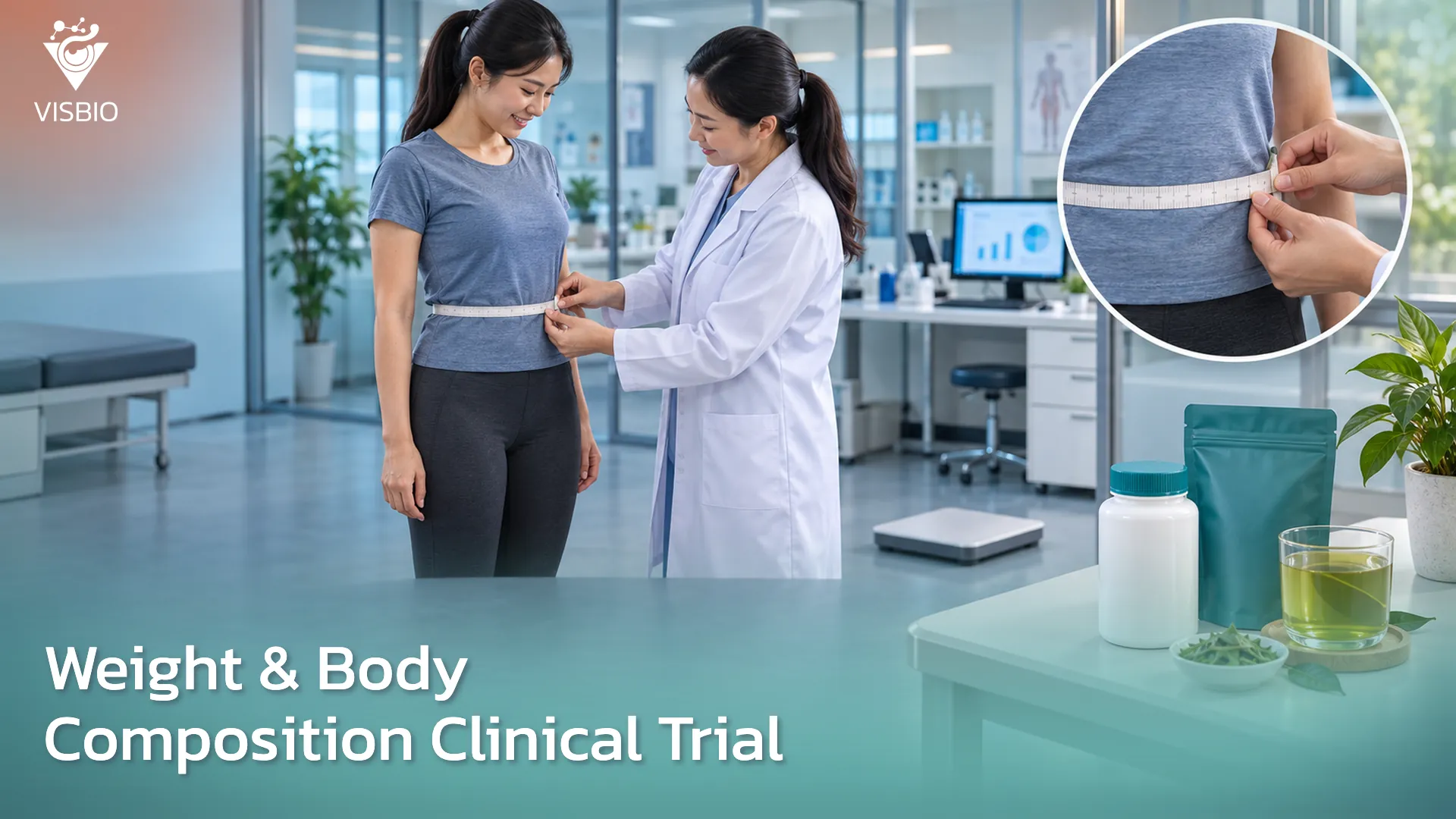
Body composition is the proportion of the body’s main components, usually divided into fat mass and fat-free mass, which includes muscle, bone, organs and body water. A body composition clinical trial for dietary supplements is a study in volunteers who receive the actual product, measuring body weight, body mass index, waist circumference and waist-to-hip ratio at set time points and comparing them with a control group.
Dietary supplements related to body weight and body composition are a category with many products on the Thai market, ranging from green tea extract, white kidney bean extract and soluble fiber to many other active ingredients. Consumers often refer to the whole category as “weight-loss supplements”, but statements about body weight on labels and in advertising must stay within the limits allowed by food law and must be backed by verifiable evidence from studies in humans.
VISBIO Co., Ltd. provides study design, project management and project coordination for clinical studies of these dietary supplements, working with a network of partner clinical research sites and hospitals. Studies use standard anthropometric measurements accepted in the international scientific literature, under Good Clinical Practice (GCP), for sponsors in Thailand and abroad.
Limits of the Thai FDA number and body weight claims
Under the Food Act B.E. 2522 (1979), the approval of dietary supplements by the Thai Food and Drug Administration (Thai FDA) focuses mainly on product safety and quality. The food serial number (Thai FDA number) on the label therefore does not mean that the Thai FDA has confirmed the product’s effect on consumers’ body weight or body composition.
Body weight claims are a high legal risk category in dietary supplement advertising. On dietary supplement labels and in advertising, such claims may only use the wording and conditions permitted by the Thai FDA, and dietary supplements cannot make anti-obesity claims. Relying on ingredients or the manufacturing process alone, without supporting clinical data, is therefore high risk, especially in online advertising, which is closely monitored.
The gap between “having a Thai FDA number” and “having clinical evidence” is a major weakness for brands in this category when they negotiate with retailers and export channels. Clinical studies that measure body weight and body proportions with standard methods are designed to fill this gap with verifiable data. Study results do not, however, extend the range of wording the law allows.
Body composition and its importance for health: the basics for product developers
Clinical assessment of body composition looks not only at body weight or body mass index (BMI) but also at how fat is distributed in the body, especially visceral adipose tissue (VAT), which is more closely associated with metabolic risk than subcutaneous fat.
Després and Lemieux (2006) reviewed the evidence in Nature and explained that abdominal obesity is the most common feature of the metabolic syndrome, which is associated with dyslipidemia, insulin resistance and inflammation. Waist circumference is therefore an easy and practical clinical indicator of abdominal obesity, and it can estimate the amount of visceral fat to some extent.
Fat accumulation and loss are complex processes that result from an imbalance between energy intake and energy expenditure, and they are influenced by eating habits, exercise and individual biological factors. Data in this area therefore vary widely between individuals. For formulas that do not yet have human data, a pilot study helps assess feasibility and the variability of preliminary data, which can then be used to plan the sample size of a larger study.
Active ingredients in this category: from scientific evidence to study design
Watanabe et al. (2020) reviewed the evidence for marketed dietary supplements that claim to help with weight loss and grouped them by their main proposed mechanism: reducing nutrient absorption, regulating appetite, increasing energy expenditure, modulating fat metabolism and modulating carbohydrate metabolism.
Green tea extract, whose main active compound is epigallocatechin gallate (EGCG), has a relatively large body of human research. Hursel et al. (2009) conducted a meta-analysis of 11 studies and found that green tea catechins were associated with weight loss and with weight maintenance after a weight-loss period compared with the control group (mean difference −1.31 kg, p < 0.001). The authors concluded that the effect is small and that habitual caffeine intake and ethnicity may influence its size.
In the GRADE assessment of evidence quality by Watanabe et al. (2020), none of the 21 dietary supplements evaluated had high-quality evidence. Only 8 had moderate-quality evidence, such as green tea, white kidney bean and caffeine, and the rest had low-quality evidence. The authors also noted that the effects found for many supplements have little clinical relevance when used alone and that higher-quality studies are needed. Many active ingredients on the market therefore still need more clinical data, which is an opportunity for brands that want to stand out with verifiable data.
Endpoints and measurement tools in body composition studies
Evaluating dietary supplements in this category requires a set of measurement tools that covers both objective data and data reported by the volunteers themselves (subjective). The main endpoints used in clinical research are as follows.
Standard anthropometric measurements (anthropometrics)
Body weight, body mass index, waist circumference and waist-to-hip ratio (WHR) are basic indicators widely used in body composition research, especially waist circumference, which reflects abdominal obesity as explained by Després and Lemieux (2006). Measurements must follow a standard method, such as the World Health Organization (WHO) guidelines, so that the data are reliable and reproducible.
Diaries and patient-reported outcomes (diaries and PROMs)
Daily records kept throughout the study, such as a food diary and an activity diary, together with patient-reported outcome measures (PROMs) on satiety, energy levels and adverse events, are an important part of studies in this category, because body weight and body composition are strongly influenced by personal behavior. These data help interpret the results fully and form part of adverse event recording under GCP.
The clinical study process with VISBIO and partner clinical research sites
Every study follows GCP. VISBIO designs, manages and coordinates the study from planning through to delivery of the report, while volunteer recruitment, measurements and volunteer care are handled by the physicians and investigators of the research site responsible for the study.
Step 1: Consultation and protocol design
VISBIO and the investigators of the partner research site define a primary endpoint that matches the message the product wants to communicate, set the volunteer inclusion/exclusion criteria and the approach for recording eating habits and physical activity during the study, and estimate a sample size that gives adequate statistical power.
Step 2: Approval from a human research ethics committee
Before any data are collected, the protocol and the informed consent documents must be approved by a human research ethics committee (Institutional Review Board, IRB) in every case. VISBIO coordinates the preparation of documents with the investigators and follows up on the revisions requested by the committee until approval is granted.
Step 3: Volunteer recruitment and screening
The physicians and investigators of the research site responsible for the study recruit and screen volunteers according to the protocol, and make sure that every volunteer receives complete information, gives written informed consent and passes health screening before joining. VISBIO coordinates schedules and project readiness between the sponsor and the research site.
Step 4: Study conduct and data collection
Volunteers receive the test product or a comparator product. The research site measures body weight, waist circumference and other body proportions at the time points in the protocol, and collects daily diaries and adverse event records throughout the study. The site’s investigators safeguard volunteer safety, while VISBIO, as project manager, monitors progress and data completeness.
Step 5: Data analysis and reporting
All data are analyzed statistically according to a pre-specified statistical analysis plan (SAP) and summarized in a full scientific report. VISBIO coordinates the analysis and delivers the report to the sponsor. The report supports product development and evidence-based communication.
Dietary supplements suited to this service
This service is designed for dietary supplements that aim to communicate effects on body weight or body composition, in capsule, powder and ready-to-drink (RTD) form. Examples of suitable ingredient types include:
| Ingredient type | Product format |
|---|---|
| Green tea extract (EGCG) | Capsules, powders |
| White kidney bean extract | Capsules |
| Soluble fiber | Powders, capsules |
| Plant extracts with supporting scientific evidence | Capsules, powders |
| Combination formulas | Capsules, powders, ready-to-drink (RTD) beverages |
Some markets permit ingredients such as caffeine in dietary supplements under local regulations; study designs follow the rules of the target market.
Business benefits of clinical studies
Brand owners who invest in clinical studies gain concrete strategic benefits in several areas.
Premium product positioning
In a crowded, price-competitive market, clinical study data comparing changes in body weight or waist circumference with a control group provide a reasoned basis for premium positioning.
Negotiating with modern trade and e-commerce channels
A clinical study report prepared under GCP is one of the important documents that make negotiations with modern trade buyers and e-commerce platforms in the dietary supplement category smoother, and it gives an advantage over competitors without such data.
Reducing legal risk and expanding into export markets
Body composition statements backed by clinical study evidence reduce the risk that advertising will be considered exaggerated, but they do not make statements that the law does not permit usable. Export markets such as the European Union, Japan and ASEAN require claim substantiation before a product goes on sale, so a study designed in line with international practice is part of preparing to enter these markets, although each country has its own requirements.
Using scientific data in communication
Data actually measured in a clinical study can be used across several communication channels. Any use in advertising must first obtain advertising approval from the Thai FDA, and only wording permitted by law may be used.
Conditions before a study starts
- Dietary supplements sold in Thailand must be approved by the Thai FDA and hold a food serial number (Thai FDA number) before the study starts. For products from international sponsors, VISBIO assesses the legal requirements with the research site on a project-by-project basis.
- VISBIO and the research site design the study plan specifically for each product and its claims.
- Every study must be approved by a human research ethics committee before it starts, without exception.
From laboratory testing to studies in volunteers
For brands that want to build evidence at every level, VISBIO supports laboratory testing of weight management supplements and cell-based (in vitro) efficacy testing, through to clinical studies in volunteers. GCP applies to studies in humans, while laboratory work follows the test method of each assay. Planning every level of evidence with a single coordinator reduces coordination complexity and keeps the data at each stage consistent. Brand owners who want to confirm the key ingredients in their product through laboratory testing can find details on the V-PROVED mark for dietary supplements.
Frequently asked questions about body composition clinical trials
What is body composition?
Body composition is the proportion of the body’s main components, usually divided into fat mass and fat-free mass, which includes muscle, bone, organs and body water. Clinical assessment also looks at how fat is distributed, especially visceral fat.
What does this study measure?
The main endpoints are standard anthropometric measurements: body weight, body mass index, waist circumference and waist-to-hip ratio, together with food and activity diaries, assessments completed by the volunteers and adverse event recording throughout the study.
Why measure more than body weight?
Body weight alone does not show how fat is distributed. Waist circumference reflects abdominal obesity and can estimate visceral fat to some extent, so measuring waist circumference and waist-to-hip ratio together with body weight gives a more complete interpretation than body weight alone.
Can study results be used to advertise that a product causes weight loss?
Body weight statements on dietary supplement labels and in advertising may only use the wording and conditions permitted by the Thai FDA, and dietary supplements cannot make anti-obesity claims. Study results do not extend these limits; they support product development and evidence-based communication. Advertising requires Thai FDA approval before publication, and VISBIO does not guarantee regulatory decisions.
Who performs the measurements and looks after the volunteers?
The physicians and investigators of the partner research site responsible for the study screen, measure and look after the volunteers. VISBIO designs, manages and coordinates the study between the sponsor and the research site, from planning through to delivery of the report.
What needs to be prepared before a project starts?
Dietary supplements sold in Thailand must already hold a food serial number (Thai FDA number). For products from international sponsors, VISBIO assesses the legal requirements with the research site on a project-by-project basis. The study plan is designed for the product and the message to be communicated, and every project must be approved by a human research ethics committee before it starts.
Talk to VISBIO about your clinical study
If you are interested in a clinical trial for your body weight or body composition supplement, contact VISBIO for a free initial consultation through the following channels:
- Contact form: https://visbio.co.th/en/contact-us/
- LINE Official Account: @visbio
- Email: service@visbio.co.th
- Phone: 098-635-4197 (+66 98 635 4197)
- Timeline: please ask our team directly.
See all clinical trial services on VISBIO’s clinical trial page.
This article was prepared by the science and business development team of VISBIO Co., Ltd. to provide scientific information for businesses in the dietary supplement industry.
Important information about clinical studies
- VISBIO’s role: VISBIO designs studies and provides project management and project coordination with a network of partner clinical research sites and hospitals, for sponsors in Thailand and abroad. Volunteers are recruited and cared for by the physicians and investigators of the site responsible for the study.
- Research ethics: Every study in humans starts only after approval by a human research ethics committee and is conducted in line with Good Clinical Practice (GCP). All volunteers give informed consent after receiving complete information.
- Drugs and herbal medicines: Studies must follow the requirements of the Thai Food and Drug Administration (Thai FDA) that apply to the product. The sponsor, the research site and VISBIO plan these steps together from the start of the project.
- Use of results: Study results support product development and evidence-based communication. Use on labels or in advertising must comply with the law for each product type, with approval from the relevant authorities where the law requires it. VISBIO does not guarantee study outcomes or regulatory decisions.
- Foods and dietary supplements: Study results are not a claim that a product diagnoses, treats, cures, mitigates or prevents any disease.
- Timeline: This depends on the study design and the approval process. Please ask our team directly.
References:
- Després, J.-P., & Lemieux, I. (2006). Abdominal obesity and metabolic syndrome. Nature, 444(7121), 881–887. https://doi.org/10.1038/nature05488
- Hursel, R., Viechtbauer, W., & Westerterp-Plantenga, M. S. (2009). The effects of green tea on weight loss and weight maintenance: A meta-analysis. International Journal of Obesity, 33(9), 956–961. https://doi.org/10.1038/ijo.2009.135
- Watanabe, M., Risi, R., Masi, D., Caputi, A., Balena, A., Rossini, G., Tuccinardi, D., Mariani, S., Basciani, S., Manfrini, S., Gnessi, L., & Lubrano, C. (2020). Current evidence to propose different food supplements for weight loss: A comprehensive review. Nutrients, 12(9), Article 2873. https://doi.org/10.3390/nu12092873