

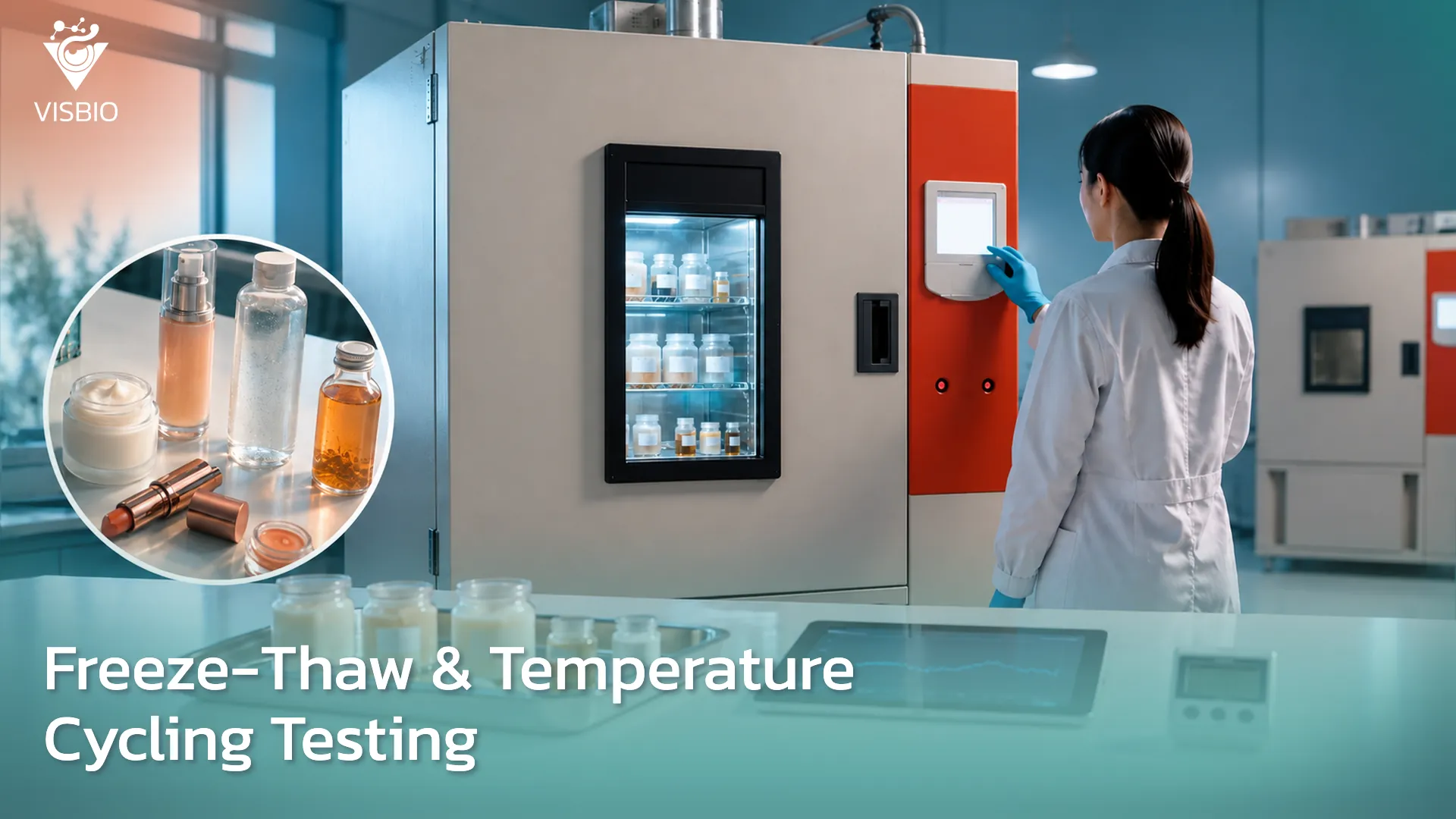
A freeze thaw test, also called a freeze–thaw cycle test, stores a product below its freezing point alternating with room temperature or a high temperature, in repeated cycles. A temperature cycling test alternates between cold and hot temperatures without necessarily reaching the freezing point. Both are stress tests used to see whether a product can withstand temperature changes during transport and warehouse storage, especially creams, emulsions and liquid products that separate or crystallize easily.
In the supply chain of exported cosmetics and dietary supplements, products are not kept at a constant temperature. Sea freight may pass through both tropical and cold regions, goods may sit in warehouses without temperature control during transshipment, air freight may expose goods to very different temperatures while they wait to be loaded or unloaded, and storage at a destination with distinct seasons puts products through several temperature changes before they reach consumers. Temperature cycling tests simulate these conditions in the laboratory to confirm that the product keeps its quality through real-world conditions.
VISBIO Laboratory designs temperature cycles to match the brand’s actual shipping routes and measures parameters after the set number of cycles to show how much the product has changed. This article summarizes what brand owners, quality assurance (QA) teams and research and development (R&D) teams should understand before submitting products for testing: the principles of the test, the products that should be tested, the parameters and interpretation of results, and how to link the results to real transport.
Principles of freeze-thaw and temperature cycling tests
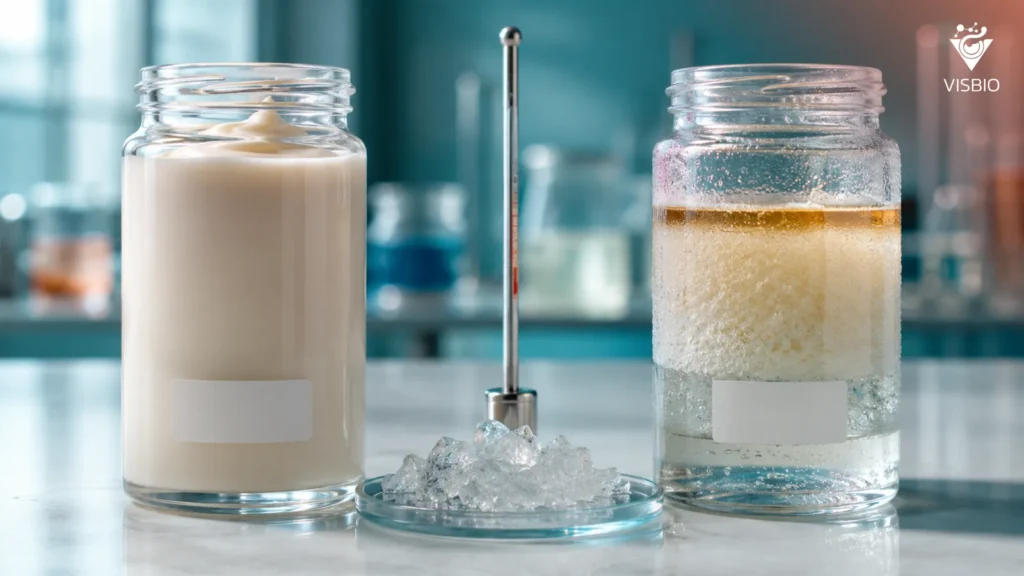
The principle of the test is to simulate the temperature stress that a product may meet in the supply chain. Alternating between low and high temperatures causes physical changes in the formula, especially in emulsions, which may undergo phase separation. Ice crystals formed during freezing may damage the film surrounding the emulsion droplets until the droplets coalesce; waxes and solid fats such as cetyl alcohol or stearic acid may crystallize (wax crystallization) and make the product grainy; and emulsions with large droplets (macroemulsions) may separate into their water and oil phases.
The commonly used pattern is 3–6 cycles, each consisting of storage at a low temperature, such as −20 °C (freeze-thaw) or 4 °C (temperature cycling), for 24 hours, followed by storage at a high temperature, such as 40 °C or 50 °C, for 24 hours. This pattern is a widely used industry practice, not a condition set in ICH Q1A(R2), so the number of cycles, the temperatures and the durations can be adjusted to the brand’s actual supply chain. For cosmetics, the stability testing guideline ISO/TR 18811:2018 is a reference used in designing the test, together with the brand’s transport data.
ICH Q1A(R2) states that data from accelerated conditions can be used to evaluate the effect of short excursions outside the storage conditions, such as during shipping, but accelerated testing keeps samples at a constant high temperature, so it does not simulate freezing or repeated alternation between hot and cold. The ASEAN guidelines for health supplements also cite suspensions and emulsions as examples of products that may undergo physical or chemical changes at low temperatures. Temperature cycling testing therefore supplements real-time stability testing and accelerated stability testing; it does not replace them.
Products that should undergo freeze-thaw testing
Products that should undergo freeze-thaw testing carry risks that differ from those of products tested only under long-term and accelerated conditions. The high-risk group is emulsions of every type: oil-in-water (O/W) emulsions such as ordinary creams and lotions, water-in-oil (W/O) emulsions such as some sunscreen formulas, and multiple emulsions (W/O/W or O/W/O) used in delivery systems.
Suspensions, such as sunscreens with zinc oxide or titanium dioxide particles dispersed in the formula, and exfoliating products containing silica are at risk of sedimentation after temperature cycling. For color cosmetics such as lipsticks and balms based on a wax–oil system, it must be confirmed that they do not crack when they go through temperature cycles.
For water-based toners and essences that use a solubilizer to carry oil-soluble substances into the water phase, it must be confirmed that the solubilizer still works after temperature cycling. Liquid dietary supplements, functional drinks and liquid botanical extracts that use dispersing agents should also be tested.
Parameters measured and pass/fail interpretation
Evaluation after temperature cycling covers several dimensions. The physical dimension includes a check of visual appearance that records phase separation, color change, crystal formation, graininess or loss of the original form; quantitative color measurement against a reference sample stored under normal conditions; viscosity, which may change after cold cycles; pH, which may change as the system in the formula adjusts; and mean particle size and particle size distribution, which indicate changes in the dispersion system. VISBIO Laboratory measures particle size in collaboration with partner laboratories.
The microbiological dimension uses microbial enumeration by reference methods such as USP <61>, because a separated water layer, or water droplets condensed on the surface of the product, may contain a diluted preservative that makes it easier for microorganisms to grow. The chemical dimension measures active content by high-performance liquid chromatography (HPLC) to confirm that the temperature cycles have not degraded the active compounds. VISBIO Laboratory performs both microbial enumeration and HPLC analysis in-house.
Pass/fail interpretation refers to the acceptance criteria set for each parameter before testing begins. Examples of criteria that many manufacturers use are: no phase separation visible to the naked eye, a color difference (ΔE2000) within the set limit, a viscosity change of no more than 10%, a pH change of no more than 0.5 units, and microbial results still within limits. These figures are examples, not universal standard values; the actual criteria should be set according to the characteristics of the product and the brand’s specification.

Linking test results to real transport and export markets
Freeze-thaw results are most useful to the business when they are interpreted together with real transport conditions. For example, sea freight from Thailand to Europe takes about 4–6 weeks; along the way, the temperature inside a container may reach about 40 °C when passing through the tropics and fall to about 4 °C in cold regions, or lower on arrival at a destination in winter. In air freight, the risk usually arises while goods wait to be loaded or unloaded on the apron and in airport warehouses, where they may be exposed to very hot or very cold air depending on the season at origin and destination. Holding goods in warehouses without temperature control in the destination country is a normal part of the supply chain.
Many buyers, trading houses and key accounts ask to see the results of 3–6 temperature cycles before accepting goods. If the goods that arrive differ from the specification, for example by separating or forming sediment, the buyer may reject the whole batch (batch reject). Testing in advance therefore helps reduce this risk before the goods are shipped. The results can also be used to set storage instructions on the label or shipping carton, such as “Do not freeze”, which ICH Q1A(R2) calls for specifically for products that cannot tolerate freezing.
In Thailand, no law specifically requires freeze-thaw testing, but the Cosmetic Act B.E. 2558 (2015) aims to protect consumers from cosmetics that are unsafe to use, so manufacturers and importers should have data confirming that their products keep their quality through real transport and storage.
Scope of VISBIO Laboratory's freeze-thaw testing service
VISBIO Laboratory tailors the test to the characteristics of the product and its actual shipping route, and handles the following:
- Design a test that simulates the brand’s actual supply chain, including the number of cycles, the low and high temperatures and the duration of each phase
- Receive and handle samples, recording receipt, transfer and storage at every step (chain of custody)
- Measure baseline values for every parameter before the first cycle, and keep reference samples under normal conditions for comparison
- Test in VISBIO Laboratory’s programmable chambers, which switch temperatures automatically without moving samples between chambers, within −20 °C to 40 °C and with hot cycles that can be set as high as 50 °C, with continuous temperature recording (continuous logging)
- Measure every dimension of the parameters after the set number of cycles and compare them with the baseline values and the reference samples (particle size is measured in collaboration with partner laboratories)
- Report results against the acceptance criteria, with an analysis of the cause when changes are found
Frequently asked questions about freeze-thaw testing
What is a freeze-thaw test?
A freeze-thaw test stores a product below its freezing point alternating with room temperature or a high temperature, in repeated cycles, to see whether the product can withstand temperature changes during transport and warehouse storage.
How does freeze-thaw differ from temperature cycling?
Freeze-thaw uses temperatures below the freezing point, such as −20 °C, alternating with higher temperatures, while temperature cycling alternates between a cold temperature, such as 4 °C, and a hot temperature, such as 40 °C, without reaching the freezing point. Both are stress tests that supplement real-time and accelerated stability testing.
How many cycles are needed?
The commonly used pattern is 3–6 cycles, each with 24 hours at a low temperature and 24 hours at a high temperature. This pattern is industry practice, not a fixed condition in ICH Q1A(R2), so it can be adjusted to the brand’s actual supply chain.
Which products should undergo freeze-thaw testing?
All types of emulsions; suspensions, such as sunscreens containing zinc oxide or titanium dioxide; lipsticks and balms based on wax and oil; toners and essences that use solubilizers; and liquid dietary supplements that use dispersing agents.
What are the pass/fail criteria for a freeze-thaw test?
The criteria should be set according to the characteristics of the product before testing begins. Examples used by many manufacturers are no phase separation visible to the naked eye, a color difference within the limit, a viscosity change of no more than 10% and a pH change of no more than 0.5 units. These figures are examples, not universal standard values.
Can freeze-thaw testing replace real-time stability testing?
No. Temperature cycling is a stress test that supplements real-time and accelerated stability testing. The shelf life must still be set from real-time stability data.
References:
- ASEAN Consultative Committee for Standards and Quality – Traditional Medicines and Health Supplements Product Working Group. (2013). ASEAN guidelines on stability study and shelf-life of health supplements (Version 1.0). Association of Southeast Asian Nations.
- International Conference on Harmonisation. (2003). ICH harmonised tripartite guideline Q1A(R2): Stability testing of new drug substances and products. ICH.
- International Organization for Standardization. (2018). Cosmetics — Guidelines on the stability testing of cosmetic products (ISO/TR 18811:2018). ISO.
- United States Pharmacopeial Convention. (2023). General chapter <61> Microbiological examination of nonsterile products: Microbial enumeration tests. In United States Pharmacopeia 46–National Formulary 41. USP.
- Royal Thai Government Gazette. (2015, September 8). Cosmetic Act B.E. 2558 (2015). Royal Thai Government Gazette, 132(86 Kor), 1–22.