

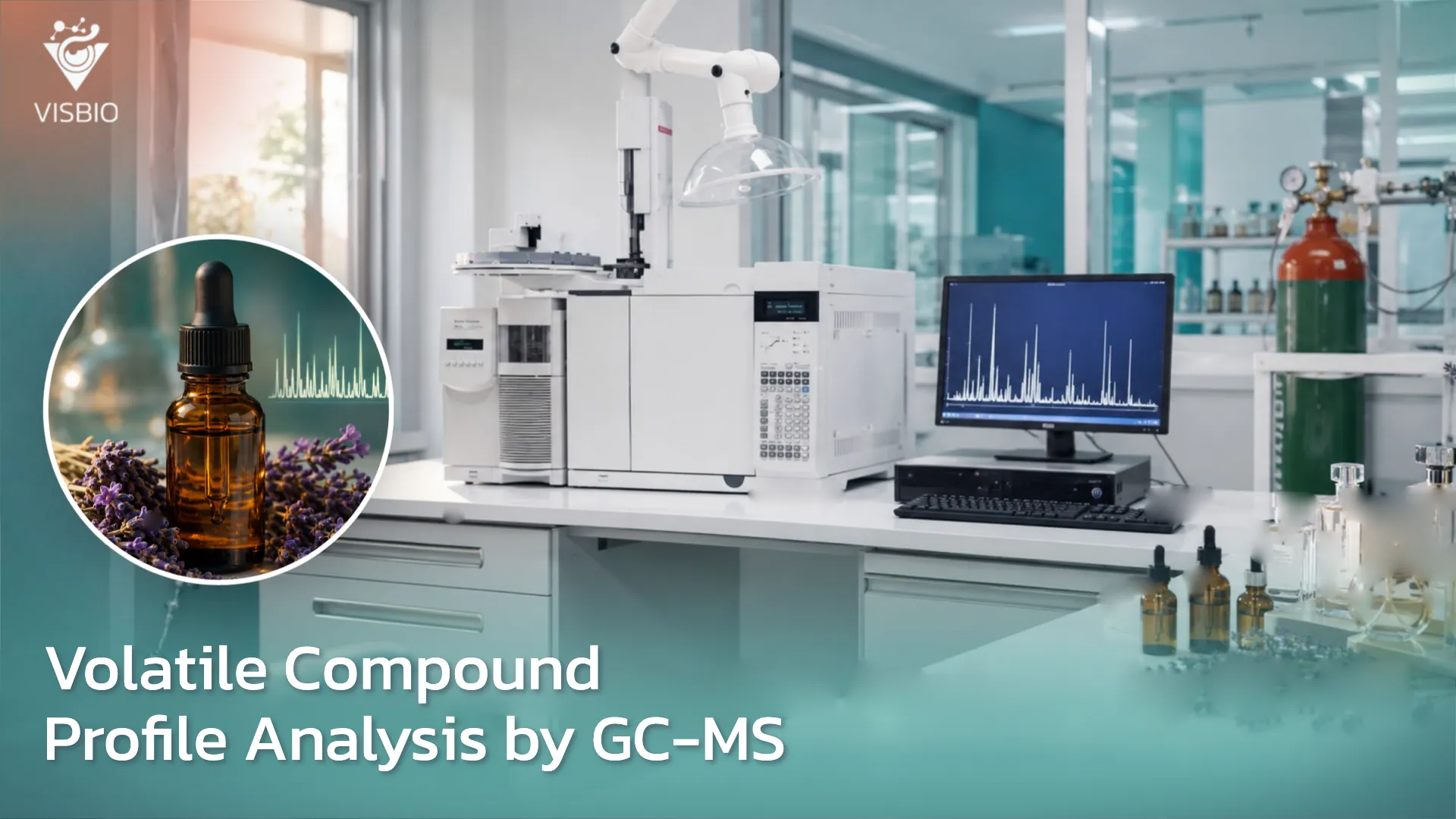
GC-MS (gas chromatography–mass spectrometry) is a technique that separates a mixture of volatile substances into individual compounds and then identifies each compound from its mass spectrum. Volatile compounds are substances that evaporate easily and create the odors that the nose perceives. The result of GC-MS is therefore a volatile profile that shows which compounds make up a scent and in what proportions.
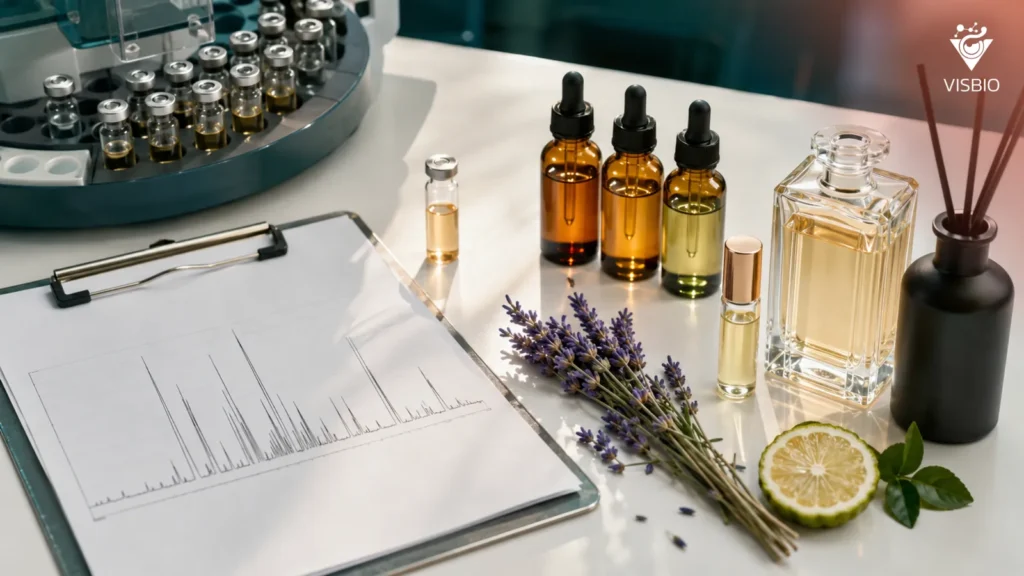
In products where scent is the selling point, such as premium perfumes, signature scents that define a brand and aromatherapy essential oils with a distinctive herbal scent, the human nose perceives a scent as a single overall impression. Inside that scent, however, are tens to hundreds of volatile compounds blended in specific proportions. Examining the volatile compounds that make up a scent is therefore a more detailed quality check than smelling alone.
A common problem in the essential oil and perfume market is adulteration, both of raw materials and of finished products. Under the ISO 9235 definition, an essential oil is a product obtained from plant raw material by steam distillation, by mechanical expression of citrus peel, or by dry distillation, after separation of the aqueous phase (International Organization for Standardization [ISO], 2021). Some products on the market, however, do not match their labels. For example, lavender oil sold at an unusually low price may be lavandin oil from hybrid lavender, which is cheaper and smells similar, or it may be synthetic linalool and linalyl acetate mixed into a solvent, which is not an essential oil under this definition at all. Buyers pay according to the type and origin of the oil, so adulteration is both an ethical and a commercial problem that undermines trust in the market.
VISBIO Laboratory offers volatile compound analysis by GC-MS, in collaboration with partner laboratories, for perfumes and essential oils, focusing on three tasks: checking volatile profiles against reference profiles, checking batch-to-batch consistency, and studying aroma stability throughout shelf life. We also measure the actual amounts of selected volatile compounds against reference standards, for example fragrance allergens in perfumes. For complete essential oil quality testing, covering physical properties, biological activity and microbiology, see our essential oil quality and efficacy testing service.
What is GC-MS, and how does it analyze volatile compounds?
Gas chromatography (GC) separates a mixture in the gas phase based on differences in how each substance distributes between the stationary phase coated inside the column and the mobile phase, which is a carrier gas; most GC-MS work uses helium. Each substance in the sample leaves the column at a different time, called its retention time, which is characteristic of that substance under the specified analytical conditions.
Mass spectrometry (MS) is the detector connected to the end of the column. It ionizes the molecules leaving the column, breaks them into fragments in a characteristic pattern and then measures the mass-to-charge ratio (m/z) of each ion. The resulting mass spectrum acts like a chemical fingerprint of each substance and is compared with a mass spectral library to identify it. Reliable identification usually combines the mass spectrum with the retention index or a comparison with a reference standard, because some groups of compounds, such as terpenes that are isomers of each other, have very similar mass spectra.
The results have two parts. The first is the chromatogram, which shows a peak for each compound in order of retention time. The second is a table of identified compounds (compound identification) with their relative amounts as percent peak area (% peak area). This value shows the proportion of each compound relative to the others in the same sample, but it is not the actual concentration, because each compound gives a different signal per unit amount. To obtain the actual amount of a particular compound, it must be analyzed against a reference standard of that compound.

Why volatile profiles matter for the quality of perfumes and essential oils
At raw material receiving, GC-MS provides a chemical fingerprint of each batch of essential oil for comparison with the reference profile or specification for that oil. For example, ISO 3515 for lavender oil (Lavandula angustifolia Mill.) sets ranges for the main constituents, linalool and linalyl acetate, together with several minor constituents (ISO, 2002). An oil blended with synthetic linalool and linalyl acetate may have main-constituent proportions close to the genuine oil but lack the minor constituents found in the natural oil. This kind of abnormality shows up in the GC-MS profile even when the human nose cannot tell the difference.
However, a GC-MS profile is a screening tool that points out abnormalities, not proof of authenticity in every case. Some types of adulteration, such as adding synthetic compounds with the same structure as the natural ones in proportions deliberately designed to imitate the genuine oil, may require additional techniques, such as enantiomeric analysis on a chiral column, which is outside the scope of routine profile analysis. Results should therefore be read together with raw material origin documents and the buyer’s specifications.
In perfume development, GC-MS lets the research and development (R&D) team see the composition of the designed scent and adjust the formula compound by compound. When the team wants to strengthen or reduce a particular scent note, it can identify the volatile compounds responsible for that character and adjust their amounts in the formula precisely. In essential oil blends made from several oils, GC-MS also shows which oil each main volatile compound comes from, so the proportion of each oil can be adjusted to reach the target scent profile.
From a regulatory perspective, the Cosmetic Act B.E. 2558 (2015) does not require GC-MS analysis, but many manufacturers and buyers use volatile profiles as part of their raw material specifications, and international standards for many essential oils, such as ISO 3515 for lavender oil, set ranges for main constituents determined by gas chromatography (ISO, 2002).
Aroma stability studies with GC-MS
The scent of perfumes and essential oils can change throughout shelf life, because each volatile compound degrades at a different rate. Temperature, light and oxygen reaching the product are the main factors that accelerate oxidation and polymerization of compounds in essential oils (Turek & Stintzing, 2013). Some compounds degrade quickly. Citral, for example, the main constituent of lemongrass oil, is sensitive to oxygen and light and may change into compounds with a different odor during storage, while many other volatile compounds are more stable.
GC-MS tracks changes in each volatile compound throughout the study by comparing the profile at each time point with the starting point (time zero, T0). Several signals can be tracked, such as a decrease in the percent peak area of fast-degrading compounds, new compounds formed by oxidation, and the ratio of fast-degrading to stable compounds. This ratio serves as an indicator of how long the scent that consumers perceive will last. Changes in some compounds may not alter the scent that people perceive, however, so GC-MS results can be read more completely when combined with sensory evaluation.
The study results help in choosing packaging and storage conditions, such as opaque bottles, reducing the headspace above the product in the bottle or storage at low temperature, and support setting a shelf life that is consistent with the product’s scent profile. This analysis can be combined with stability testing under different conditions, such as storage at high temperature or under light.
How the GC-MS service on this page differs from complete essential oil testing
VISBIO Laboratory offers two essential oil services, and clients can choose according to the question they need answered.
| Item | Essential oil quality and efficacy testing service | Volatile compound analysis by GC-MS (this page) |
|---|---|---|
| Samples | Essential oils | Perfumes and essential oils |
| Scope | Several aspects at once: physical properties (refractive index, specific gravity and optical rotation), chemical composition by GC-MS, biological activity and microbiology | Focus on detailed volatile profiles, comparison with reference profiles, batch-to-batch consistency, changes in scent throughout shelf life, and measurement of selected volatile compounds against reference standards |
| Best for | Complete quality testing of essential oils, for example for comparison with the standard for each oil | Raw material acceptance against reference profiles, perfume development and aroma stability studies |
Scope of VISBIO Laboratory's GC-MS analysis service
VISBIO Laboratory’s GC-MS analysis service, carried out in collaboration with partner laboratories, covers two sample groups in the health and beauty industry:
- Essential oils and herbal oils: essential oils from various plants, herbal oils, essential oil blends for aromatherapy and oils for diffusers
- Perfumes: premium perfumes, eau de toilette and perfume products for spas
The report includes a table of identified volatile compounds showing retention time, compound name, molecular formula and percent peak area (% peak area), together with a comparison against the reference profile specified by the client. For stability studies, it shows the quantitative change over time relative to the starting point (T0).
Measuring selected volatile compounds against reference standards
Percent peak area shows only the proportion of each compound relative to the others in the same sample. When clients need the actual amount of certain compounds, this service measures selected volatile compounds against a reference standard of each compound. One example is fragrance allergens, which buyers in Europe use for label declarations. The report for this work shows the concentration of each compound measured. Clients should list the compounds they want quantified at the quotation stage.
Using GC-MS results
GC-MS results are useful at several stages of a product’s life:
- Raw material receiving: to check that the profile of incoming essential oil matches the specification or reference profile, and to screen for abnormalities that indicate adulteration with synthetic compounds or cheaper oils
- Formulation: to compare several prototype versions, choose the one whose scent profile is closest to the reference profile, and find the cause when a formula’s scent drifts from the design
- Batch release: to confirm that each batch has a scent profile that matches the specified master reference
- Aroma stability studies: to track changes in each volatile compound throughout shelf life, in order to adjust packaging and storage conditions
- Export: as an attachment to the certificate of analysis (COA) for buyers in the perfume and essential oil market who make a GC-MS profile a condition of purchase
Frequently asked questions about GC-MS
What is GC-MS?
GC-MS is a technique that combines gas chromatography, which separates a mixture of volatile substances into individual compounds, with mass spectrometry, which identifies each compound from its mass spectrum. It can therefore show which volatile compounds make up a scent and in what proportions.
What are volatile compounds?
Volatile compounds are substances that evaporate easily and create the odors that the nose perceives. The scent of a perfume or essential oil consists of tens to hundreds of volatile compounds blended in specific proportions.
What does % peak area in the report mean?
It shows the proportion of each compound relative to the others in the same sample, not the actual concentration, because each compound gives a different signal. To obtain the actual amount of a particular compound, it must be analyzed against a reference standard of that compound, which this service offers for selected volatile compounds, such as fragrance allergens in perfumes.
Can GC-MS detect fake essential oils?
GC-MS helps screen for abnormalities, such as main-constituent proportions that do not match the specification or the absence of minor constituents found in natural oils. Some types of adulteration, however, require additional techniques, so results should be read together with raw material origin documents.
Why does the scent of perfumes and essential oils change during storage?
Temperature, light and oxygen accelerate oxidation and polymerization of the compounds in the oil, and each compound degrades at a different rate. Citral in lemongrass oil, for example, degrades faster than many other compounds, so the scent profile changes over time.
How does the service on this page differ from complete essential oil testing?
The complete service tests essential oils on several aspects: physical properties, chemical composition, biological activity and microbiology. The service on this page focuses on the volatile profiles of perfumes and essential oils, comparison with reference profiles, tracking scent throughout shelf life, and measuring selected volatile compounds against reference standards.
References:
- International Organization for Standardization. (2002). Oil of lavender (Lavandula angustifolia Mill.) (ISO 3515:2002). ISO.
- International Organization for Standardization. (2021). Aromatic natural raw materials — Vocabulary (ISO 9235:2021). ISO.
- Royal Thai Government Gazette. (2015, September 8). Cosmetic Act B.E. 2558 (2015). Royal Thai Government Gazette, 132(86 Kor), 1–22.
- Turek, C., & Stintzing, F. C. (2013). Stability of essential oils: A review. Comprehensive Reviews in Food Science and Food Safety, 12(1), 40–53. https://doi.org/10.1111/1541-4337.12006