


A pilot clinical trial is a small study in volunteers that tests the feasibility of methods and procedures before investing in a larger study, for example the volunteer recruitment rate, product tolerability and the suitability of the protocol, while providing preliminary information on effect size and the variability of endpoints (Thabane et al., 2010). For herbal health products that already have laboratory data or a history of traditional use but no human data yet, a pilot clinical trial is a starting point that helps confirm the direction before planning a full-scale randomized controlled trial (RCT).
The market for Thai herbal health products continues to grow both in Thailand and in export markets. Brand owners who want to communicate health benefits on labels or in marketing materials must have scientific evidence and must use wording that complies with the law for the product category under which the product is approved. Starting with a small, systematically designed study reduces risk before investing in a larger and more expensive study.
VISBIO Co., Ltd. provides study design, project management and project coordination for pilot clinical studies of herbal health products, working with a network of partner clinical research sites and hospitals under Good Clinical Practice (GCP). The service runs from planning the study protocol to the final pilot study report, for sponsors in Thailand and abroad.
Limits of the Thai FDA number: why herbal brands need human data
Herbal health products may be approved in the food category, for example as dietary supplements under the Food Act B.E. 2522 (1979), or in the herbal product category under the Herbal Products Act B.E. 2562 (2019), depending on the nature of the product and its intended use. For products in the food category, approval by the Thai Food and Drug Administration (Thai FDA) focuses mainly on safety and quality and does not confirm clinical efficacy. For products in the herbal product category, the statements that may be displayed must stay within the scope approved under that Act. Whatever the category, the number issued by the Thai FDA is not evidence that the brand’s formula has the health effect the brand wants to communicate.
In vitro data and a history of traditional use are valuable as preliminary information, but they do not measure the effect of that formula in volunteers directly. A pilot clinical study is therefore a bridge between traditional knowledge and internationally accepted clinical evidence.
Herbs in health products and the rationale for pilot studies: the scientific basis
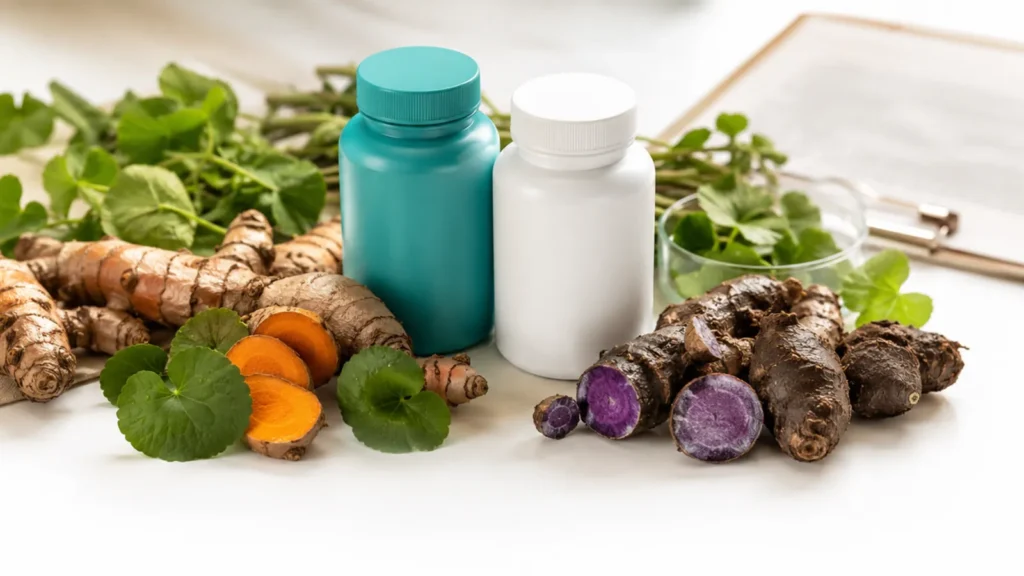
Popular herbal health products on the Thai market, such as turmeric (Curcuma longa), gotu kola (Centella asiatica) and Indian gooseberry (Phyllanthus emblica), have a long history of use in traditional medicine formulas, and their active compounds have been widely studied in vitro and in animals (in vivo).
Chainani-Wu (2003) systematically reviewed the literature on the safety and anti-inflammatory activity of curcumin, the key compound in turmeric. The review found many laboratory and animal studies of antioxidant and anti-inflammatory activity, while the human studies available at the time were few; these found no toxicity and some evidence of anti-inflammatory activity. A situation like this makes a pilot clinical study an appropriate step for generating human data for each product formula.
Gohil et al. (2010) reviewed the pharmacological data on gotu kola, covering activities related to wound healing and collagen synthesis, antioxidant activity and effects on brain function. Most of these data come from animal studies, and the authors state that more randomized, blinded trials in humans are still needed.
Thabane et al. (2010) explain that a pilot study means the same as a feasibility study, whose aim is to help plan a larger study, and that it is the best way to assess the feasibility of a large, expensive study, to the point of being almost a prerequisite before the main study begins. A pilot study therefore has its own objectives; it is not a scaled-down version of a large study. The same authors caution that effect size estimates from pilot studies may be inaccurate because the sample is small, so they must be used with care when calculating the sample size of the main study.
The pilot study process with VISBIO and partner clinical research sites
Every pilot study follows GCP and takes into account the nature of herbal health products, which often have laboratory data and a history of traditional use but lack systematic clinical data. The design must therefore balance practical feasibility with scientific rigor. VISBIO designs the study and manages it from planning through to delivery of the report, while volunteers are recruited and cared for by the physicians and investigators of the research site responsible for the study.
Step 1: Consultation and protocol design
VISBIO analyzes the product’s characteristics, the effects the company wants to study and the product’s objectives together with the investigators of the partner research site to define the pilot study plan, including primary feasibility endpoints, such as recruitment and retention rates, and secondary clinical endpoints that match the benefits to be studied. This step covers inclusion/exclusion criteria, success criteria for the pilot study and a sample size that is sufficient for the feasibility objectives. A sample size calculation with adequate statistical power is then carried out for the main study, using data from the pilot study.
Step 2: Approval from a human research ethics committee
Before any data are collected, the protocol and the informed consent documents must be approved by a human research ethics committee (Institutional Review Board, IRB) in every case. VISBIO coordinates the preparation of documents with the site’s investigators and follows up on the revisions requested by the committee until approval is granted.
Step 3: Volunteer recruitment and screening
Once approval is granted, the research site responsible for the study recruits and screens volunteers according to the protocol. The site’s physicians and investigators make sure that every volunteer receives complete information, gives written informed consent and passes health screening before joining. A pilot study usually has a smaller sample than the main study, but the sample must be sufficient to assess feasibility against the targets set. VISBIO coordinates schedules and project readiness between the sponsor and the research site.
Step 4: Study conduct and data collection
Volunteers receive the product, and data are collected at the time points set in the protocol using assessment tools suited to the benefits being studied, such as validated standard questionnaires and biochemical endpoints consistent with the herb’s mechanism of action, together with a tolerability diary and adverse event recording throughout the study. The site’s investigators assess and safeguard volunteer safety, while VISBIO, as project manager, monitors progress and data completeness.
Step 5: Data analysis and reporting
All data are analyzed statistically according to a pre-specified plan and summarized in a full pilot study report, which sets out the feasibility results, preliminary effect size estimates, safety data and recommendations for designing the main study. VISBIO coordinates the analysis and delivers the report to the sponsor. The report is used for decision-making and for planning the next stage of study; it is not evidence of efficacy for marketing claims.
Herbal health products suited to pilot studies
This service is designed for herbal health products that need preliminary clinical data. Examples of suitable ingredient types include:
| Ingredient type | Product format |
|---|---|
| Turmeric (Curcuma longa), curcumin extract | Capsules, powders |
| Gotu kola (Centella asiatica) | Capsules, powders, liquids |
| Indian gooseberry (Phyllanthus emblica) | Capsules, powders, liquid extracts |
| Black ginger (Kaempferia parviflora) | Capsules, powders |
| Combination herbal formulas, such as gotu kola with turmeric | Capsules, powders, ready-to-drink (RTD) beverages |
Business benefits of pilot clinical studies
A pilot study is not just a scientific step. It is a strategic investment that helps herbal brands build evidence efficiently.
Key information before investing in a larger study
A pilot study gives brand owners key information before they invest in a larger study: a preliminary effect size, which must be interpreted with caution; the feasibility of volunteer recruitment; product tolerability; and protocol problems that should be fixed before scaling up.
Preliminary data for business negotiations
Preliminary data from a pilot study can support negotiations with business partners, investors and sales channels that want to see early scientific evidence before deciding to invest in a larger study, provided it is clearly communicated that these are pilot study results.
Brand-owned data and competitive advantage
Pilot study data belong to the brand (proprietary data), are hard for competitors to copy, and become a valuable long-term data asset when built on in a main study.
An efficient path to the main study
A good pilot study report helps design the main study more precisely and reduces the chance that a large study will fail because it is underpowered or because the protocol is unsuitable.
Conditions before a study starts
- Products already approved by the Thai FDA can start a study through the normal process. For formulas not yet approved and for products from abroad, the sponsor, the research site and VISBIO review the Thai FDA requirements and the related legal conditions, and plan together case by case before the study starts.
- VISBIO and the research site design the pilot study plan specifically for each product and its objectives.
- Every study must be approved by a human research ethics committee before it starts, without exception.
From laboratory testing to studies in volunteers
For brands that want to build evidence at every level, VISBIO supports cell-based (in vitro) efficacy testing and ex vivo models, through to pilot clinical studies and larger clinical studies in volunteers. For herbal products, VISBIO also offers key compound analysis, such as curcuminoids in turmeric and key compounds in black ginger, which helps confirm the composition of the product used in the study. GCP applies to studies in humans, while laboratory work follows the test method of each assay. Planning every level of evidence with a single coordinator keeps the data at each stage consistent and free of gaps.
Frequently asked questions about herbal pilot clinical trials
What is a pilot clinical trial?
A pilot clinical trial is a small study in volunteers that tests the feasibility of methods and procedures before investing in a larger study, for example the volunteer recruitment rate, product tolerability and the suitability of the protocol. It also provides preliminary information on effect size and the variability of endpoints.
How does a pilot study differ from a large clinical study?
A pilot study’s main objective is feasibility, so its sample size is set to be sufficient for that objective rather than calculated to prove efficacy. The main study needs a sample size with adequate statistical power, which is calculated using data from the pilot study.
Can pilot study results be used for marketing claims?
A pilot study report is meant for decision-making and for planning the next stage of study. Effect size estimates from a small sample may be inaccurate, so they are not evidence of efficacy for marketing claims. Preliminary data can support negotiations with partners or investors, provided they are clearly identified as pilot study results.
What does a pilot study measure?
The primary endpoints concern feasibility, such as recruitment and retention rates. Secondary clinical endpoints are chosen to match the benefits being studied, such as validated standard questionnaires and biochemical endpoints consistent with the herb’s mechanism, together with a tolerability diary and adverse event recording.
What is VISBIO’s role, and who looks after the volunteers?
VISBIO designs the study and provides project management and coordination with a network of partner clinical research sites and hospitals. Volunteers are recruited and cared for by the physicians and investigators of the site responsible for the study.
What needs to be prepared before a project starts?
Products already approved by the Thai FDA can start a study through the normal process. For formulas not yet approved and for products from abroad, the sponsor, the research site and VISBIO review the relevant requirements and plan together case by case. The pilot study plan is designed for each product and its objectives, and every project must be approved by a human research ethics committee before it starts.
Talk to VISBIO about your pilot study
If you are interested in pilot clinical trial design and management for your herbal health product, contact VISBIO for a free initial consultation through the following channels:
- Contact form: https://visbio.co.th/en/contact-us/
- LINE Official Account: @visbio
- Email: service@visbio.co.th
- Phone: 098-635-4197 (+66 98 635 4197)
- Timeline: please ask our team directly.
See all clinical trial services on VISBIO’s clinical trial page.
Important information about clinical studies
- VISBIO’s role: VISBIO designs studies and provides project management and project coordination with a network of partner clinical research sites and hospitals, for sponsors in Thailand and abroad. Volunteers are recruited and cared for by the physicians and investigators of the site responsible for the study.
- Research ethics: Every study in humans starts only after approval by a human research ethics committee and is conducted in line with Good Clinical Practice (GCP). All volunteers give informed consent after receiving complete information.
- Drugs and herbal medicines: Studies must follow the requirements of the Thai Food and Drug Administration (Thai FDA) that apply to the product. The sponsor, the research site and VISBIO plan these steps together from the start of the project.
- Use of results: Study results support product development and evidence-based communication. Use on labels or in advertising must comply with the law for each product type, with approval from the relevant authorities where the law requires it. VISBIO does not guarantee study outcomes or regulatory decisions.
- Foods and dietary supplements: Study results are not a claim that a product diagnoses, treats, cures, mitigates or prevents any disease.
- Timeline: This depends on the study design and the approval process. Please ask our team directly.
References:
- Chainani-Wu, N. (2003). Safety and anti-inflammatory activity of curcumin: A component of tumeric (Curcuma longa). Journal of Alternative and Complementary Medicine, 9(1), 161–168. https://doi.org/10.1089/107555303321223035
- Gohil, K. J., Patel, J. A., & Gajjar, A. K. (2010). Pharmacological review on Centella asiatica: A potential herbal cure-all. Indian Journal of Pharmaceutical Sciences, 72(5), 546–556. https://doi.org/10.4103/0250-474X.78519
- Thabane, L., Ma, J., Chu, R., Cheng, J., Ismaila, A., Rios, L. P., Robson, R., Thabane, M., Giangregorio, L., & Goldsmith, C. H. (2010). A tutorial on pilot studies: The what, why and how. BMC Medical Research Methodology, 10, Article 1. https://doi.org/10.1186/1471-2288-10-1