

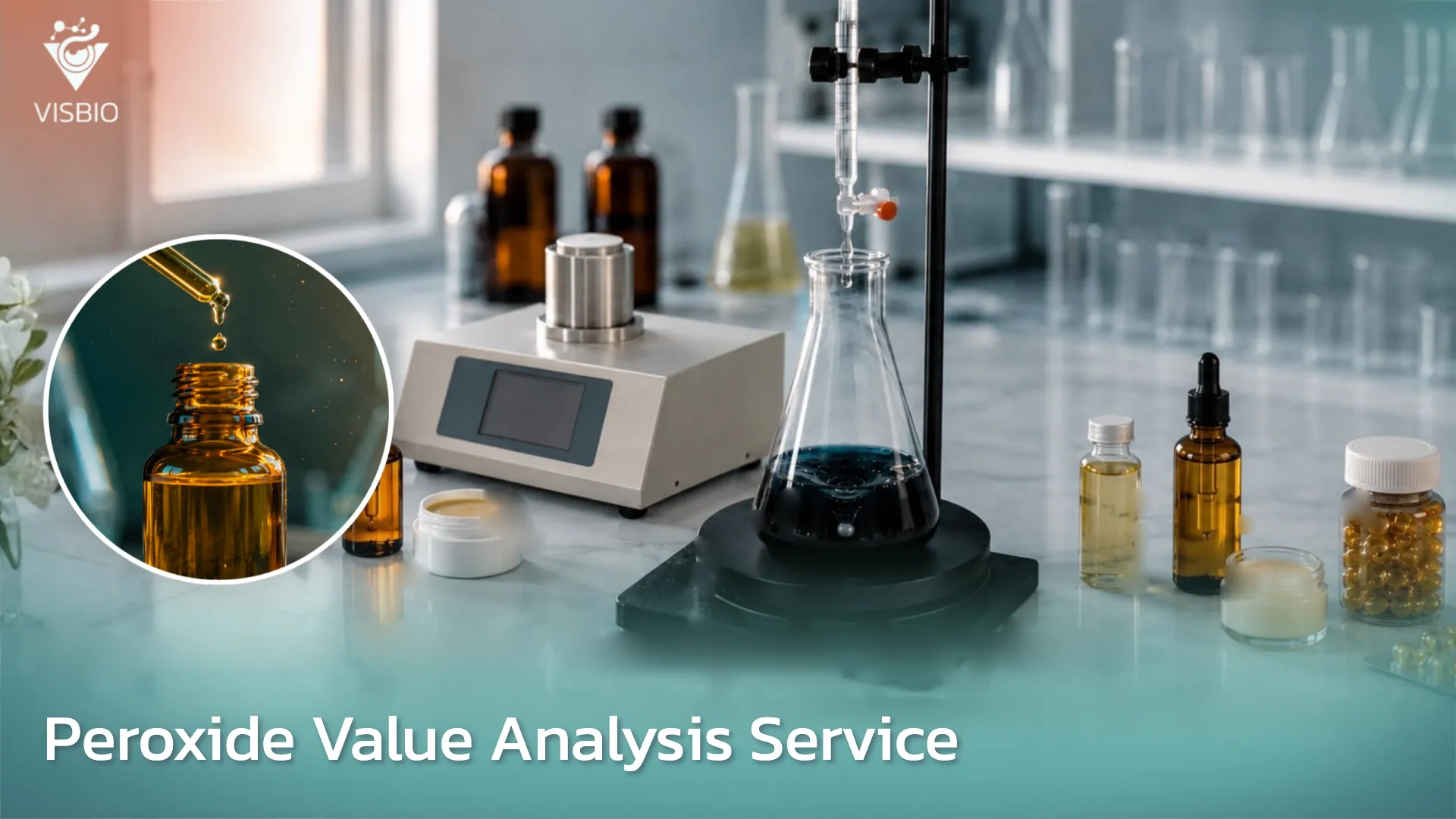
Peroxide value (PV) is the amount of hydroperoxides in an oil or fat. Hydroperoxides form in the early stage of lipid oxidation, and PV is reported in milliequivalents of oxygen per kilogram of oil (mEq O₂/kg). PV therefore shows how far an oil has started to deteriorate through oxidation, before consumers can smell rancidity.
For oil-containing products such as facial oils, hair oils, herbal medicated balms, creams based mainly on oil, softgel dietary supplements and vegetable oils used as raw materials, PV is a parameter that shows oil deterioration before a rancid odor appears. Tracking PV over time is therefore an important tool for assessing the shelf life of oil-based products, and some business-to-business (B2B) buyers in export markets also set PV as a release criterion.
Rancidity is caused by chemical reactions that proceed silently: in the early stages there is nothing visible and no clear odor. The process can be divided into three stages. In the first stage, the oil reacts with oxygen from the air through a free radical chain reaction triggered by light, heat or metal ions, forming hydroperoxides, which PV measures. In the second stage, the hydroperoxides break down into secondary products such as aldehydes and ketones, which give a distinct rancid odor. In the third stage, PV starts to fall because hydroperoxides break down faster than new ones form. A high PV therefore shows that the oil is in the phase where oxidation is accelerating and a rancid odor is close. A low PV in an oil that already smells rancid shows that the oil has passed its PV peak and has deteriorated to the point where it should not be used. Results should therefore be interpreted from the PV trend over time, together with odor or a value that indicates secondary oxidation products, such as the p-anisidine value, which the fish oil standard uses together with PV (Codex Alimentarius Commission, 2017).
VISBIO Laboratory offers peroxide value measurement by iodometric titration, in collaboration with partner laboratories, for vegetable oils, skin and hair care oils, medicated balms, essential oils, oil capsule dietary supplements and products based mainly on fats.
Why PV determines the shelf life of oil-based products
During formulation, choosing the type of oil and antioxidant means balancing the properties consumers want against long-term stability. Oils high in unsaturated fatty acids, such as rice bran oil, sesame oil, rosehip oil, argan oil and oils rich in omega-3 or omega-6, offer good nourishing properties but oxidize more easily than oils high in saturated fatty acids, such as coconut oil and palm oil. Adding suitable amounts of antioxidants, such as tocopherol (vitamin E), rosemary extract and ascorbyl palmitate, is therefore a way to extend the life of this group of oils.
When selecting raw material suppliers, the PV of the same oil from different producers can differ widely, depending on the extraction process and storage. For example, oil from one producer may have a PV below 5 mEq O₂/kg, while oil from another may be above 10 mEq O₂/kg, which exceeds the ceiling that the Codex standard sets for edible oils in general. For cold-pressed and virgin oils, the same standard sets the ceiling at 15 mEq O₂/kg (Codex Alimentarius Commission, 2019). Products made from high-PV oil start with a high PV and become rancid sooner than designed. Measuring the PV of every incoming batch of oil raw material is therefore quality control at the source.
In oil capsule dietary supplements, such as omega-3 fish oil and vitamin E softgels, PV is a key quality parameter for which oil standards set a ceiling. For example, the Codex standard for fish oils (CXS 329-2017) sets a PV of no more than 5 mEq O₂/kg (Codex Alimentarius Commission, 2017). A product whose PV exceeds the ceiling in its specification or in the agreement with the buyer fails its quality criteria: consumers receive oil that has already deteriorated, and the manufacturer may have to recall the product. In Thailand, dietary supplements fall under the Food Act B.E. 2522 (1979).
In cosmetics, a rising PV is a warning sign before a rancid odor becomes obvious. For example, if the PV of a skin care oil rises from 2 to 8 mEq O₂/kg within 6 months of a stability study, the manufacturer should assess whether the product may start to smell rancid before it expires. This information gives the product development and sales teams time to decide whether to adjust the formula or packaging before the problem reaches consumers.
From a regulatory perspective, the Cosmetic Act B.E. 2558 (2015) and the Herbal Products Act B.E. 2562 (2019) form the regulatory framework for skin care oils, medicated balms and herbal oils. PV is quality data that manufacturers set in the specifications of herbal oils, medicated balms and oil capsule dietary supplements. Manufacturers should therefore keep measurement results so that they can present them to regulators or buyers on request.
Principles of peroxide value measurement by iodometric titration
Iodometric titration is based on an oxidation–reduction reaction. The oil sample is dissolved in a solvent mixture containing acetic acid, and potassium iodide (KI) solution is added. The hydroperoxides in the oil oxidize iodide to iodine (I₂) in an amount directly proportional to the amount of hydroperoxide. The iodine formed is then titrated with standard sodium thiosulfate (Na₂S₂O₃) solution, using a starch indicator to show the end point, where the solution changes from dark blue to colorless. The amount of sodium thiosulfate used is converted back into PV in mEq O₂/kg (American Oil Chemists’ Society, 2017; International Organization for Standardization, 2017).
PV is measured on the oil or fat portion of a sample. Samples that are pure oil, such as vegetable oils and the oil in softgels, can be measured directly. Creams and products that contain a large proportion of water or other ingredients must first have their oil portion separated by a method that does not cause further oxidation, so that the result reflects the condition of the oil in the actual product.
Scope of VISBIO Laboratory's peroxide value measurement service
VISBIO Laboratory’s peroxide value service, carried out in collaboration with partner laboratories, covers several sample groups:
- Cosmetic oils: facial oils, body oils, hair oils, coconut oil, cold-pressed sesame oil, rosehip oil, argan oil and herbal oils
- Medicated balms and other balms: herbal medicated balms, cooling balms, warming balms, lip balms, body balms and other semi-solid products based mainly on oil
- Oil-based dietary supplements: fish oil capsules, omega-3 capsules, vitamin E capsules, grape seed oil, flaxseed oil and oil capsules blended with herbs
- Oils used as raw materials: rice bran oil, cold-pressed coconut oil, black sesame oil and herbal oils used to make cosmetics and dietary supplements
- Essential oils and creams: essential oils (for our full range of essential oil analyses, see the essential oil service page) and creams based mainly on oil, whose oil portion must be separated before measurement
The report shows PV in mEq O₂/kg, with the mean and standard deviation of replicate measurements. For stability studies, the report shows the quantitative change over time relative to the starting point (T0). Clients can choose between a single measurement for batch release and a continuing study throughout shelf life.

Using PV results
PV results are useful at several stages of a product’s life. In research and development, they are used to select oils and antioxidants that give long-term stability, to test how well the chosen antioxidant system works, and to compare oils from different extraction processes, such as cold-pressed and solvent-extracted oils, which start with different PV values. When selecting raw material suppliers, they are used to check the quality of every incoming batch of oil, especially oils whose price and quality change with the season.
Before launch (pre-launch), PV serves as the baseline for the specification and is used to set acceptable deviation limits for batch release. In commercial production, it serves as a batch release criterion that shows the product’s level of oxidation before distribution begins. In stability studies, it is used together with real-time and accelerated stability studies to support the assessment of the product’s shelf life.
For export, the results can be attached to the certificate of analysis (COA) to support inspections by business buyers who set a PV ceiling in their trade agreements.
Frequently asked questions about peroxide value
What is peroxide value?
Peroxide value (PV) is the amount of hydroperoxides in an oil or fat, which form in the early stage of lipid oxidation. It is reported in mEq O₂/kg and shows how far an oil has started to deteriorate before it smells rancid.
Does a low PV always mean the oil is still good?
Not always. Once oxidation reaches a certain stage, hydroperoxides break down faster than new ones form, so PV falls even though the oil has deteriorated. A low PV in an oil that smells rancid means the oil has passed its PV peak, so the PV trend over time should be read together with odor or a value that indicates secondary oxidation products.
Which oils oxidize easily?
Oils high in unsaturated fatty acids, such as rice bran oil, sesame oil, rosehip oil, argan oil and oils rich in omega-3 or omega-6, oxidize more easily than oils high in saturated fatty acids, such as coconut oil. Adding antioxidants such as tocopherol or rosemary extract helps extend the life of these oils.
What is the maximum acceptable PV for an oil?
It depends on the product type and the standard used. For example, the Codex standard for edible oils in general sets no more than 10 mEq O₂/kg, and no more than 15 mEq O₂/kg for cold-pressed and virgin oils, while the Codex standard for fish oils sets no more than 5 mEq O₂/kg. Individual buyers may also set their own ceilings in trade agreements.
How is PV measured?
By iodometric titration. The hydroperoxides in the oil oxidize potassium iodide to iodine, and the iodine is titrated with standard sodium thiosulfate, using starch as the end-point indicator. The result is calculated in mEq O₂/kg.
What does a PV report include?
The report shows PV in mEq O₂/kg, with the mean and standard deviation of replicate measurements. For stability studies, it shows the change in PV over time relative to the starting point (T0).
References:
- American Oil Chemists’ Society. (2017). Peroxide value: Acetic acid–isooctane method (AOCS Official Method Cd 8b-90). AOCS Press.
- Codex Alimentarius Commission. (2017). Standard for fish oils (CXS 329-2017). FAO/WHO.
- Codex Alimentarius Commission. (2019). Standard for edible fats and oils not covered by individual standards (CXS 19-1981). FAO/WHO.
- International Organization for Standardization. (2017). Animal and vegetable fats and oils — Determination of peroxide value — Iodometric (visual) endpoint determination (ISO 3960:2017). ISO.
- Royal Thai Government Gazette. (1979, May 13). Food Act B.E. 2522 (1979). Royal Thai Government Gazette, 96(79 Kor), 1–24.
- Royal Thai Government Gazette. (2015, September 8). Cosmetic Act B.E. 2558 (2015). Royal Thai Government Gazette, 132(86 Kor), 1–22.
- Royal Thai Government Gazette. (2019, April 30). Herbal Products Act B.E. 2562 (2019). Royal Thai Government Gazette, 136(56 Kor), 116–161.