

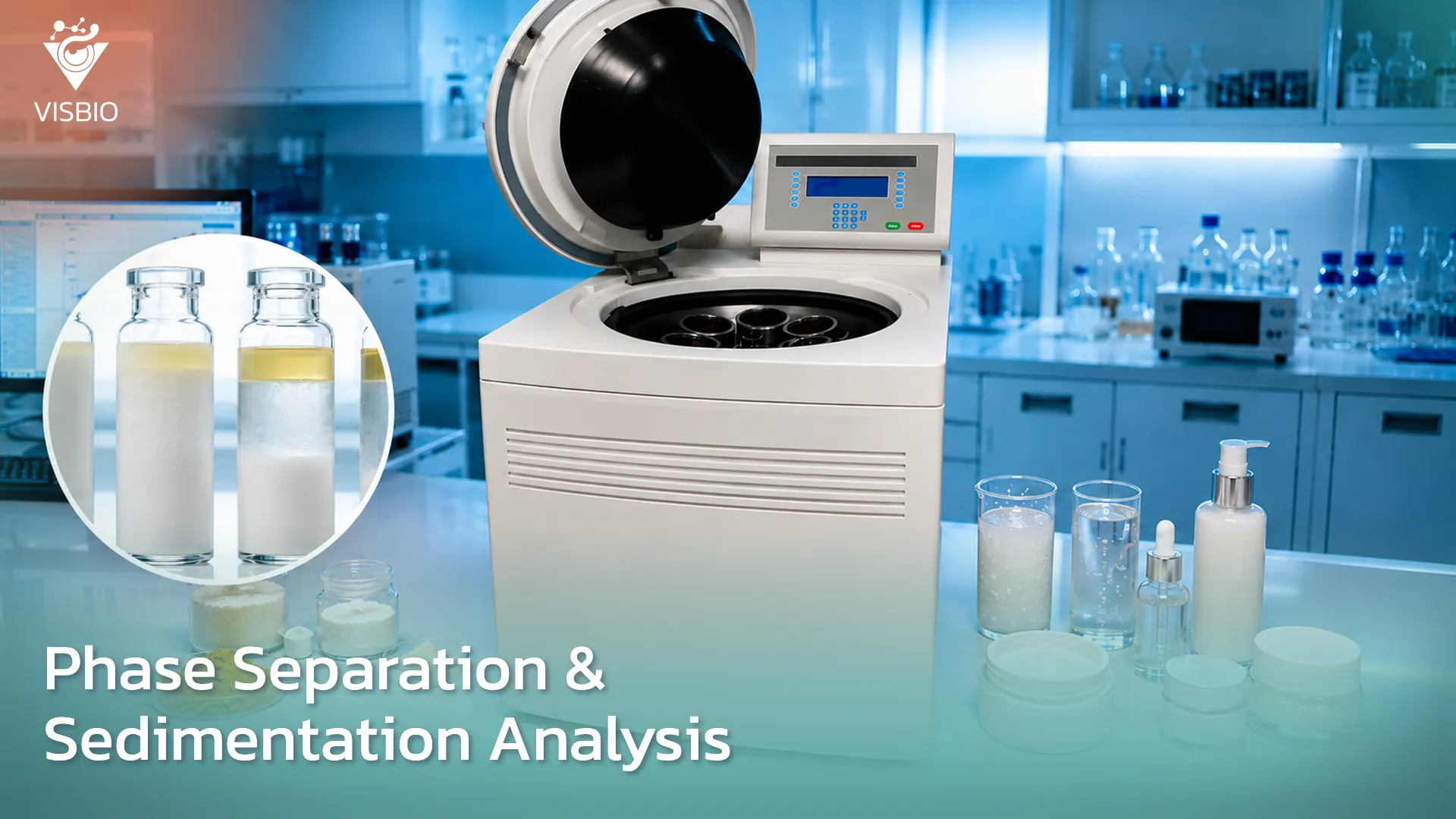
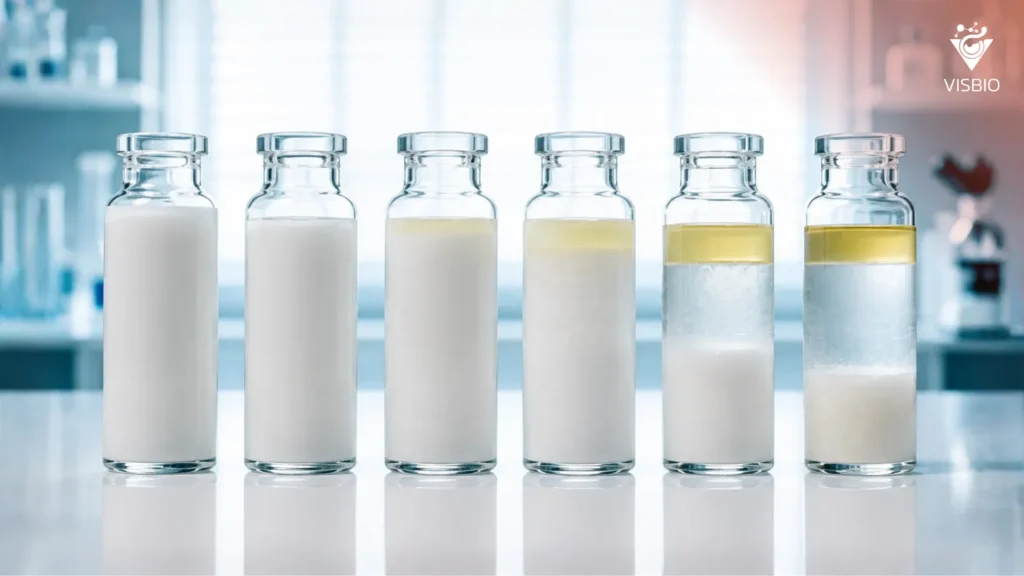
Phase separation is when components of a product that were once mixed into a uniform whole, such as the water and oil in a cream or lotion, separate from each other into visible layers. Sedimentation is when solid particles in a liquid gradually sink and collect at the bottom of the container. Both are signs that a product is becoming unstable, so they are key parameters monitored in stability testing of emulsions and suspensions.
In emulsion cosmetics and liquid dietary supplements that are suspensions, phase separation is a quality problem that consumers notice immediately. A cream that shows water or oil separating on its surface when opened, a serum with colored sediment at the bottom of the bottle, or a herbal syrup whose active ingredients settle to the bottom so that consumers do not receive the same amount each time all make consumers lose confidence in a brand from the first use, and may lead business-to-business (B2B) buyers in export markets to refuse a whole batch.
Phase separation and sedimentation do not happen at random. They are physical processes that can be predicted and measured. Creaming of oil droplets in an oil-in-water emulsion follows Stokes’ law, which states that the rising velocity is directly proportional to the square of the droplet radius and to the density difference between the droplet and the continuous phase, and inversely proportional to the viscosity of the continuous phase (McClements, 2007). Sedimentation of solid particles in a suspension follows the same principle. Controlling phase separation therefore requires a formula designed to balance droplet or particle size, the density of each phase and viscosity.
VISBIO Laboratory provides phase separation and sedimentation analysis in-house by observing samples stored in temperature- and humidity-controlled chambers and by centrifuge testing, approaches widely used in the cosmetics and pharmaceutical industries. Measurement of light scattering along the height of the sample is carried out in collaboration with partner laboratories. The service covers creams, lotions, serums, emulsions, liquid dietary supplements and suspensions.
Why phase separation often limits the shelf life of emulsions and suspensions
At the formulation stage, phase separation is often the parameter that limits the shelf life of an emulsion. Formulas that begin to show creaming in the first week after production usually separate clearly within a few months under normal storage conditions, while formulas that do not separate after centrifugation tend to be more stable. Centrifuge testing can therefore be used to screen formulas early in development without waiting months for storage results. However, centrifuge results are only a preliminary screen: the shelf life stated on the label must be confirmed by stability studies under real storage conditions.
In suspensions such as liquid dietary supplements and herbal syrups, sedimentation of water-insoluble active ingredients determines how consistent the amount received by consumers is from dose to dose. This matters especially for products that state the amount of active ingredient per serving on the label. If the ingredient settles at the bottom of the bottle, consumers may receive less than the stated amount at first and a more concentrated dose than stated as the bottle nears empty. Controlling the stability of a suspension therefore concerns both consumer safety and the accuracy of label statements.
From a regulatory perspective, appearance, including phase separation and sedimentation, is one of the items in the specification that manufacturers under the Cosmetic Act B.E. 2558 (2015), the Herbal Products Act B.E. 2562 (2019) and the Food Act B.E. 2522 (1979) use for quality control, and for some product types it is information submitted to the Thai Food and Drug Administration (Thai FDA). A product that separates beyond what the specification accepts has a quality defect. In the ASEAN market, the ASEAN Cosmetic Directive (ACD) requires the person placing a product on the market to keep a Product Information File (PIF), which must include the specification of the finished product (ASEAN Cosmetic Committee, 2008), and the ASEAN guidelines for the PIF recommend including a Product Stability Summary Report to support the expiry date of products with a durability of less than 30 months (ASEAN Cosmetic Committee, 2007). For emulsion products, phase separation is a key parameter assessed in this set of stability data.
Principles of phase separation and sedimentation analysis
Phase separation and sedimentation analysis uses three basic approaches, chosen according to the purpose of the test.
Approach one: observing samples during storage under controlled conditions
The first approach is visual observation of samples stored under controlled conditions according to the stability study plan, at both long-term (real-time) and accelerated conditions. Long-term conditions are chosen according to the climatic zone of the target market: 25°C/60%RH for Climatic Zone II, 30°C/65%RH for Zone IVa and 30°C/75%RH for Zone IVb, which covers Thailand. The commonly used accelerated condition is 40°C/75%RH (World Health Organization, 2018). VISBIO Laboratory has in-house temperature- and humidity-controlled chambers for these conditions. At each sampling point, the analyst scores phase separation on a 0–5 scale (phase separation grade), where 0 means no separation is seen and higher scores mean more pronounced separation. A commonly used approach treats grades 0–1 as acceptable and grade 3 or above as clear separation that should not be seen in stability test samples. Actual acceptance criteria for each product should be set in its specification.
Approach two: centrifuge testing
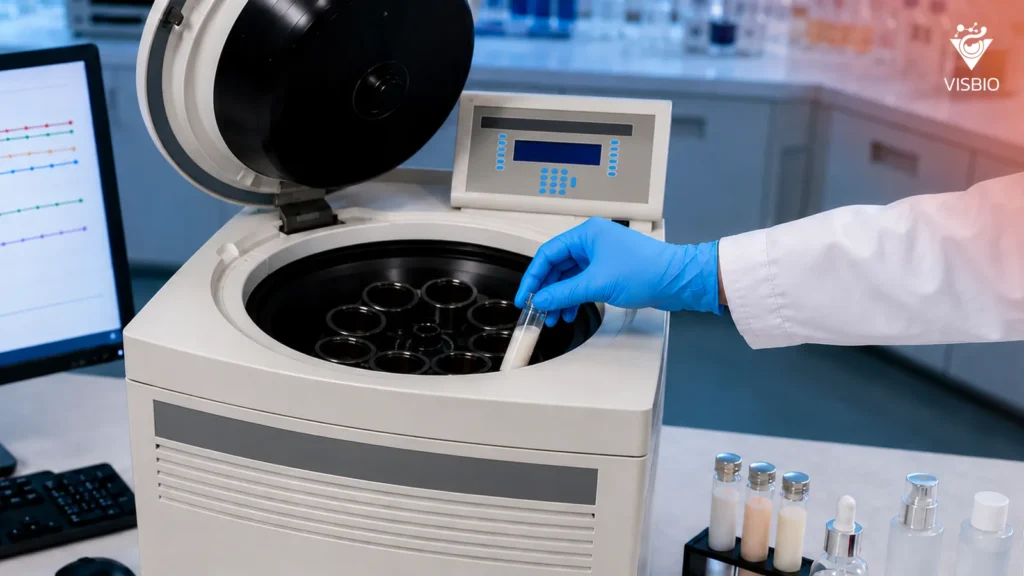
The second approach is the centrifugation stress test, which accelerates creaming and sedimentation with a centrifugal force several hundred times greater than normal gravity or more. Conditions commonly used to screen cosmetics include speeds of 3,000–5,000 revolutions per minute in standard centrifuge tubes, but conditions should be stated as relative centrifugal force (RCF, expressed as multiples of gravity, or × g) together with time, because the same speed gives a different force depending on the rotor radius. Reported results are the phase separation grade after centrifugation, the sediment volume ratio at the bottom of the tube, and the thickness of the cream layer that rises to the top (cream layer thickness) or of any oil layer that separates. Very high centrifugal force may cause changes that would not occur under normal gravity, so centrifuge results are used to compare formulas and screen risk, not to replace stability studies (McClements, 2007).
Approach three: measuring light scattering along the height of the sample
The third approach is analysis by static multiple light scattering. The instrument scans transmitted and backscattered light along the height of a sample left standing, at set intervals. Changes in the signal at the top or bottom of the tube indicate creaming or sedimentation, while changes along the whole tube indicate a change in droplet or particle size, such as droplet coalescence (McClements, 2007). The instrument software summarizes the results as an instability index, whose name and calculation vary by instrument manufacturer. This technique detects changes before they are visible to the naked eye, so it helps compare formulas early in the storage period.
Technical factors that must be controlled
Technically, three factors make test results reliable. The first is keeping the sample temperature constant during testing, because a change of even a few degrees Celsius alters the viscosity and density of each phase and may cause separation that does not reflect the true properties of the formula. The second is choosing a centrifugal force and centrifugation time that suit the product type: thick creams need more force and time than thin lotions, and using the same conditions for every product gives results that do not reflect reality. The third is recording results with photographs taken under controlled lighting and background, so that batches and sampling points can be compared.
Scope of VISBIO Laboratory's phase separation and sedimentation service
VISBIO Laboratory’s service covers three groups of samples:
- Emulsion cosmetics: facial and body creams, lotions, serums, BB creams, sunscreens, cleansing creams and leave-in hair creams
- Liquid dietary supplements and herbal products: herbal syrups, beverages with added active ingredients, fruit juices with added extracts and herbal syrup medicines
- Delivery systems and special dispersions: emulsions containing nanoscale active ingredients, liposomes, nanoemulsions and controlled-release delivery systems
Reported results include the phase separation grade on a 0–5 scale, the sediment volume ratio for suspensions, the cream layer thickness for emulsions, the instability index from light scattering measurement (measured in collaboration with partner laboratories), and the change over time compared with the starting point (T0). Clients can choose a single test for batch release or monitoring at several sampling points throughout a stability study.
Using phase separation and sedimentation results
The results can be used at several stages of a product’s life:
- Research and development: select a suitable emulsifier system from several options, and test the effect of changing a raw-material supplier, which may change emulsion stability.
- Pre-launch: set the baseline for the specification and the acceptable phase separation grade throughout shelf life.
- Commercial production: use centrifuge results as one criterion for factory batch release.
- Stability studies: combine with real-time and accelerated stability studies, as well as freeze-thaw cycling, which simulates the temperature swings of transport, to confirm that the formula does not separate beyond the limit throughout the stated shelf life.
- Export: attach to the Certificate of Analysis (COA) to support incoming inspection by buyers at the destination.
Frequently asked questions about phase separation and sedimentation
What is the difference between phase separation and sedimentation?
Phase separation is when components that were once mixed into a uniform whole, such as the water and oil in a cream, separate into visible layers. Sedimentation is when solid particles in a liquid sink and collect at the bottom of the container. Both are signs of instability monitored in stability testing.
What determines how fast phase separation happens?
According to Stokes’ law, the speed at which droplets and particles rise or sink increases with the square of their radius and with the density difference between the phases, and decreases as the viscosity of the continuous phase increases. Controlling droplet size, the density of each phase and viscosity is therefore at the heart of designing a stable formula.
If a product does not separate after centrifugation, does that establish its shelf life?
No. Centrifugation is used to screen and compare formulas early in development. Formulas that do not separate after centrifugation tend to be more stable, but the shelf life stated on the label must be confirmed by stability studies under real storage conditions.
Why should centrifugal force be stated in × g rather than revolutions per minute?
Because the same speed gives a different centrifugal force depending on the rotor radius. Stating relative centrifugal force (× g) together with time makes results comparable between instruments and between laboratories.
What information does the phase separation report include?
The report includes the phase separation grade on a 0–5 scale, the sediment volume ratio for suspensions, the cream layer thickness for emulsions, the instability index from light scattering measurement when the client chooses this method, and the change over time compared with the starting point (T0). Clients can choose between a single test for batch release and monitoring throughout a stability study.
What types of samples does VISBIO Laboratory accept?
Emulsion cosmetics such as creams, lotions, serums and sunscreens; liquid dietary supplements and herbal products such as herbal syrups and beverages with added active ingredients; and special delivery systems such as liposomes and nanoemulsions.
References:
- ASEAN Cosmetic Committee. (2007). ASEAN cosmetic directive: Guidelines for product information file (PIF). ASEAN Secretariat.
- ASEAN Cosmetic Committee. (2008). ASEAN Cosmetic Directive. ASEAN Secretariat.
- McClements, D. J. (2007). Critical review of techniques and methodologies for characterization of emulsion stability. Critical Reviews in Food Science and Nutrition, 47(7), 611–649. https://doi.org/10.1080/10408390701289292
- World Health Organization. (2018). Annex 10: Stability testing of active pharmaceutical ingredients and finished pharmaceutical products. In WHO Expert Committee on Specifications for Pharmaceutical Preparations: Fifty-second report (WHO Technical Report Series, No. 1010, pp. 309–352). World Health Organization.
- Royal Thai Government Gazette. (1979, May 13). Food Act B.E. 2522 (1979). Royal Thai Government Gazette, 96(79 Kor), 1–24.
- Royal Thai Government Gazette. (2015, September 8). Cosmetic Act B.E. 2558 (2015). Royal Thai Government Gazette, 132(86 Kor), 1–22.
- Royal Thai Government Gazette. (2019, April 30). Herbal Products Act B.E. 2562 (2019). Royal Thai Government Gazette, 136(56 Kor), 116–161.