

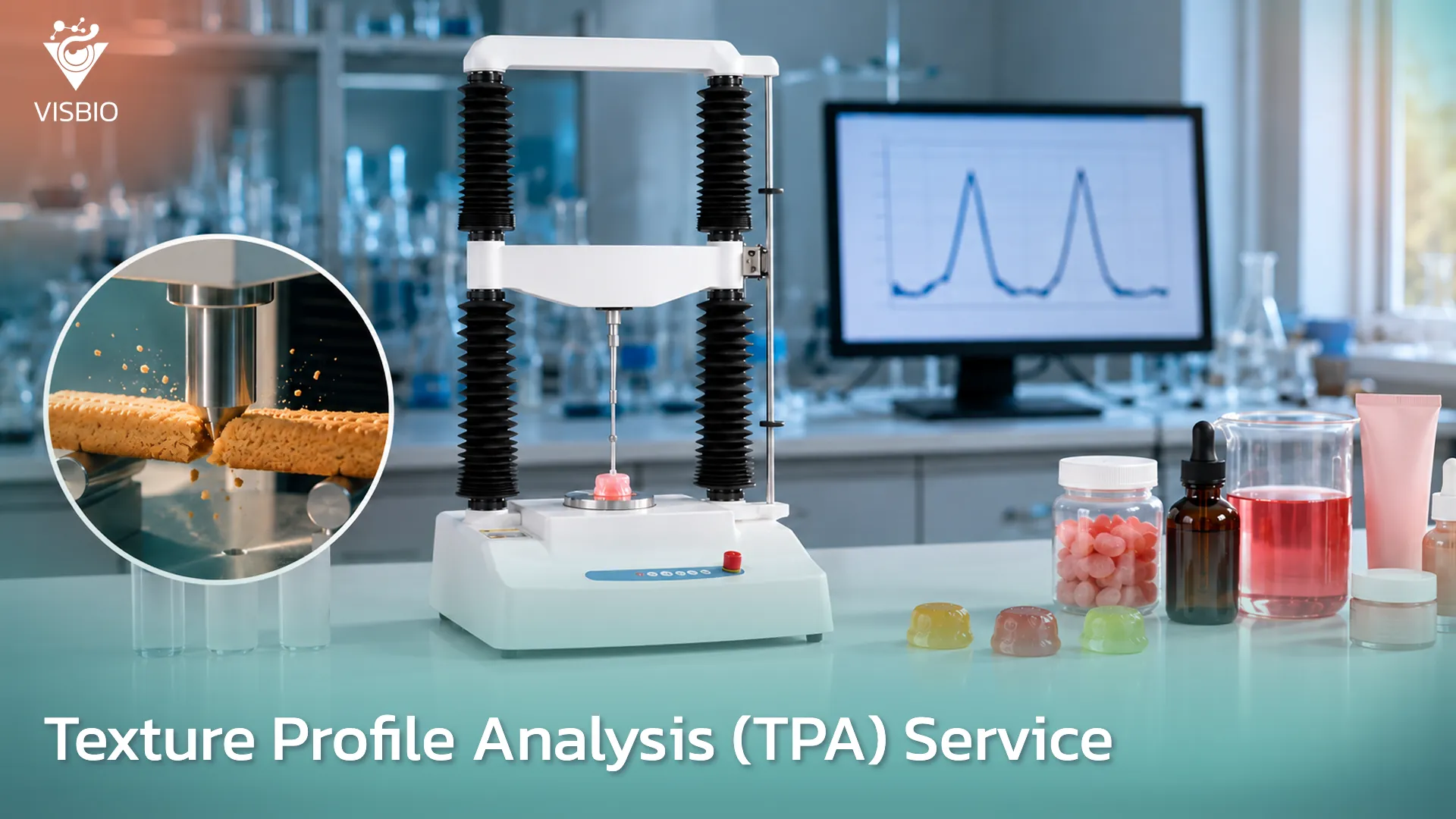
Texture profile analysis (TPA) is the measurement of hardness, springiness, chewiness and other texture attributes as numbers, using a texture analyzer that compresses a sample twice in succession to imitate human biting. The results can be compared between formulas, between batches and across storage time, so they can be used alongside sensory assessment by panelists.
In Thailand’s and ASEAN’s premium snack and dietary supplement markets, consumers and business-to-business (B2B) buyers judge product quality by mouthfeel before they judge taste or nutritional value. Snacks that are crisp on day one but soft by month six, soft chews that become too hard to chew when moisture changes during storage, jellies that lose their bounce and turn soft and runny, or dietary supplement gummies that stick together in clumps inside the pack are the reasons trading houses reject whole batches and consumers do not buy again.
Texture is not an attribute that can be judged by touch alone. It is a scientific quantity that can be recorded with a texture analyzer, which simulates human biting, chewing and finger pressing. TPA, developed in the 1960s, built on Szczesniak’s (1963) classification of textural characteristics and became a common language that food scientists, brand formulators, sales teams and B2B buyers use to discuss crispness, hardness, springiness and chewiness as verifiable numbers.
VISBIO Laboratory, in collaboration with partner laboratories, provides texture analysis with a texture analyzer for crisp snacks, gummies, chewable tablets, jellies, dried fruit, chewable dietary supplements and semi-solid cosmetics. The service can be used in formulation development, batch release and texture monitoring during stability testing.
Why texture determines both mouthfeel and shelf life
The texture of food and cosmetic products reflects several phenomena happening at the same time. In crisp snacks, both fried and baked, a long-term loss of crispness usually comes from moisture uptake by the starch and protein in the structure, which softens a structure that was once hard and brittle, collapses the pores and makes the product soft. An increase in hardness in snacks and gummies usually comes from loss of the water held in the gel network, or from the Maillard reaction, which forms cross-links in the protein network.
In jellies and dietary supplement gummies, springiness and cohesiveness are indices of the stability of the pectin or gelatin network used to form the gel. A fall in both values often means that the hydrocolloid network is breaking down because of a change in pH, temperature or water migration. In chewy confectionery, chewiness, calculated as the product of hardness, cohesiveness and springiness, is often used as a single number that summarizes the feel during chewing.
In semi-solid cosmetics and herbal products, a change in texture is a sign that the formulation system is unstable. A balm that is too soft may melt and lose its shape during sea shipment to tropical countries, a lipstick that is too hard and brittle may break when it is twisted up for use, and a brittle pressed foundation may crack during transport.
From a regulatory perspective, these products fall under different laws: the Food Act B.E. 2522 (1979), the Cosmetic Act B.E. 2558 (2015) and the Herbal Products Act B.E. 2562 (2019). Texture is part of the appearance characteristics that manufacturers define in the specification for quality control, so a product whose texture changes beyond the set limit is a quality defect. In export markets, some buyers set the acceptable range of hardness drift and cohesiveness drift in their trade agreements.
Principles of texture analysis by double compression (two-bite test)
TPA imitates two consecutive human bites. The probe of the texture analyzer compresses the sample to a set distance, for example 50% or 75% of the sample’s height, twice in succession with a rest period in between. The instrument records force against distance and time, and processes the data into seven main quantitative parameters:
- Hardness: the peak force of the first compression
- Springiness: the distance by which the sample recovers before the second compression
- Cohesiveness: the ratio of the area under the curve of the second compression to the area under the curve of the first compression
- Adhesiveness: the negative-force area after the first compression, caused by the sample sticking to the probe as the probe lifts
- Gumminess: the product of hardness and cohesiveness, used for semi-solid products
- Chewiness: the product of hardness, cohesiveness and springiness, used for solid products
- Resilience: the ratio of the energy the sample returns as the probe lifts to the energy used in the first compression
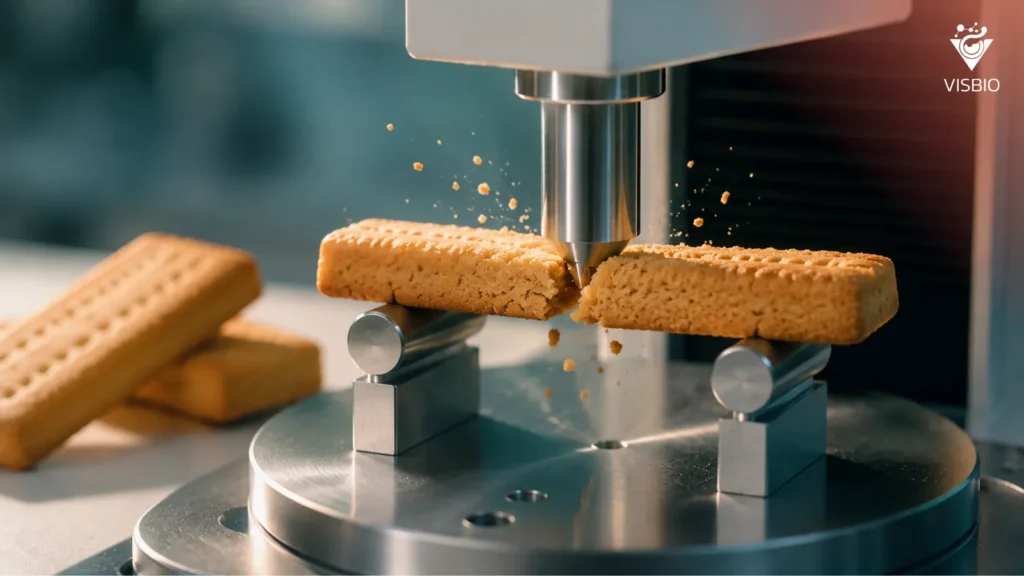
Beyond TPA, in the scientific literature a texture analyzer can also be used for other specialized tests when fitted with suitable fixtures. For example, a 3-point bend test is used for snack bars and cookies to measure brittleness and breaking force; a penetration test is used for creams and balms to assess firmness and spreadability; a cylinder compression test, based on the same principle as the method for measuring bread firmness (AACC International, 2010), is used for soft chews and chewable tablets; and a tensile test is used for sheet masks and films. These tests each require their own dedicated fixtures and are separate from TPA, which is the main service on this page.
Scope of VISBIO Laboratory's texture analysis service
VISBIO Laboratory’s service, carried out in collaboration with partner laboratories, covers four groups of samples:
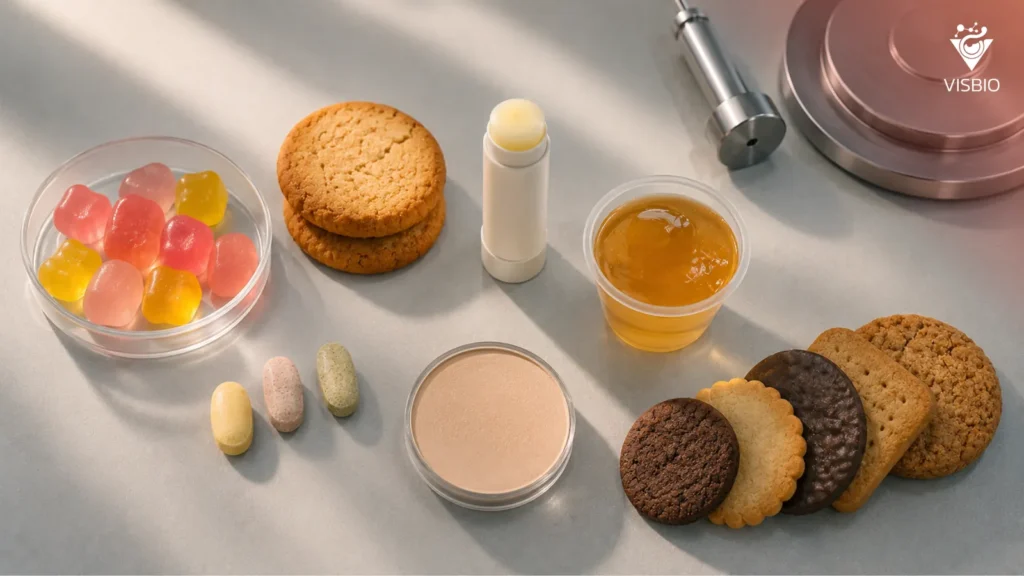
- Snacks: crisp snacks, cookies, snack bars, dried fruit, cereal-based snacks and healthy snacks
- Chewable dietary supplements: gummies, chewables, soft chews and chewable tablets
- Jellies and desserts: jelly cups, konjac jelly, and gelatin- or pectin-based products
- Semi-solid or solid cosmetics and herbal products: balms, lipsticks, pressed foundations, eye shadows and molded products
Using texture analysis results
Texture analysis results can be used at several stages of a product’s life:
- Research and development: compare prototype formulas using TPA values, and test the effect of changing the supplier of a key raw material.
- Pre-launch: set the baseline for the specification and the acceptable change in hardness for batch release.
- Commercial production: use as a batch-release criterion, and combine with stability studies to confirm that the product keeps the texture defined in its specification throughout shelf life, in both real-time stability and accelerated stability studies.
- Export: attach to the Certificate of Analysis (COA) to support buyers’ incoming inspection.
Frequently asked questions about texture profile analysis (TPA)
What is texture profile analysis (TPA)?
TPA is the measurement of hardness, springiness, chewiness and other texture attributes as numbers, using a texture analyzer that compresses a sample twice in succession to imitate human biting. The results are used to compare formulas and batches and to track texture throughout shelf life.
How does a texture analyzer work?
The probe compresses the sample to a set distance, for example 50% or 75% of the sample’s height, twice in succession with a rest period in between. The instrument records force against distance and time and calculates the texture parameters.
What values does TPA give?
There are seven main values: hardness, springiness, cohesiveness, adhesiveness, gumminess for semi-solid products, chewiness for solid products, and resilience.
Why does the texture of snacks or gummies change during storage?
Crisp snacks usually soften because the starch and protein in their structure absorb moisture. Snacks and gummies that become harder have usually lost water from the gel network or undergone the Maillard reaction, while jellies that lose their bounce usually have a hydrocolloid network that is breaking down because of pH, temperature or water migration.
What types of samples does VISBIO Laboratory accept for texture analysis?
Four groups: snacks such as crisp snacks, cookies and snack bars; chewable dietary supplements such as gummies and chewable tablets; jellies and desserts; and semi-solid cosmetics or herbal products such as balms, lipsticks and pressed foundations.
How can texture analysis results be used?
They can be used to compare prototype formulas and the effect of changing raw-material suppliers, to set the baseline for the specification, to release batches and track texture during stability studies, and as an attachment to the Certificate of Analysis for export.
References:
- AACC International. (2010). Measurement of bread firmness by universal testing machine (Approved Method 74-09.01). AACC International.
- Szczesniak, A. S. (1963). Classification of textural characteristics. Journal of Food Science, 28(4), 385–389. https://doi.org/10.1111/j.1365-2621.1963.tb00215.x
- Royal Thai Government Gazette. (1979, May 13). Food Act B.E. 2522 (1979). Royal Thai Government Gazette, 96(79 Kor), 1–24.
- Royal Thai Government Gazette. (2015, September 8). Cosmetic Act B.E. 2558 (2015). Royal Thai Government Gazette, 132(86 Kor), 1–22.
- Royal Thai Government Gazette. (2019, April 30). Herbal Products Act B.E. 2562 (2019). Royal Thai Government Gazette, 136(56 Kor), 116–161.