

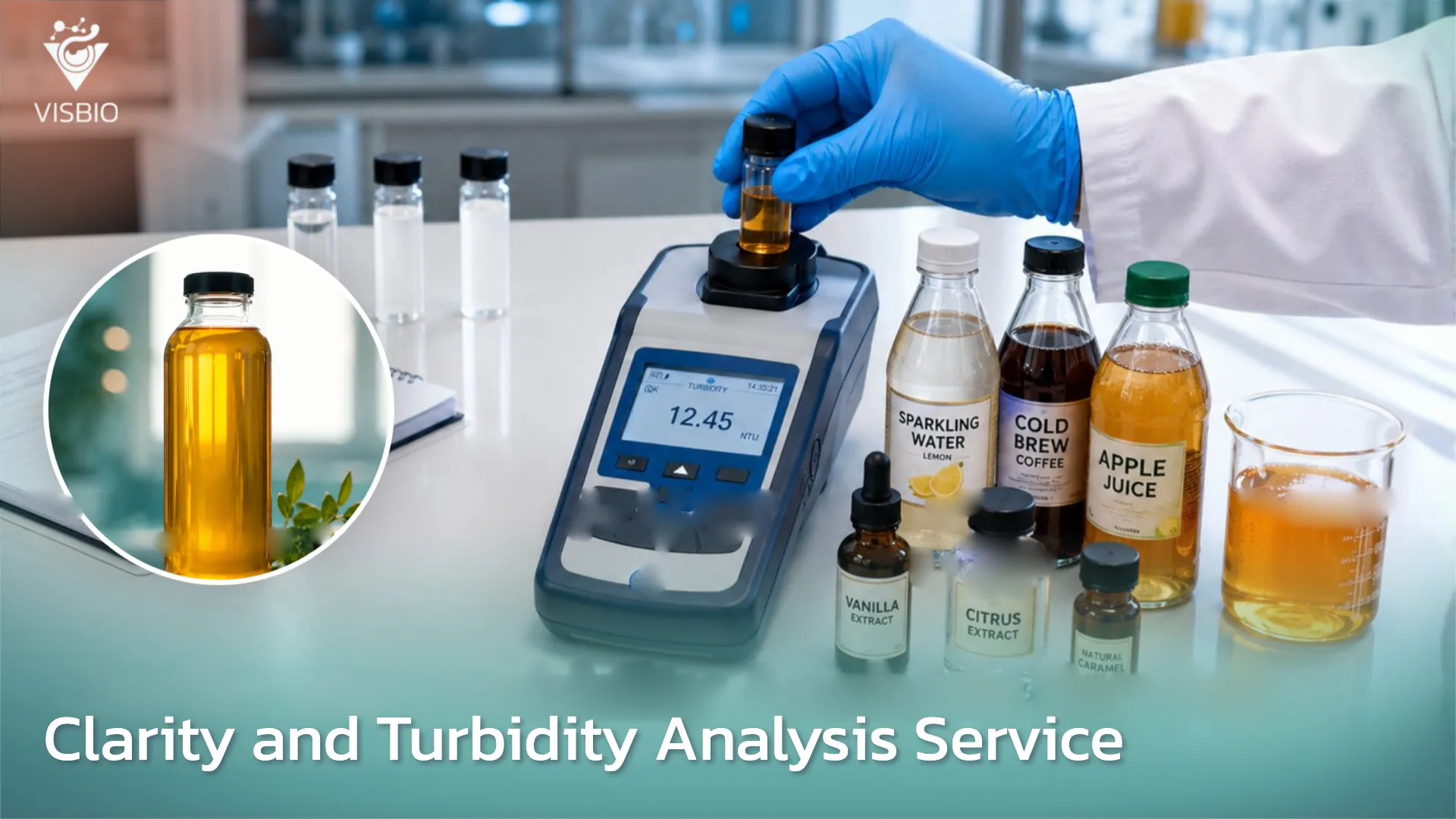
Turbidity is the degree to which a liquid loses its clarity because small suspended particles scatter the light that passes through it. Turbidity can be measured as a number in Nephelometric Turbidity Units (NTU), while clarity is usually reported as percent transmittance (%T). Once clarity becomes a number, manufacturers can set limits, release batches and track changes throughout shelf life before consumers can see any haze with the naked eye.
In Thailand’s markets for functional drinks and liquid herbal extracts, clarity is the first thing consumers and business-to-business (B2B) buyers use to judge quality, before efficacy or taste can be proven. A beverage that starts to turn cloudy within 3 months of filling, a liquid extract that forms sediment during storage, or a toner or essence that becomes hazy when the temperature changes are all signals that lead consumers and distribution channels to stop buying again, and reasons why importers and trading houses in export markets refuse goods.
Turbidity does not appear at random. It results from measurable chemical and physical processes, such as precipitation of bioactive compounds when pH changes, binding of proteins with tannins in cold-extracted beverages, the Maillard reaction forming brown polymers, or aggregation of particles in an unstable encapsulation system. Every one of these mechanisms changes the instrument reading before consumers can see the change with the naked eye.
VISBIO Laboratory, in collaboration with partner laboratories, provides quantitative turbidity and clarity measurement: turbidity in NTU or FNU with a turbidimeter, and light transmittance (%T) with a spectrophotometer. The service covers beverages, liquid extracts and clear cosmetics, and can be used in formulation development, batch release and clarity monitoring during stability testing.
Why clarity and turbidity matter
For functional drink brands and clear cosmetics, clarity is a market value that consumers perceive immediately. Products that stay consistently clear throughout their shelf life can be positioned as premium products, whereas products that begin to turn cloudy lose commercial value as soon as consumers or retail buyers notice. Clarity therefore does two jobs at once: it can both create and destroy a product’s value.
A change in turbidity is also an indicator that the formulation system is deteriorating. In functional drinks containing several herbal extracts, a rising NTU value often means precipitation of tannins, which are phenolic compounds, precipitation of active compounds when pH changes, or loss of performance of the emulsifier that keeps oil dispersed in water. In cosmetics such as toners and essences, haze often means that the solubilizer used to dissolve water-insoluble actives is losing effectiveness. In encapsulation systems such as liposomes and nanoemulsions, rising turbidity is often a sign of particle aggregation or coalescence, which may occur together with leakage of the encapsulated material and a drop in encapsulation efficiency.
From a regulatory and trade perspective, appearance, including clarity and turbidity, is one of the items in the specification that manufacturers use to control quality in line with the law for each product type: the Food Act B.E. 2522 (1979) for beverages and the Cosmetic Act B.E. 2558 (2015) for toners and essences. A batch whose turbidity exceeds the limit in the specification does not meet the specification, and the cause must be investigated before any decision to release it for sale. In export markets, some buyers set a maximum acceptable turbidity in their agreements and use the value shown on the Certificate of Analysis (COA) as the acceptance criterion for each batch.

Principles of turbidity and clarity measurement: light scattering and light transmission
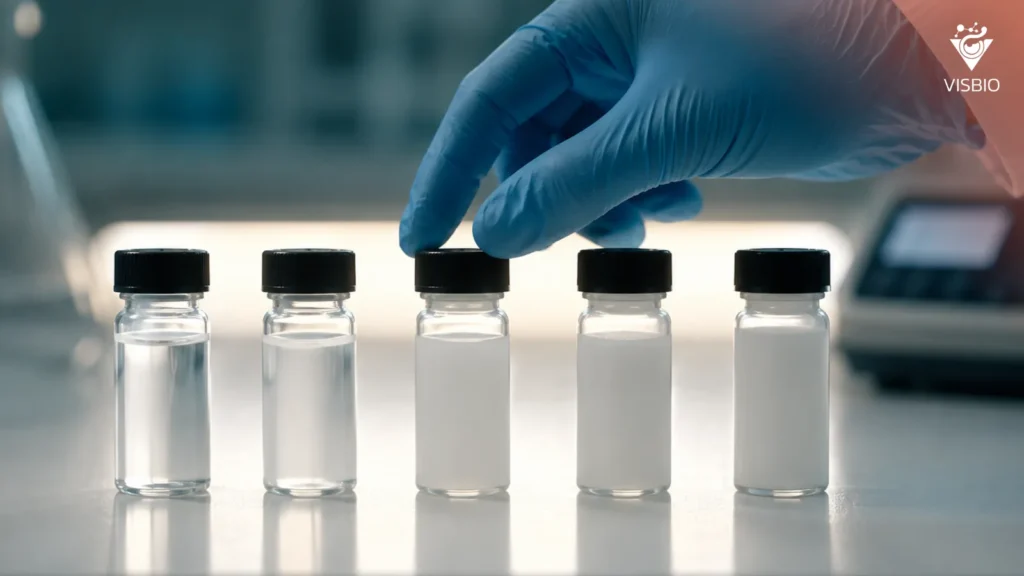
Turbidity is measured using two main principles. The first is nephelometry, which measures light scattered at 90 degrees to the beam that passes into the sample. Results are reported in NTU or in Formazin Nephelometric Units (FNU), depending on the type of light source: NTU is used with instruments that use white light, and FNU with instruments that use infrared light. Both are calibrated with formazin standards, but when real samples are measured, especially colored samples, the two types may not give the same number, so the report must always state the unit used. This principle is the basis of standard water-quality methods such as EPA Method 180.1 (United States Environmental Protection Agency, 1993) and is highly sensitive when a sample is clear or only slightly turbid.
The second principle is turbidimetry, which measures the attenuation of light passing through the sample with a spectrophotometer at a set wavelength. Results are reported as percent transmittance (%T) or in Formazin Attenuation Units (FAU) (United States Pharmacopeial Convention, 2023). This approach is widely used in product development laboratories because it uses the same type of instrument that is used to measure the color of solutions and the content of some active compounds, and it suits very turbid samples, in which the scattered-light signal at 90 degrees no longer rises in proportion to turbidity. However, FAU values are not equivalent to NTU values and should not be used interchangeably when the limit in a specification or in a buyer agreement is set in NTU. The choice of principle and reporting unit must therefore match the purpose for which the results will be used.
Scope of VISBIO Laboratory's turbidity and clarity service
VISBIO Laboratory’s service, carried out in collaboration with partner laboratories, covers three groups of samples:
- Beverages: functional drinks, ready-to-drink beverages, fruit juices, cold-extracted teas, beverages with added active ingredients, herbal syrups and probiotic beverages
- Extracts and raw materials: liquid extracts, concentrated extracts, herbal extracts in hydroalcoholic solvents, and essential oils dissolved in solvents
- Clear cosmetics: toners, essences, ampoules and mists
Results are reported as turbidity in NTU or FNU for scattered-light measurement, or as %T for transmitted-light measurement, using the principle that suits the sample and the purpose for which the results will be used.
Using turbidity and clarity results
The results can be used at several stages of a product’s life:
- Research and development: compare prototype formulas using NTU and %T values to select the solubilizer or encapsulation system that keeps clarity most consistent over the long term.
- Pre-launch: set the baseline for the specification and the acceptable change in turbidity (ΔNTU) throughout shelf life.
- Commercial production: use as a batch-release criterion, and combine with stability studies to confirm that the product remains as clear as defined in the specification.
- Export: attach to the Certificate of Analysis to support buyers’ incoming inspection.
Frequently asked questions about turbidity
What is turbidity?
Turbidity is the degree to which a liquid loses its clarity because small suspended particles scatter light. It can be measured as a number in NTU or FNU, while clarity is usually reported as percent transmittance (%T).
What is the difference between NTU and FNU?
Both units come from measuring light scattered at 90 degrees, and both are calibrated with formazin standards. The difference lies in the light source: NTU is used with instruments that use white light, and FNU with instruments that use infrared light. The two may give different numbers for real samples, especially colored ones, so the unit used should always be stated.
Should turbidity be measured by light scattering or by light transmission?
Scattered-light measurement (nephelometry) is highly sensitive when a sample is clear or only slightly turbid, while transmitted-light measurement (turbidimetry) suits very turbid samples. FAU values from transmitted-light measurement are not equivalent to NTU, so the principle should match the unit set in the specification or in the buyer agreement.
Why do beverages or toners become cloudy during storage?
There are several possible causes, such as precipitation of tannins or active compounds when pH changes, binding of proteins with tannins, the Maillard reaction, and aggregation of particles in encapsulation systems. In toners and essences, haze usually comes from a solubilizer that has lost its effectiveness.
What types of samples does VISBIO Laboratory accept for turbidity measurement?
Three groups: beverages such as functional drinks, fruit juices and cold-extracted teas; extracts and raw materials such as liquid extracts and concentrated extracts; and clear cosmetics such as toners, essences, ampoules and mists.
How can turbidity results be used?
They can be used to compare prototype formulas in research and development, to set the baseline and ΔNTU limit in the specification before launch, to release batches and monitor clarity during stability studies, and as an attachment to the Certificate of Analysis for export.
References:
- United States Environmental Protection Agency. (1993). Determination of turbidity by nephelometry (Method 180.1). U.S. EPA.
- United States Pharmacopeial Convention. (2023). Nephelometry, turbidimetry, and visual comparison (USP <855>). USP.
- Royal Thai Government Gazette. (1979, May 13). Food Act B.E. 2522 (1979). Royal Thai Government Gazette, 96(79 Kor), 1–24.
- Royal Thai Government Gazette. (2015, September 8). Cosmetic Act B.E. 2558 (2015). Royal Thai Government Gazette, 132(86 Kor), 1–22.