

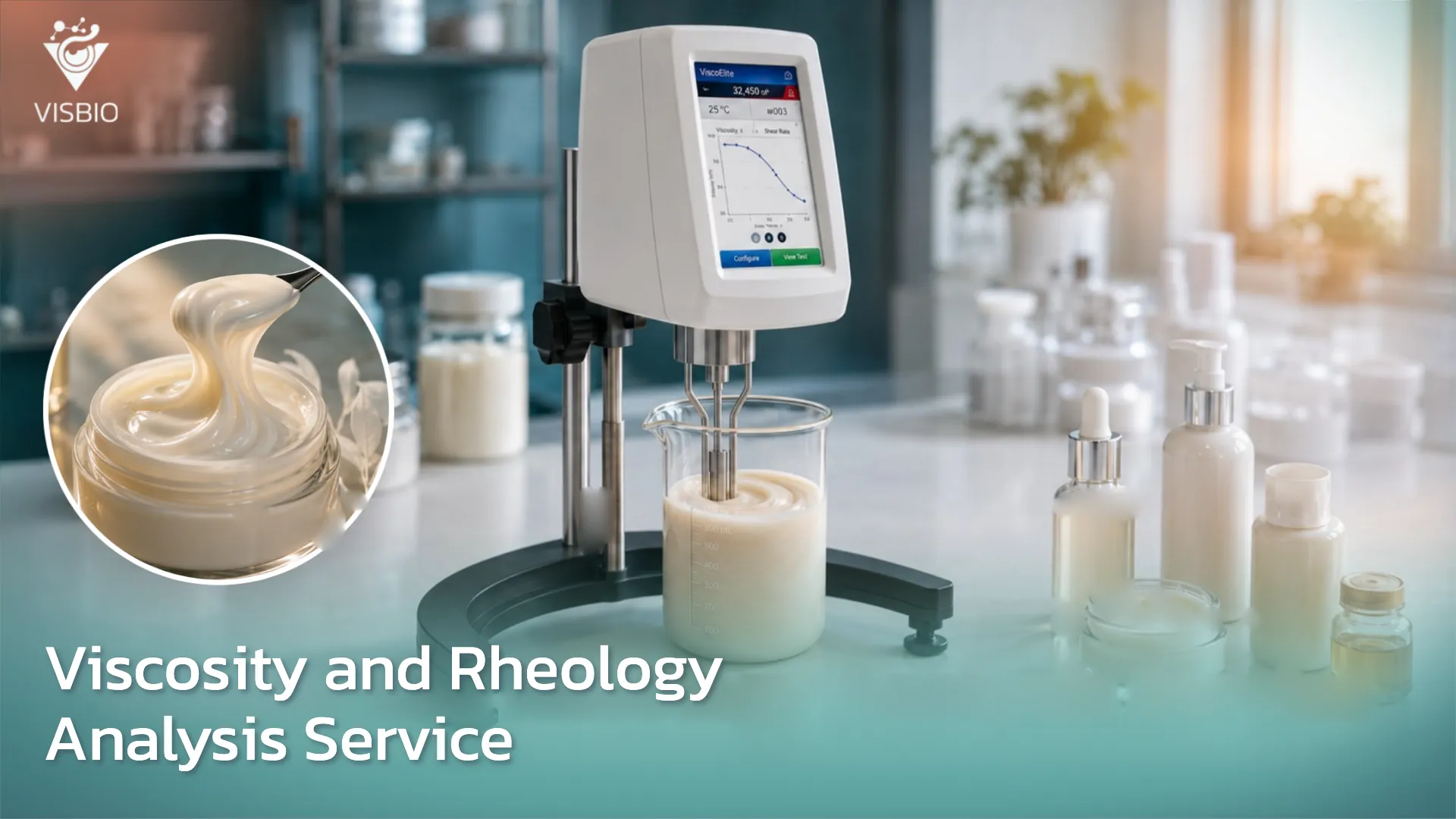
Viscosity is a liquid’s resistance to flow, which is why honey flows more slowly than water: it is more viscous. Rheology is the science of how materials flow and deform, and it shows how a product’s viscosity changes when it is squeezed, poured or applied. Together, these two sets of data are used to control both the texture that users perceive and the stability of the product throughout its shelf life.
In Thailand’s cosmetics and dietary supplement supply chains, viscosity is a property that consumers notice from the moment they squeeze a tube or open a bottle. A cream that flows too quickly feels thin and poor value; a serum that is too viscous feels heavy on the skin and is hard to wash off; a lotion whose viscosity changes between the first and sixth month makes consumers suspect the product has gone bad; and a dietary supplement syrup that is not viscous enough to keep particles suspended will let the active ingredients settle, so consumers do not receive the same amount in every dose.
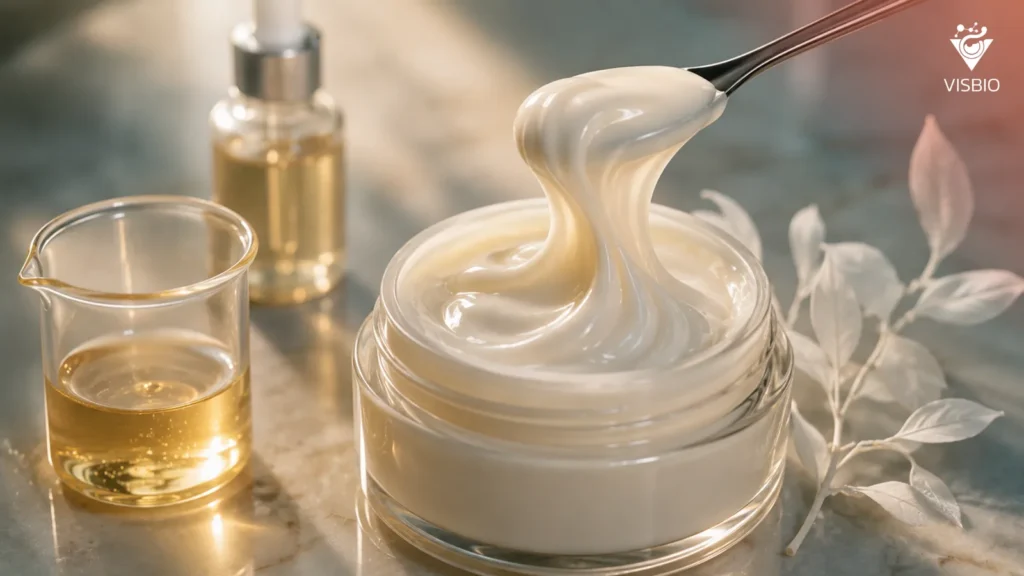
Viscosity and flow behavior are not a single number but a set of data describing how a product behaves under different conditions. A cream with well-designed rheology has a high viscosity at rest (the viscosity as the shear rate approaches zero, or zero-shear viscosity) to hold oil droplets in place, yet flows out easily when squeezed and spreads smoothly under the fingertips, a behavior known as shear-thinning. An emulsion with a suitable yield stress helps prevent phase separation over the long term, while well-designed thixotropy lets a lip gloss or mascara stay viscous enough in the tube to hold its shape, yet glide and spread smoothly when applied.
VISBIO Laboratory measures viscosity and flow behavior in-house with a rotational viscometer and a rheometer, covering creams, lotions, serums, gels, syrups, oils and many types of emulsion systems. The service can be used in formulation development, batch release and viscosity monitoring during stability testing.
Why viscosity and flow behavior matter
Viscosity and flow behavior are key properties that shape the user experience of cosmetics and liquid products. Many brands therefore pay close attention to rheology design, because it can create a difference in quality even when the base formula is similar to a competitor’s. Commercially, well-designed viscosity helps a product to be positioned at a higher price point, and business-to-business (B2B) buyers often select contract manufacturers (OEM) on their ability to deliver goods that meet the rheological specification in every batch.
Beyond the user experience, viscosity is also a mechanism that protects a formulation against separation and sedimentation. In emulsion cosmetics, a low-shear viscosity high enough to slow the movement of oil droplets in the continuous phase, in line with Stokes’ law, helps prevent creaming of the oil droplets and sedimentation over the long term. In dietary supplement syrups and suspensions, viscosity keeps particles of insoluble active ingredients evenly distributed throughout shelf life. In herbal beverages thickened with hydrocolloids such as xanthan gum, shear-thinning behavior helps keep fruit pulp or fine particles suspended while the drink stands still, yet it can still be poured easily.
From a regulatory perspective, viscosity is one of the physical properties that manufacturers define in the specification for quality control in line with the law for each product type: the Cosmetic Act B.E. 2558 (2015), the Herbal Products Act B.E. 2562 (2019) and the Food Act B.E. 2522 (1979). The acceptable viscosity range depends on the type of formula; some manufacturers set it at about ±20% to ±25% of the target value. A product whose viscosity deviates beyond the defined range does not meet the specification. In export markets, some buyers set a maximum viscosity deviation in their agreements and ask for the value to be shown on the Certificate of Analysis (COA).
Principles of viscosity and flow behavior measurement
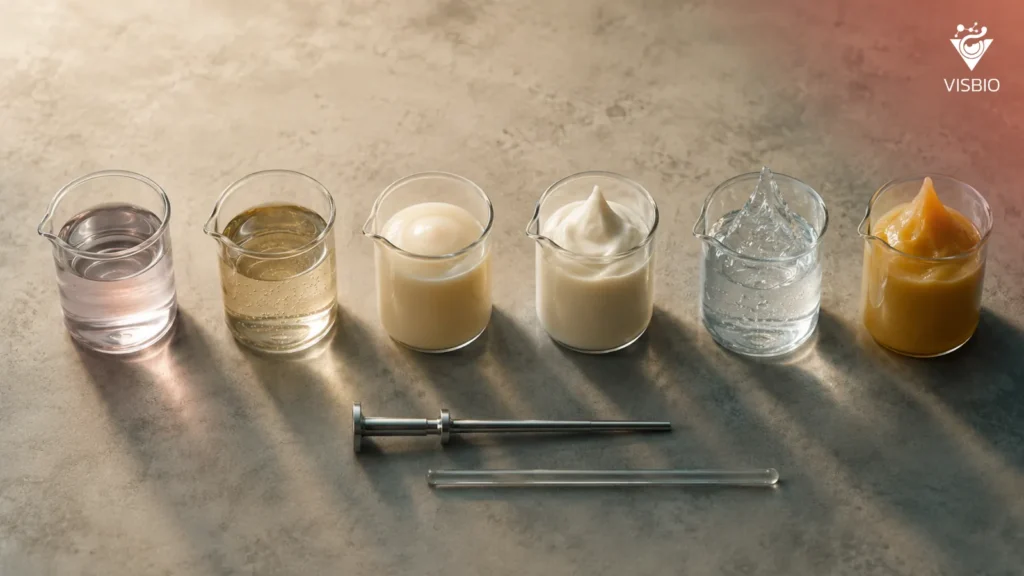
In physics, viscosity is the ratio of shear stress to shear rate, expressed in pascal-seconds (Pa·s) or centipoise (cP), where 1 cP equals 1 millipascal-second (mPa·s). Newtonian fluids have a constant viscosity that does not depend on shear rate, for example water, pure oils and clear syrups. Non-Newtonian fluids have a viscosity that changes with shear rate, so the measurement conditions must always be stated for results to be comparable.
Non-Newtonian fluids can be grouped by behavior into the following main types:
- Shear-thinning (pseudoplastic): viscosity falls as shear rate rises, as in moisturizing creams and lotions. This behavior makes a product viscous in the bottle, yet it flows when squeezed and spreads smoothly.
- Shear-thickening (dilatant): viscosity rises as shear rate rises; this is uncommon in cosmetics.
- Bingham plastic: the material must receive a minimum shear stress (the yield stress) before it starts to flow, as in mayonnaise and some toothpaste formulas.
- Thixotropy: viscosity falls under continuous shear over time and gradually recovers when shearing stops, as in lip glosses and hair styling gels.
Measurements are made with two main types of instrument, and VISBIO Laboratory has both. The first is the rotational viscometer, which rotates a spindle in a temperature-controlled sample and reports viscosity as a single value at a given spindle and rotational speed, so the spindle, speed and temperature must always be reported. This type of instrument is widely used for batch release (United States Pharmacopeial Convention, 2023). The second is the rheometer, which controls shear stress or shear rate over a wide range and can therefore measure flow curves, yield stress and thixotropic behavior (International Organization for Standardization, 2021).
Scope of VISBIO Laboratory's viscosity and rheology service
VISBIO Laboratory’s service covers five groups of samples:
- Emulsion cosmetics: creams, lotions, serums, BB creams, sunscreens and leave-in conditioners
- Gel and liquid cosmetics: skin gels, toners, essences, facial cleansing gels, hair styling gels and leave-in hair serums
- Surfactant-based products: shampoos, shower creams and cleansing products
- Syrup products: herbal syrups, syrup medicines, honey and thick functional drinks
- Oil products: facial oils, body oils and hair oils
Using viscosity and rheology results
The results can be used at several stages of a product’s life:
- Research and development: compare prototype formulas using flow curves to select the rheology modifier that gives the texture the brand wants, and test the effect of changing the supplier of a key raw material, such as carbomer, xanthan gum or cellulose derivatives.
- Pre-launch: set the baseline and the acceptable viscosity drift for batch release.
- Commercial production: use as a batch-release criterion, and combine with stability studies to confirm that flow behavior still meets the specification throughout shelf life, in real-time, accelerated and freeze-thaw cycling studies.
- Export: attach to the Certificate of Analysis to support buyers’ incoming inspection.
Frequently asked questions about viscosity
What is viscosity?
Viscosity is a liquid’s resistance to flow. In physics, it is the ratio of shear stress to shear rate, expressed in Pa·s or cP, where 1 cP equals 1 mPa·s. A highly viscous liquid such as honey flows more slowly than a low-viscosity liquid such as water.
What is the difference between viscosity and rheology?
Viscosity is a value that describes resistance to flow, while rheology is the science of how materials flow and deform as a whole, including how viscosity changes when a product is squeezed, poured or applied, the yield stress and thixotropic behavior.
Why must viscosity results state the spindle, speed and temperature?
Because most creams, lotions and gels are non-Newtonian fluids, their viscosity changes with shear rate. Values measured with a different spindle or rotational speed therefore cannot be compared directly, and temperature also affects viscosity.
What is the difference between shear-thinning and thixotropy?
Shear-thinning is an immediate fall in viscosity as shear rate rises, as in a cream that flows easily when squeezed. Thixotropy is a fall in viscosity under continuous shear over time, followed by gradual recovery when shearing stops, as in a lip gloss that is viscous in the tube but glides when applied.
How does viscosity relate to the stability of creams and syrups?
A low-shear viscosity high enough to slow the movement of oil droplets, in line with Stokes’ law, helps prevent creaming and phase separation in creams. In syrups and suspensions, viscosity keeps particles of active ingredients evenly distributed throughout shelf life.
What types of samples does VISBIO Laboratory accept for viscosity measurement?
Five groups: emulsion cosmetics such as creams, lotions and sunscreens; gel and liquid cosmetics such as skin gels and toners; surfactant-based products such as shampoos and shower creams; syrup products such as herbal syrups and honey; and oil products for skin and hair.
References:
- International Organization for Standardization. (2021). Rheology — Part 2: General principles of rotational and oscillatory rheometry (ISO 3219-2:2021). ISO.
- United States Pharmacopeial Convention. (2023). Viscosity — Rotational methods (USP <912>). USP.
- Royal Thai Government Gazette. (1979, May 13). Food Act B.E. 2522 (1979). Royal Thai Government Gazette, 96(79 Kor), 1–24.
- Royal Thai Government Gazette. (2015, September 8). Cosmetic Act B.E. 2558 (2015). Royal Thai Government Gazette, 132(86 Kor), 1–22.
- Royal Thai Government Gazette. (2019, April 30). Herbal Products Act B.E. 2562 (2019). Royal Thai Government Gazette, 136(56 Kor), 116–161.