

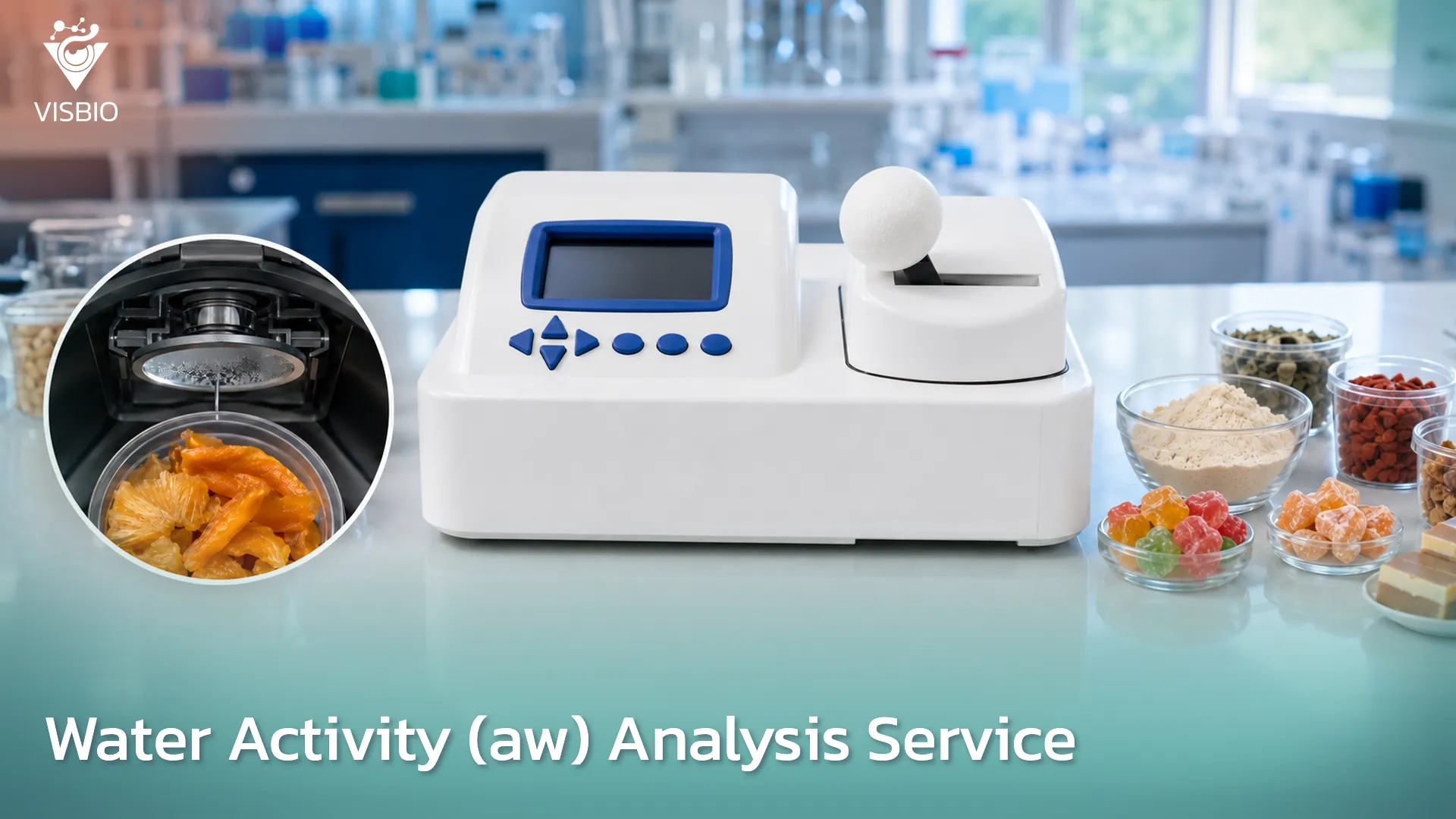
Water activity (aw) is a value that shows how available the water in a product is to microorganisms for growth. It is calculated as the vapor pressure of water above the sample surface divided by the vapor pressure of pure water at the same temperature, so it ranges from 0 to 1.00. Some Thai sources call this value “free water content”, but aw is a ratio of vapor pressures and does not indicate the amount of water in a product.
For powdered dietary supplements, dried herbs, high-sugar confectionery and desserts, jellies and other products with a long shelf life, aw is the parameter that directly determines the microbiological safety of the product. aw values that look only slightly different, such as 0.65 and 0.70, can mark the line between a product that keeps for its full stated shelf life and one that develops mold or yeast before it expires.
VISBIO Laboratory measures aw with a water activity meter (aw meter) for powdered dietary supplements, dried herbs, high-sugar confectionery, jellies, gummies, dried fruit, powdered drink mixes, premixes and other food and pharmaceutical products, either as a single measurement for batch release or as repeated measurements during a stability study.
How does aw differ from moisture content?
A common misunderstanding is to use moisture content in place of aw, or to use the two interchangeably without distinguishing them. Moisture content measures the total weight of water in a sample, whereas aw shows how available the water in the sample is to microorganisms for growth. Two products with the same moisture content, for example 10%, can have very different aw values, depending on the sugar, salt, protein and carbohydrate that bind the water.
High-sugar confectionery has a low aw because the sugar binds the water so that microorganisms cannot use it, even though the total weight of water in the confectionery is high. Conversely, a product that contains protein but no sugar may have a high aw despite a low moisture content. Moisture content and aw therefore provide different information, and one should not be used in place of the other.
Why aw marks the line between safe and unsafe products
In microbiological terms, all microorganisms need water to grow, and each group needs a different minimum aw. The following values are approximate, and different textbooks give slightly different figures. Most bacteria need an aw above about 0.91. The dangerous pathogen Clostridium botulinum needs an aw above about 0.93, depending on the type, but some pathogenic bacteria, such as Staphylococcus aureus, can still grow at an aw of about 0.86. Most yeasts need an aw above about 0.88, molds need an aw above about 0.80, and the most drought-tolerant molds (xerophilic molds), which can grow on spices and dry confectionery, can still grow at an aw of about 0.62. Keeping a product’s aw below the level that the target microorganisms need is therefore an effective preventive strategy that does not require chemical preservatives. aw shows whether microorganisms could grow in a product, but not whether the product is already contaminated. For direct detection of microorganisms, microbial contamination testing can be used alongside it.
During formulation, designing a product to have a safe aw is a way to extend shelf life without adding preservatives. Many shelf-stable products, such as dry confectionery, fruit pastes and jellies made mainly with sugar, rely on low aw as their main protection against microorganisms. The proportion of sugar, glycerol or other humectants in the formula therefore directly determines aw and shelf life.
In commercial production, aw is used as a batch release criterion that indicates safety in advance, before distribution begins. Powders with an aw above the level at which xerophilic molds can grow are at risk of mold growth during transport and storage. Checking the aw of every batch before release is therefore a preventive tool that helps reduce the risk of a product recall.
From a regulatory perspective, aw is used together with pH to classify certain types of food. A widely cited example is an aw of 0.85, one of the criteria used to define low-acid foods in hermetically sealed containers (pH above 4.6 and aw above 0.85). Foods in this group must undergo heat sterilization as required by law (Codex Alimentarius Commission, 1993). The value of 0.85 is therefore not a single criterion that applies to every product. Food manufacturers under the Food Act B.E. 2522 (1979) should check the Ministry of Public Health notifications that apply to their products.
For herbal products under the Herbal Products Act B.E. 2562 (2019), the Thai Herbal Pharmacopoeia (THP) does not set aw as a mandatory criterion, but aw data can serve as supporting evidence of the microbiological safety of herbal products.
Principles of water activity measurement
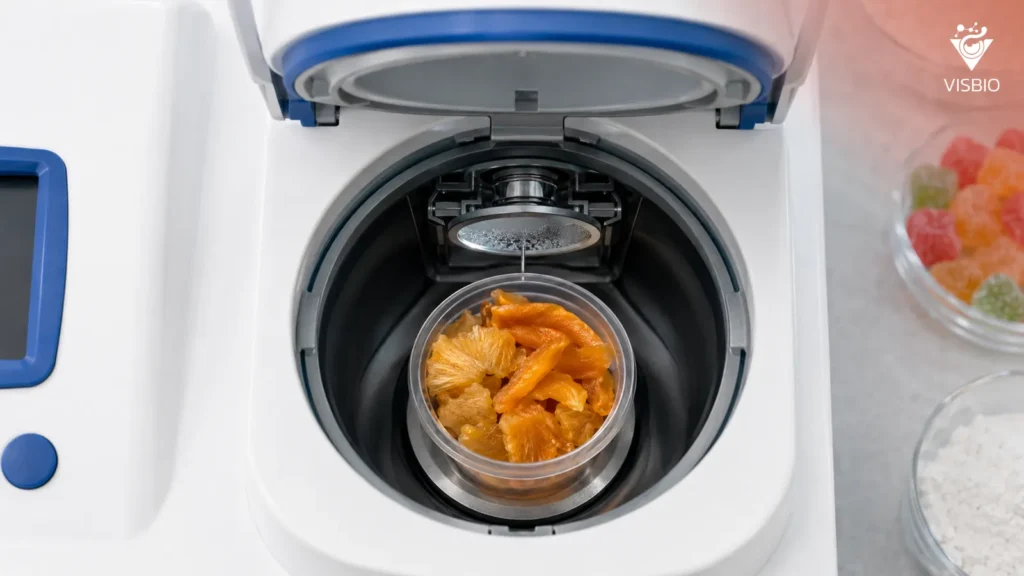
The principle of aw measurement is to measure the vapor pressure of water above the sample surface and compare it with the vapor pressure of pure water at the same temperature (AOAC International, 2005; International Organization for Standardization, 2017). aw equals p/p₀, where p is the vapor pressure of water above the sample and p₀ is the vapor pressure of pure water. aw therefore ranges from 0 (completely dry) to 1.00 (pure water). Most products on the market have an aw between 0.10 and 0.99.
aw meters fall into two main types. The first uses a capacitance sensor or a resistive sensor to measure the relative humidity of the air in a sealed sample chamber after the sample has reached equilibrium. The reading is the equilibrium relative humidity (ERH), which gives aw when divided by 100. This type takes about 5–30 minutes per measurement and suits batch release at factory level. The second type is the chilled-mirror dew point meter, which measures the dew point temperature of the air in the sample chamber. It is more accurate and faster (about 3–5 minutes per measurement), but the instrument costs more.
Scope of VISBIO Laboratory's aw measurement service
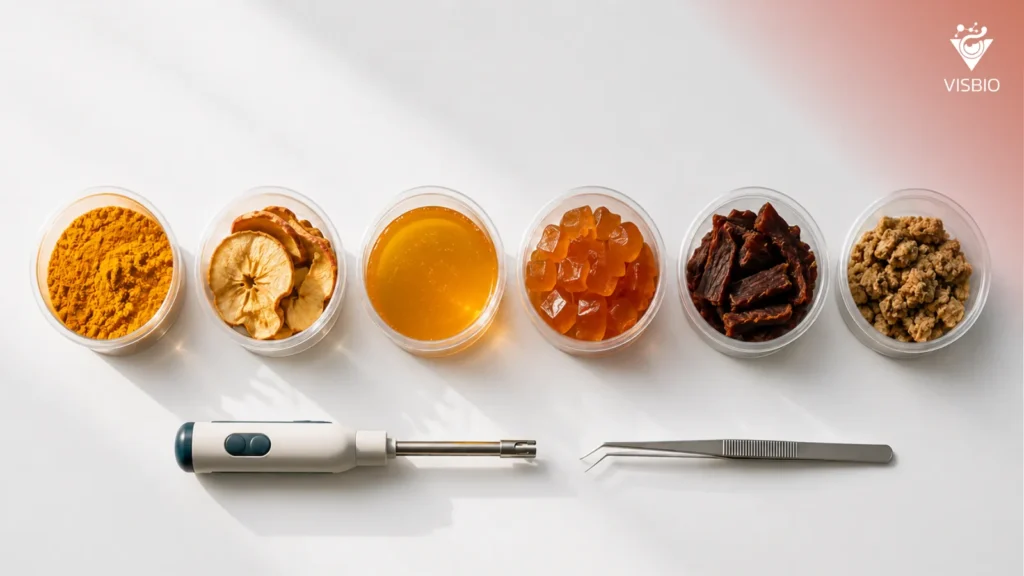
VISBIO Laboratory’s service covers several sample groups:
- Dried products and powders: herbal extract powders, powdered dietary supplements, dried herbs, dried fruit, dry snacks, curry pastes and powdered drink mixes
- High-sugar confectionery and desserts: jellies, dietary supplement gummies, fruit pastes, marshmallows, toffees, candies and honey
- Intermediate-moisture foods: seasoning sauces, concentrated salad dressings and semi-prepared dried foods
- Processed meat products: dried meat and high-protein snacks
The report shows aw at 25 °C, with the mean and standard deviation of replicate measurements. For stability studies, the report shows the quantitative change in aw over time relative to the starting point (T0). Clients can choose between a single measurement for batch release and a continuing study throughout shelf life.
Using aw results
aw results are useful at several stages of a product’s life. In research and development, they are used to design formulas with a safe aw without adding preservatives, to test the effect of different humectants, such as low-molecular-weight sugars, glycerol, sorbitol and maltitol, which affect aw differently, and to choose ingredient proportions that give the target aw. When selecting packaging, they are used to test how well the packaging stops aw from changing with the humidity of the outside air, which matters greatly in Thailand’s humid climate.
Before launch (pre-launch), aw serves as the baseline for the specification and is used to set acceptable deviation limits. In commercial production, the results serve as a batch release criterion that indicates microbiological safety in advance. In stability studies, aw is tracked throughout shelf life under normal conditions, ASEAN Zone IVb conditions and conditions simulating sea freight. A rising aw is an early warning that the product is approaching the range where microorganisms are at risk of growing.
For export, the results can be attached to the certificate of analysis (COA) to support inspections by business buyers in markets where aw is specified in trade agreements.
Frequently asked questions about aw
What is aw?
Water activity (aw) is the ratio of the vapor pressure of water above the sample surface to the vapor pressure of pure water at the same temperature. It ranges from 0 (completely dry) to 1.00 (pure water) and shows how available the water in a product is to microorganisms for growth.
How does aw differ from moisture content?
Moisture content measures the total weight of water in a sample, while aw shows how available the water is to microorganisms. Products with the same moisture content can therefore have very different aw values, depending on the sugar, salt, protein and carbohydrate that bind the water.
Why is aw important for shelf life?
Each group of microorganisms needs a different minimum aw. Keeping aw below the level that the target microorganisms need helps prevent spoilage without chemical preservatives, so manufacturers use aw in formulation, batch release and monitoring during stability studies.
How many types of aw meter are there?
There are two main types. The first uses a capacitance or resistive sensor to measure the equilibrium relative humidity in a sealed sample chamber. The second measures the dew point temperature with a chilled mirror (chilled-mirror dew point), which is more accurate and faster.
What types of samples does VISBIO Laboratory accept for aw measurement?
We accept four groups of samples: dried products and powders, such as herbal extract powders and powdered dietary supplements; high-sugar confectionery and desserts, such as jellies, gummies and fruit pastes; intermediate-moisture foods, such as seasoning sauces and concentrated salad dressings; and processed meat products, such as dried meat.
What does an aw report include?
The report shows aw at 25 °C, with the mean and standard deviation of replicate measurements. For continuing studies, the report shows the change in aw over time relative to the starting point (T0).
References:
- AOAC International. (2005). AOAC Official Method 978.18: Water activity of canned vegetables. In Official methods of analysis of AOAC International (18th ed.). AOAC International.
- Codex Alimentarius Commission. (1993). Recommended international code of hygienic practice for low and acidified low acid canned foods (CAC/RCP 23-1979, Rev. 2-1993). FAO/WHO.
- International Organization for Standardization. (2017). Foodstuffs — Determination of water activity (ISO 18787:2017). ISO.
- Royal Thai Government Gazette. (1979, May 13). Food Act B.E. 2522 (1979). Royal Thai Government Gazette, 96(79 Kor), 1–24.
- Royal Thai Government Gazette. (2019, April 30). Herbal Products Act B.E. 2562 (2019). Royal Thai Government Gazette, 136(56 Kor), 116–161.