

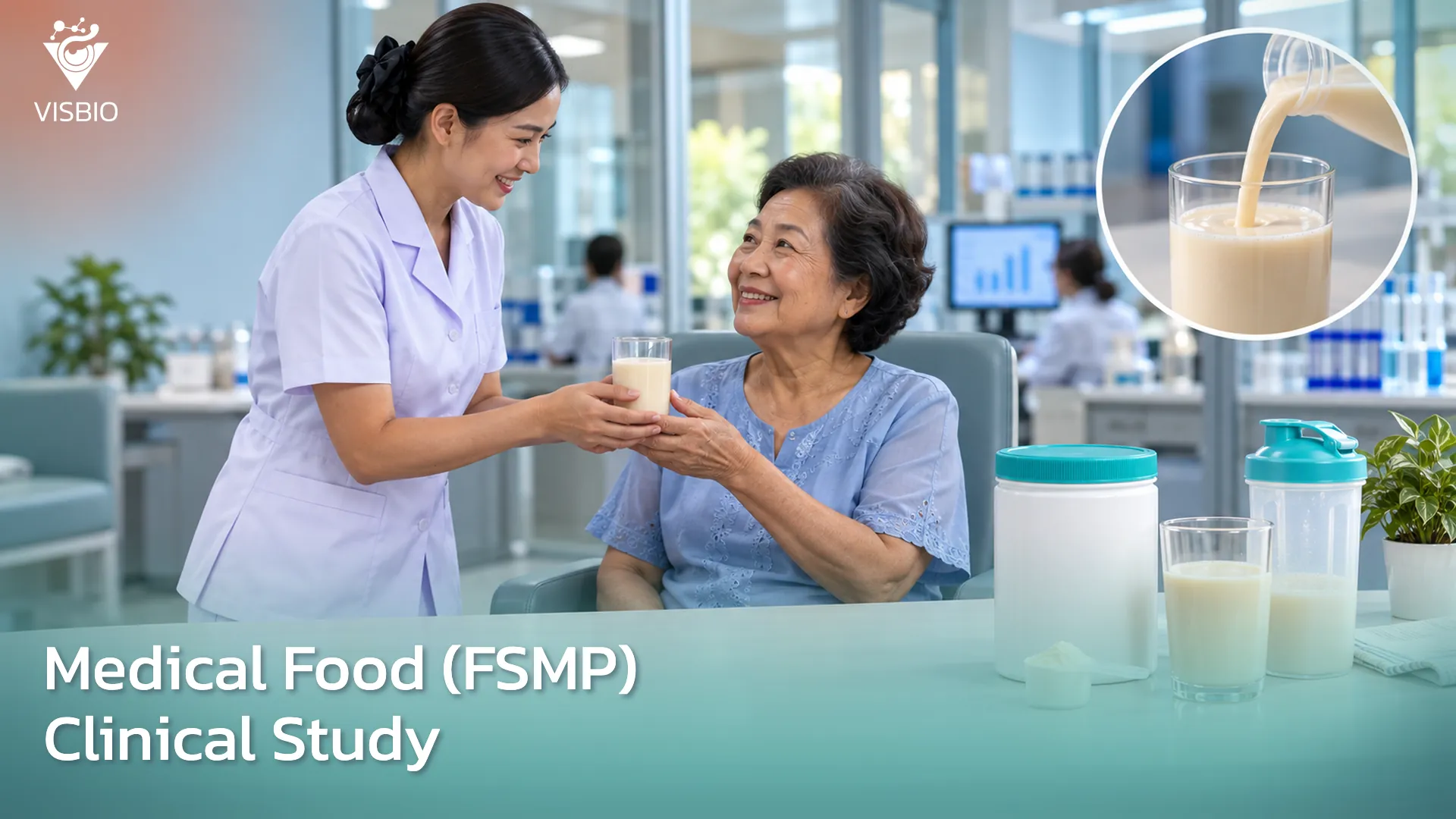
Medical foods, or foods for special medical purposes (FSMP), are foods specially processed or formulated for the dietary management of patients or people with specific medical conditions who cannot meet their nutritional needs from normal food, and they are generally used under the supervision of a physician or healthcare professional (Kang & Park, 2025). An acceptability and tolerability study examines whether the target users accept the product’s taste, smell and texture, can consume the full recommended amount, and do so without adverse gastrointestinal symptoms.
The medical food market is expanding worldwide, driven by aging societies, the rising prevalence of chronic disease and home-based patient care (Kang & Park, 2025). Before introducing a product into hospitals or selling it widely, manufacturers should therefore have scientific evidence that the target users actually accept the product, in terms of taste, texture and gastrointestinal tolerability.
VISBIO Co., Ltd. provides study design, project management and project coordination for acceptability and tolerability studies of oral medical foods, both ready-to-drink (RTD) liquids and complete nutritional formula powders, in collaboration with a network of partner clinical research sites and hospitals. When a study must be conducted in patients, the physicians of the partner research site or hospital screen and supervise the patients throughout the study. Every project follows Good Clinical Practice (GCP) under the oversight of a human research ethics committee and supports sponsors in Thailand and abroad.
What Thai FDA authorization covers, and why real-world acceptance must be demonstrated
Medical foods must be authorized by the Thai Food and Drug Administration (Thai FDA) under the Food Act B.E. 2522 (1979) before they are sold. The Thai FDA’s review focuses on safety, quality and the compliance of the formula with the requirements, but it does not assess whether the target users will accept the product and consume the full recommended amount in real-world use (real-world acceptability).
This is particularly important for medical foods designed for patients, older adults or people with specific medical conditions, because taste perception, sensitivity to texture and gastrointestinal responses in these groups may differ from those of the general population. Hubbard et al. (2012) systematically reviewed 46 studies with a total of 4,328 participants and found that users of oral nutritional supplements (ONS) consumed on average 78% of the prescribed amount (67% in hospital and 81% in the community), and that this rate was associated with the energy density of the product and the age of the users. Kang and Park (2025) point out that limited flavor options and palatability that is not yet good enough are barriers to continued use by patients.
An acceptability and tolerability study in an appropriate group of target users is therefore important scientific evidence, both for building confidence among partners in medical channels, such as hospitals, nutrition clinics and pharmacies, and for decisions by research and development (R&D) teams in developing and improving product formulas.
Benefits for medical food manufacturers
Greater credibility in medical and clinical nutrition channels
Evidence from an acceptability and tolerability study in real target users is an important tool when presenting to registered dietitians, medical specialists and healthcare facility purchasing departments, who play the main role in selecting medical foods for patients. Empirical data help show how far the target users consume the full prescribed amount, which relates directly to the effectiveness of nutrition therapy.
Supporting data for presentations to healthcare professionals
The study report can be used to support presentations of palatability and tolerability data to healthcare professionals and healthcare facilities, while all communication must comply with food law.
Lower risk of complaints and returns after launch
Finding and fixing acceptability problems or adverse symptoms before a wide launch helps manufacturers improve the formula before it reaches the market, and reduces the risk of complaints and product returns, which affect both a company’s reputation and its costs.
Data to support product development
Data from palatability scales and GI diaries are valuable feedback for R&D teams when adjusting the next version of a formula, including decisions on flavor, viscosity and packaging format suited to the users.
What are medical foods (FSMP)? Their role in clinical nutrition therapy
Medical foods (FSMP) are foods specially designed and produced to meet the particular nutritional needs of people with specific medical conditions or people undergoing treatment, such as patients recovering from major surgery, cancer patients with malnutrition, older adults with swallowing difficulties, or people with specific metabolic conditions. The laws of several regions, such as the European Union, the United States, China and India, require these foods to be used under the supervision of a physician or healthcare professional (Kang & Park, 2025).
Kang and Park (2025) report that the global medical food market is expanding, driven mainly by the rising prevalence of chronic disease, the growing proportion of older adults and awareness of the role of nutrition therapy in patient care, as well as the increasing use of home enteral nutrition. Demand is therefore growing in hospitals, long-term care facilities and home care.
Oral medical foods on the market today fall into two main formats, as follows.
| Product format | Characteristics | Main user groups |
|---|---|---|
| Ready-to-drink (RTD) liquids | Convenient to consume, with precise portion control | Patients with swallowing difficulties, post-surgical patients |
| Complete nutritional formula powders | Flexible concentration, often lower cost | Patients caring for themselves at home, older adults |
Key variables that affect the acceptance of medical foods are taste, aroma, texture, viscosity and ease of consumption. Bonelli et al. (2021) is an example of an acceptability study of a new medical food before use in patients: 12 healthy volunteers drank the product once, and gastrointestinal tolerability was assessed at 3, 6 and 24 hours after intake, together with palatability and safety, with the results used as baseline information for further studies in patients. User acceptance is also associated with the compliance rate, i.e., consuming the full prescribed amount, which underpins the effectiveness of nutrition therapy (Hubbard et al., 2012; Kang & Park, 2025).
The study process with VISBIO and partner research sites
Every study follows GCP. VISBIO designs the study and provides project management and coordination, while participant screening, assessment and care are carried out by the physicians and investigators of the research site or hospital responsible for the study.
Step 1: Consultation and protocol design
Together with the investigators of the partner research site or hospital, VISBIO reviews the product’s characteristics and format and the outcomes the sponsor wants from the study, in order to define a suitable target participant group, which may be healthy volunteers or target patients, as well as a recruitment plan and an assessment plan that covers both palatability and tolerability. Every step takes research ethics requirements and GCP into account.
Step 2: Approval from the human research ethics committee
VISBIO coordinates preparation of the protocol, the participant information sheet and informed consent form, and related documents with the investigators, for submission to a human research ethics committee (Institutional Review Board: IRB). This step is a mandatory condition before any study starts, to protect participants’ rights and safety in line with international principles.
Step 3: Participant screening and data collection
The physicians and investigators of the partner research site or hospital recruit and screen participants according to the criteria in the protocol. In studies conducted in patients, the physician investigators screen and supervise the patients throughout the study. Participants then consume the product, and data are collected over the specified period using standard palatability questionnaires, such as a 5-point Likert scale or a visual analog scale (VAS) for aroma, taste, texture and overall satisfaction, together with a daily gastrointestinal symptom diary (GI diary) to monitor tolerability throughout the study. VISBIO, as project manager, monitors progress and the completeness of the data.
Step 4: Data analysis and final report
Data are analyzed with statistical methods suited to the study design. VISBIO coordinates the analysis and prepares the final report, which includes a palatability summary by attribute, an adverse event summary, the compliance rate and statistical interpretation, with conclusions and recommendations for the sponsor.
Products suited to this service
This service suits oral medical foods in various formats. Examples of products and assessment targets are shown below.
| Product type | Examples | Assessment target |
|---|---|---|
| Ready-to-drink (RTD) medical foods | High-protein formulas, formulas for people with diabetes | Palatability and tolerability scores in the target patient group, compared with predefined criteria |
| Complete nutritional formula powders | Nutritionally complete formulas, formulas for older adults | Satisfaction after preparation and consumption, and GI symptom diaries in the test group, compared with baseline |
| Medical foods for malnutrition | High-energy formulas, formulas for patients undergoing treatment | Compliance rate and adverse symptoms in the test group, compared with a control group |
Study levels and how the work is carried out
VISBIO reports study results in full, from palatability scores and the compliance rate to every adverse event observed, and every step, from protocol design and data collection to analysis and reporting, is traceable. Sponsors can therefore use the report with confidence for business decisions and for presentations to partners in medical channels.
| Data user | Benefit |
|---|---|
| Medical food manufacturers | Empirical data for formula development, and for use in communication under food law |
| Partners (hospitals, clinics, pharmacies) | Evidence that the product has been through an acceptability and tolerability study in real target users |
| Patients and caregivers | Palatability and tolerability data from a standardized research process |
| Testing level | Details | Budget level (relative) |
|---|---|---|
| Product quality testing | Physical, chemical and microbiological properties | Entry level |
| Acceptability and tolerability study | Palatability and tolerability in the target user group | Higher |
Studies in volunteers and patients follow GCP in line with the ICH E6 guideline, while product quality testing is carried out in the laboratory according to the test method for each assay. Sponsors receive a clear assessment plan from the start of the project. Costs and timelines depend on the study design and the approval process; please ask our team directly. For measuring consumer satisfaction with general products that are not medical foods, see the consumer satisfaction testing service.
Conditions before a study starts
- Products already on the market must be authorized by the Thai FDA under the Food Act B.E. 2522 (1979). For formulas under development, the sponsor, the research site and VISBIO consider the safety documentation and related steps together on a case-by-case basis. For products of sponsors from abroad, VISBIO assesses the legal conditions together with the research site on a project-by-project basis.
- VISBIO and the research site design the assessment plan to suit each product and user group.
- Every study must be approved by a human research ethics committee before it starts, without exception.
Frequently asked questions about medical food testing
What are medical foods (FSMP)?
Medical foods are foods specially processed or formulated for the dietary management of patients or people with specific medical conditions, such as patients after major surgery, cancer patients with malnutrition or older adults with swallowing difficulties, and they are generally used under the supervision of a physician or healthcare professional.
If a product is already authorized by the Thai FDA, why test acceptability?
The Thai FDA’s review focuses on safety, quality and the compliance of the formula with the requirements, but it does not tell you whether users will accept the taste and texture and consume the full recommended amount, which is what dietitians, physicians and healthcare facilities want to know before choosing a product for patients.
Is the study done in healthy volunteers or in patients, and who looks after the patients?
Either, depending on the study objective. When the study is conducted in patients, the physicians of the partner research site or hospital screen and supervise the patients throughout the study, while VISBIO designs the study and provides project management and coordination.
How are acceptability and tolerability measured?
With standard palatability questionnaires, such as a 5-point Likert scale or a visual analog scale (VAS) for aroma, taste, texture and overall satisfaction, together with a daily gastrointestinal symptom diary (GI diary), the compliance rate and recording of adverse events.
What does the study report include?
The report includes a palatability summary by attribute, a summary of adverse events observed, the compliance rate and statistical interpretation, with conclusions and recommendations for formula development.
Do study results guarantee advertising approval?
No. Study results support product development and evidence-based communication. Use on labels or in advertising must comply with food law, with approval from the relevant authorities where the law requires it. VISBIO does not guarantee study outcomes or regulatory decisions.
Talk to VISBIO about medical food testing
If you are interested in an acceptability and tolerability study for your medical food, contact VISBIO for a free initial consultation through any of these channels:
- Contact form: https://visbio.co.th/en/contact-us/
- LINE Official Account: @visbio
- Email: service@visbio.co.th
- Phone: 098-635-4197
- Timeline: please ask our team directly.
See all clinical trial services on VISBIO’s clinical trial service page.
Important information about clinical studies
- VISBIO’s role: VISBIO designs studies and provides project management and project coordination in collaboration with a network of partner clinical research sites and hospitals, for sponsors in Thailand and abroad. Volunteers are recruited and cared for by the physicians and investigators of the research site responsible for the study.
- Research ethics: Every study in humans starts only after approval by a human research ethics committee and is conducted under Good Clinical Practice (GCP). Every volunteer signs an informed consent form after receiving complete information.
- Drugs and herbal medicines: Studies must follow the Thai FDA requirements that apply to the product. The sponsor, the research site and VISBIO plan these steps together from the start of the project.
- Use of results: Study results support product development and evidence-based communication. Use on labels or in advertising must comply with the law for each product type, with approval from the relevant authorities where the law requires it. VISBIO does not guarantee study outcomes or regulatory decisions.
- Foods and dietary supplements: Study results are not a claim that a product diagnoses, treats, cures, mitigates or prevents any disease.
- Timeline: This depends on the study design and the approval process. Please ask our team directly.
References:
- Bonelli, A., Menna, P., Minotti, G., Angeletti, S., Comandini, A., Picollo, R., Quarchioni, E., Russo, V., Salvatori, E., Ferravante, F., Emerenziani, S., Cicala, M., & Muscaritoli, M. (2021). Safety and tolerability of a novel oral nutritional supplement in healthy volunteers. Clinical Nutrition, 40(3), 946–955. https://doi.org/10.1016/j.clnu.2020.06.022
- Hubbard, G. P., Elia, M., Holdoway, A., & Stratton, R. J. (2012). A systematic review of compliance to oral nutritional supplements. Clinical Nutrition, 31(3), 293–312. https://doi.org/10.1016/j.clnu.2011.11.020
- Kang, H. J., & Park, Y. K. (2025). Food for special medical purposes: A global review of usage trends, regulatory frameworks, and key growth drivers. Clinical Nutrition Research, 14(2), 146–156. https://doi.org/10.7762/cnr.2025.14.2.146