

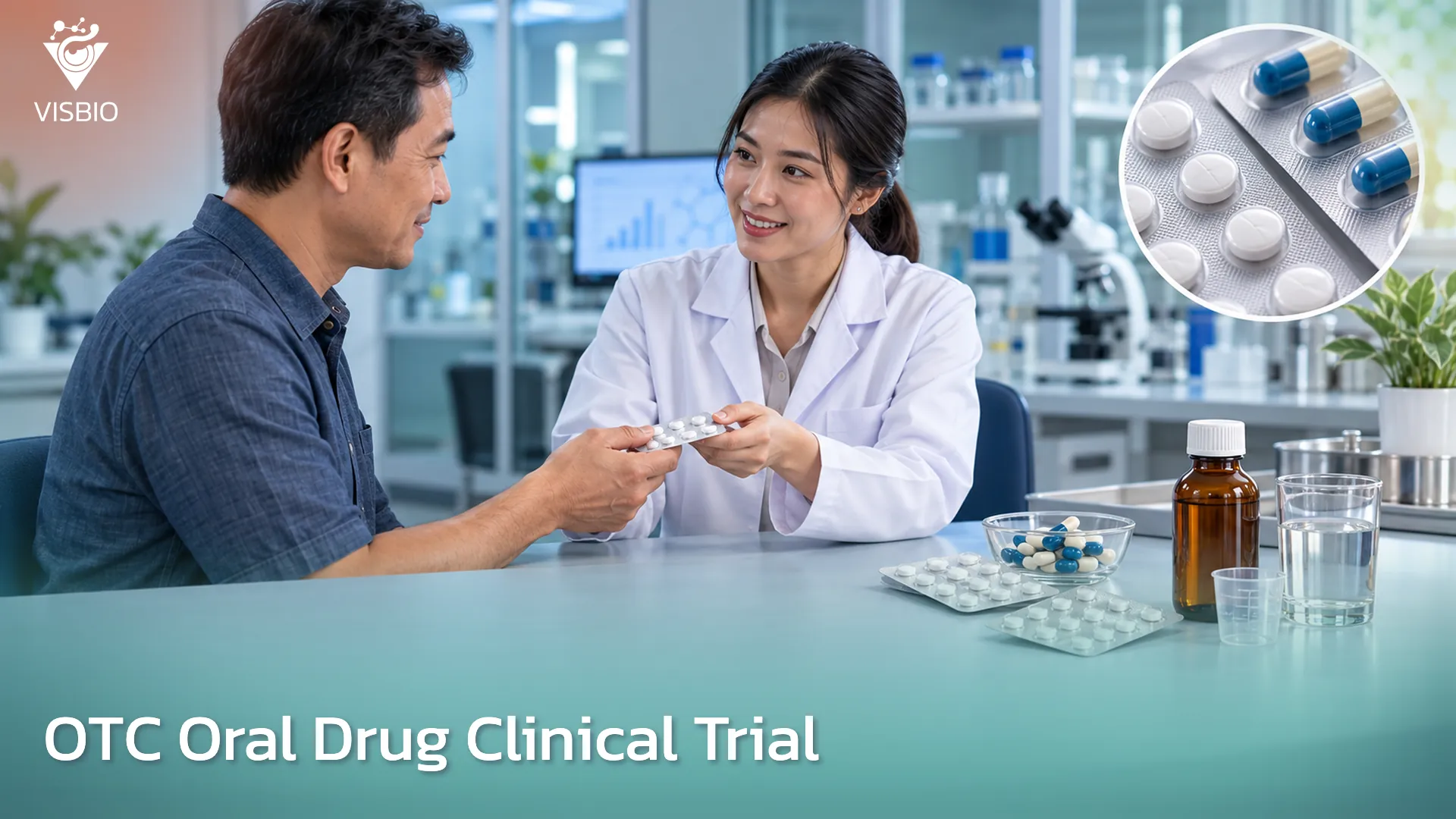
OTC (over-the-counter) drugs are medicines that consumers can buy themselves without a prescription, sold in pharmacies or in stores depending on the type of drug. Oral OTC drugs come in several dosage forms, including oral liquids, lozenges, tablets, capsules and powders for oral solution. An OTC drug clinical trial is a study in participants under controlled conditions that measures both the drug’s effect for its indication and users’ acceptance of the dosage form in actual use.
The market success of an OTC drug depends on two things that should be supported by clinical study data: clinical efficacy for the indication and drug acceptability to users. A drug that works well but is hard to take may be stopped before the recommended course is completed, while a drug that is easy to take but does not work as users expect will not be bought again.
VISBIO Co., Ltd. provides study design, project management and project coordination for clinical studies of oral OTC drugs, in collaboration with a network of partner clinical research sites and hospitals. The protocol is designed to assess efficacy for the indication, acceptability of the dosage form and adverse event monitoring in a single study, under Good Clinical Practice (GCP) following the ICH E6 guideline, for sponsors in Thailand and abroad.
OTC drugs and drug registration: what registration covers, and what is worth studying further
“OTC” is not a drug category under the Drug Act B.E. 2510 (1967). Drugs that consumers can buy themselves fall into several legal categories, such as household remedies and dangerous drugs dispensed by pharmacists in pharmacies. The category of a drug affects both where it can be sold and the restrictions on advertising it, so manufacturers should take it into account from the study planning stage.
Drug registration with the Thai Food and Drug Administration (Thai FDA) under the Drug Act B.E. 2510 (1967) assesses the quality, safety and efficacy of a drug for the indication applied for. New drugs require supporting clinical study data, while generic drugs use data showing equivalence to the reference drug according to Thai FDA criteria. A registered drug therefore has the indications approved in its registration.
What drug registration does not tell you is whether users will accept the taste, size and dosage form of the drug, and whether they will complete the course recommended on the label when using it on their own in daily life. Manufacturers that want this information, or that want to communicate specific effects of their drug on labels or in advertising, should have clinical data on their own formulation to support it, and the statements must fall within the indications approved in the drug registration. Adding a new indication requires an application to amend the drug registration, with supporting data, and approval from the Thai FDA beforehand. Drug advertising requires Thai FDA approval of the advertising text before publication, and some drug categories, such as dangerous drugs and specially controlled drugs, cannot be advertised to the general public.

Why assess efficacy and acceptability together
Hauber et al. (2024) reviewed 19 studies on patient acceptability of and preferences for solid oral dosage forms such as tablets and capsules, and grouped the drug product attributes that patients consider important into four areas: appearance, swallowability, palatability and handling. Swallowability and size were the most important attributes to consider when designing a formulation. The authors also noted that although acceptability is commonly understood to affect continued use of a medicine, few studies have directly measured the effect of these attributes on medication-taking behavior.
In practice, if a drug works well but users do not accept its taste and stop before completing the recommended course, the efficacy measured does not translate into real-world results. Conversely, a drug that users accept and take in full but that does not work for its indication does not build long-term satisfaction. Assessing both aspects in one study therefore gives more complete information for developing and communicating OTC drug products.
Key endpoints in the study
VISBIO designs the protocol with the investigators to cover three groups of endpoints in a single study. The weight and importance of each group depend on the drug group and the claim to be supported.
| Endpoint group | Example assessment tools | Purpose |
|---|---|---|
| Clinical efficacy for the indication | Symptom scores, pain measured on a Visual Analog Scale (VAS), and physiological measurements | Measures the drug’s effect for its indication |
| Drug acceptability | Palatability scale and swallowability score | Measures whether users accept the dosage form |
| Adherence and safety | Pill count, daily diary, and adverse event monitoring coded with the MedDRA dictionary | Measures actual medication-taking behavior and monitors safety |
Measuring acceptability requires clear definitions and criteria from the design stage. Ranmal et al. (2018) systematically reviewed 68 studies on the acceptability of oral medicines in children and older adults and found that the studies differed widely in participants, study settings, tools, definitions of acceptability and decision criteria, with no common standard yet. An example of a study with a clearly defined endpoint is the randomized cross-over study by Bosse et al. (2026), which compared four placebo formulations (film-coated tablets, orodispersible tablets, orodispersible films and a gel) in patients with multiple sclerosis, defining acceptability as a composite score of investigator-assessed swallowability and patient-rated palatability.
Efficacy endpoints by drug group
Efficacy endpoints are specific to the indication of each drug group. VISBIO and the investigators set endpoints that match the claim the sponsor wants to demonstrate. Examples of endpoints used in international research are shown below.
| Drug group | Example products | Primary efficacy endpoints |
|---|---|---|
| Analgesics | Pain-relief tablets or oral liquids, lozenges for sore throat | Pain scores (VAS pain score, Numeric Rating Scale: NRS) and time to pain reduction |
| Antitussives and expectorants | Cough syrups, cough lozenges | Cough questionnaire (Leicester Cough Questionnaire) and cough frequency |
| Antipyretics | Fever-reducing oral liquids and tablets | Body temperature (°C) and time to fever reduction |
| Antihistamines | Allergy tablets and oral liquids | Total Nasal Symptom Score (TNSS) and the Rhinoconjunctivitis Quality of Life Questionnaire (RQLQ) |
| Drugs for gastrointestinal symptoms | Red carminative mixture, tablets for bloating or diarrhea | GI symptom composite score and the Bristol Stool Form Scale |
Efficacy studies of these drug groups are carried out in people who have the symptoms covered by the drug’s indication, such as fever, cough, sore throat, nasal allergy symptoms or diarrhea. The physicians and investigators of the partner research site or hospital screen the participants, assess their symptoms and look after them throughout the study. VISBIO sets the endpoints together with the sponsor and the investigators at the protocol design stage, based on the claim and the target group of each product.
The study process with VISBIO and partner research sites
Every study follows GCP. VISBIO designs the study and provides project management and coordination, while participant recruitment, clinical assessment and care are carried out by the physicians and investigators of the research site responsible for the study.
Step 1: Consultation and protocol design
Together with the investigators of the research site, VISBIO reviews the drug’s characteristics, its approved indications (or the planned indication for a formulation under development) and its dosage form (oral liquid, lozenge, tablet, capsule or powder for oral solution), in order to set efficacy endpoints for the indication, acceptability endpoints and an adverse event monitoring plan. This step covers the choice of study design, setting inclusion and exclusion criteria, and estimating a sample size with adequate statistical power.
Step 2: Ethics approval and planning for Thai FDA requirements
Before any data are collected, the protocol and the informed consent documents must in every case be approved by a human research ethics committee (Institutional Review Board: IRB). VISBIO coordinates document preparation with the investigators and follows up on revisions requested by the committee until approval is granted. At this stage, the sponsor, the research site and VISBIO also check the Thai FDA requirements that apply to the drug used in the study and plan the necessary steps together from the start of the project.
Step 3: Participant recruitment and study conduct
Once approval is granted, the physicians and investigators of the research site responsible for the study recruit and screen volunteers or patients according to the criteria in the protocol. Every participant receives complete information and gives written consent before joining. Participants then receive the drug according to their assigned group and are assessed for both efficacy (e.g., VAS scores, symptom scores or physiological measurements for the indication) and acceptability (palatability scale and swallowability score), with adverse events recorded throughout the study. The physician investigators look after participant safety, while VISBIO, as project manager, coordinates schedules, monitors progress and oversees the completeness of the data.
Step 4: Data analysis
Data are analyzed with statistical methods suited to the study design, such as analysis of covariance (ANCOVA), mixed-effects models and composite endpoint analysis. VISBIO coordinates data management and analysis. The results cover efficacy outcomes, acceptability scores, the adherence rate and a summary of adverse events.
Step 5: Reporting and delivery
A clinical study report (CSR) is prepared following the structure of the ICH E3 guideline, summarizing results on both efficacy and acceptability. The report supports product development and evidence-based communication, subject to the legal conditions described in the section on drug registration.
Oral dosage forms suited to this service
This service is designed for oral OTC drugs in various dosage forms. Each form has different suitable efficacy and acceptability endpoints.
| Dosage form | Examples on the market | Example efficacy endpoints |
|---|---|---|
| Oral liquids | Cough syrups, fever-reducing oral liquids | Cough frequency and body temperature |
| Lozenges/troches | Sore-throat lozenges, pain-relief lozenges | Sore throat score (VAS throat pain score) and time to improvement |
| Tablets and coated tablets | Pain-relief tablets, antihistamines | Pain score (VAS pain score) and TNSS |
| Capsules | Symptom-relief capsules | Symptom composite score |
| Powders for oral solution | Soluble powders, oral rehydration salts | Symptom relief score and hydration status markers |
Study levels and what sponsors receive
VISBIO reports study results in full, from efficacy outcomes and palatability scores to every adverse event observed. Complete reporting makes the results credible to those who use the data, including trading partners, healthcare professionals and consumers.
| Data user | Benefit |
|---|---|
| Product owner | A CSR following the structure of the ICH E3 guideline, for use in formulation development and as a supporting document when applying for approval of advertising text within the scope permitted by law; the decision rests with the Thai FDA |
| Consumers and healthcare professionals | Actually measured data on both the efficacy and the acceptability of the drug |
| Overseas trading partners | Verifiable efficacy and safety data, usable as part of the documents for preparing registration or negotiating with trading partners, as each country has its own requirements |
| Study level | Details | Budget level (relative) |
|---|---|---|
| Acceptability study | Assesses palatability and swallowability | ●●○○○ |
| Efficacy study | Clinical endpoints for the indication | ●●●○○ |
| Combined efficacy and acceptability | Assesses both aspects with adverse event monitoring | ●●●●○ |
| Full clinical trial and CSR | All endpoints with a report following the structure of the ICH E3 guideline | ●●●●● |
Every level follows GCP in line with the ICH E6 guideline. Costs and timelines depend on the study design and the approval process; please ask our team directly. For non-drug products where consumer satisfaction is the main measure, see the consumer satisfaction testing service.
Conditions before a study starts
- Efficacy studies of drugs already on the market must use a drug registered with the Thai FDA under the Drug Act B.E. 2510 (1967). For acceptability studies of formulations under development, the sponsor, the research site and VISBIO consider the permits required together on a case-by-case basis. For products of sponsors from abroad, VISBIO assesses the legal conditions together with the research site on a project-by-project basis.
- VISBIO and the research site design the study plan specifically for the drug group and the claim of each product.
- Every study must be approved by a human research ethics committee before it starts, without exception.
Frequently asked questions about OTC drug clinical trials
Why should a registered OTC drug still have further clinical data?
Drug registration assesses quality, safety and efficacy for the approved indications, but it does not tell you whether users will accept the taste, size and dosage form of the drug, or whether they will complete the recommended course. Clinical data on your own formulation help answer these questions and help you communicate its effects with evidence within the scope of the approved indications.
How is drug acceptability measured?
With a palatability scale and a swallowability score, together with pill counts and daily diaries to see how the drug is actually used. The definition and criteria for acceptability must be set in the protocol from the start, because previous studies have used widely different definitions and tools.
Who takes part in the study, and who looks after the participants?
Participants may be volunteers or people with symptoms covered by the drug’s indication, such as fever, cough or sore throat, according to the criteria in the protocol. The physicians and investigators of the partner research site or hospital screen and look after the participants, while VISBIO designs the study and provides project management and coordination between the sponsor and the research site.
Can we study acceptability only?
Yes. Study levels range from an acceptability study alone, to an efficacy study, a combined assessment of both, and a full clinical trial with a CSR following the structure of the ICH E3 guideline.
Can study results be used in drug advertising right away?
Not immediately. Drug advertising must stay within the indications approved in the drug registration, and the advertising text must be approved by the Thai FDA before publication. Some drug categories, such as dangerous drugs and specially controlled drugs, cannot be advertised to the general public, and VISBIO does not guarantee study outcomes or regulatory decisions.
What needs to be prepared before a project starts?
Efficacy studies must use a drug registered with the Thai FDA. For acceptability studies of formulations under development and for products of sponsors from abroad, the legal steps are considered together with the research site on a case-by-case basis. The study plan is designed for the drug group and the claim of each product, and every project must be approved by a human research ethics committee before it starts.
Talk to VISBIO about OTC drug clinical studies
If you are interested in designing a clinical study for your oral OTC drug, contact VISBIO for a free initial consultation through any of these channels:
- Contact form: https://visbio.co.th/en/contact-us/
- LINE Official Account: @visbio
- Email: service@visbio.co.th
- Phone: 098-635-4197
- Timeline: please ask our team directly.
See all clinical trial services on VISBIO’s clinical trial service page.
Important information about clinical studies
- VISBIO’s role: VISBIO designs studies and provides project management and project coordination in collaboration with a network of partner clinical research sites and hospitals, for sponsors in Thailand and abroad. Volunteers are recruited and cared for by the physicians and investigators of the research site responsible for the study.
- Research ethics: Every study in humans starts only after approval by a human research ethics committee and is conducted under Good Clinical Practice (GCP). Every volunteer signs an informed consent form after receiving complete information.
- Drugs and herbal medicines: Studies must follow the Thai FDA requirements that apply to the product. The sponsor, the research site and VISBIO plan these steps together from the start of the project.
- Use of results: Study results support product development and evidence-based communication. Use on labels or in advertising must comply with the law for each product type, with approval from the relevant authorities where the law requires it. VISBIO does not guarantee study outcomes or regulatory decisions.
- Foods and dietary supplements: Study results are not a claim that a product diagnoses, treats, cures, mitigates or prevents any disease.
- Timeline: This depends on the study design and the approval process. Please ask our team directly.
References:
- Bosse, H. M., Karosaite, K., Kloft, C., Schütte, M., Pawlitzki, M., Albrecht, P., Chauhan, S., Gallou, I., Chabaud, S., Sawai, T., Tumuluri, H., Wargenau, M., Spitzhorn, L.-S., & Klingmann, V. (2026). A randomized, open, single-administration, cross-over study to investigate the acceptability, swallowability, palatability, and preference of different oral placebo formulations in patients with multiple sclerosis. Pharmaceutics, 18(3), 353. https://doi.org/10.3390/pharmaceutics18030353
- Hauber, B., Hand, M. V., Hancock, B. C., Zarrella, J., Harding, L., Ogden-Barker, M., Antipas, A. S., & Watt, S. J. (2024). Patient acceptability and preferences for solid oral dosage form drug product attributes: A scoping review. Patient Preference and Adherence, 18, 1281–1297. https://doi.org/10.2147/PPA.S443213
- Ranmal, S. R., O’Brien, F., Lopez, F., Ruiz, F., Orlu, M., Tuleu, C., Walsh, J., & Liu, F. (2018). Methodologies for assessing the acceptability of oral formulations among children and older adults: A systematic review. Drug Discovery Today, 23(4), 830–847. https://doi.org/10.1016/j.drudis.2018.01.038