

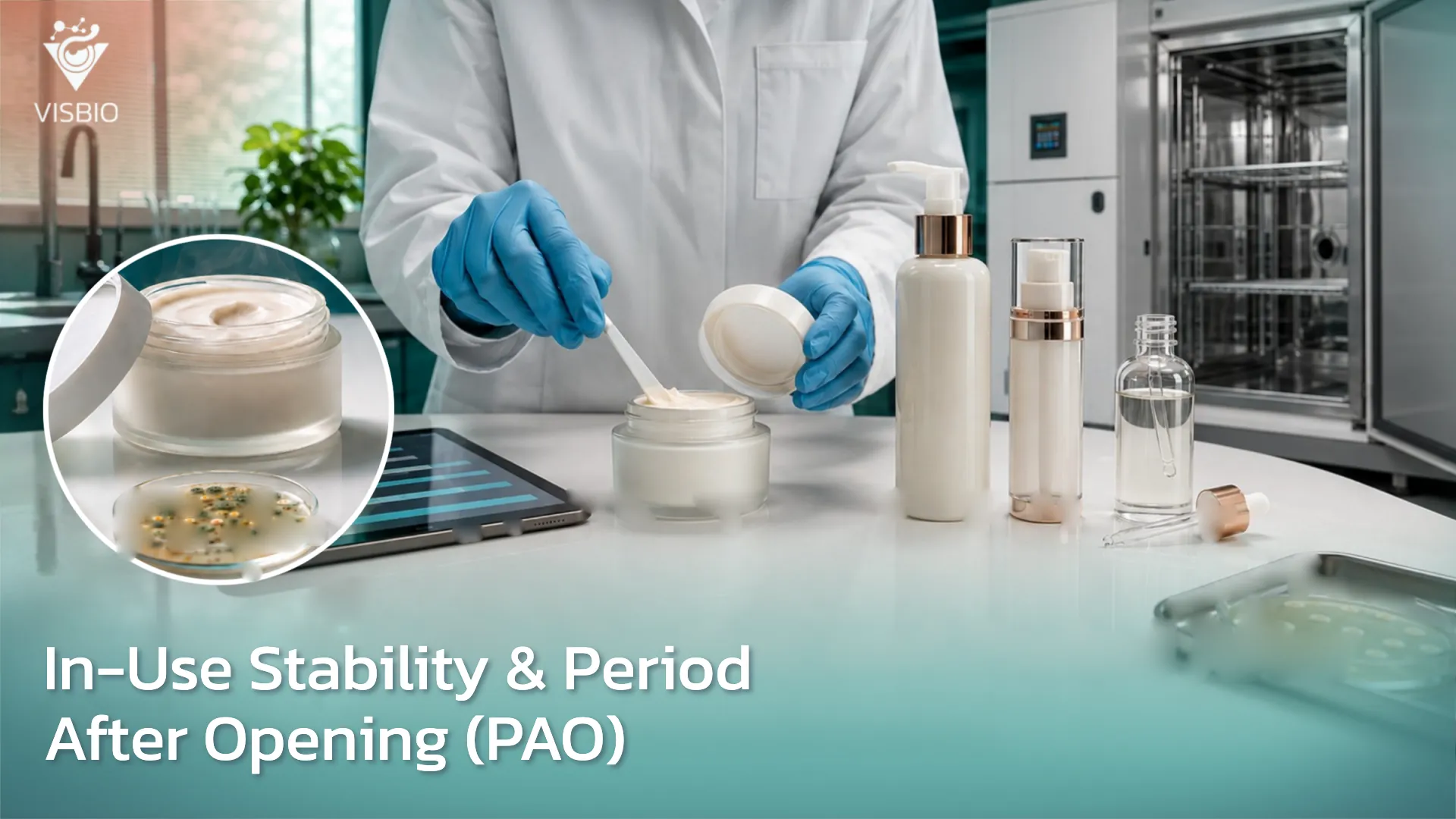
The Period After Opening (PAO) is the period during which consumers can safely use a cosmetic after its packaging is first opened. On the label it is shown by an open-jar symbol with a number and the letter M, such as 6M or 12M, meaning 6 or 12 months after opening. In-use stability testing simulates consumers opening, closing and using the product, with its quality checked at intervals, to obtain data supporting the PAO figure to be stated on the label.
The requirement to show a PAO comes from the European Union cosmetics regulation and applies to cosmetics with a minimum durability of more than 30 months. Other markets have their own labeling requirements, and many brands also show a PAO on products sold in those markets. The PAO figure should therefore be supported by data; it should not be set by estimation, copied from another product without comparable data, or chosen according to the brand’s marketing policy.
VISBIO Laboratory designs in-use stability testing to match the packaging and actual use of each product. This article summarizes what brand owners, quality assurance (QA) teams and research and development (R&D) teams should understand before submitting products for testing: the principles of the test and how it differs from real-time stability testing, how use is simulated, the parameters measured, the relationship between packaging and PAO, and PAO requirements in export markets.
Principles of in-use stability testing and how it differs from real-time stability testing
In-use stability testing differs from real-time stability testing in both purpose and method. Real-time testing keeps the product in tightly closed packaging throughout the study to set the shelf life before opening, which on EU labels is shown as a date of minimum durability (best before end: BBE). In-use testing uses product that goes through opening and closing, contact with hands and exposure to air, at a number and frequency of events that simulate real use, to determine how long the product can be used after opening.
A PAO should be supported by scientific data. These data may come from several sources taken together: in-use stability test results, microbiological test results such as the preservative efficacy test (PET), the characteristics of the packaging, and existing data on similar products. In-use testing is the source closest to real use, because it simulates what consumers do with the product after opening. For cosmetics, the stability testing guideline ISO/TR 18811:2018 is a reference used in planning stability testing as a whole.
Simulating real consumer use
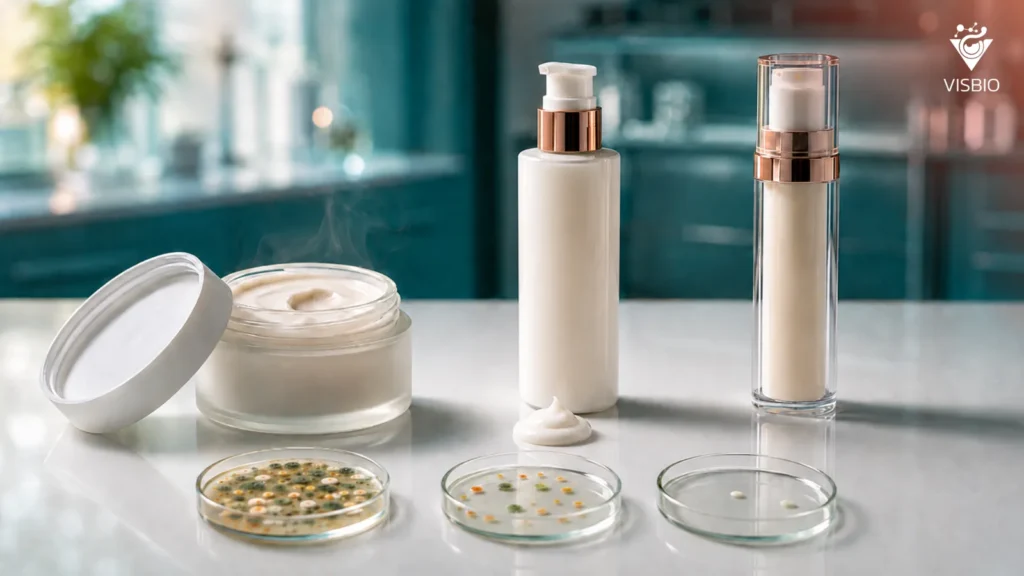
Good in-use test design starts with the question of how consumers use the product, and the answer varies with the type of product and packaging. For a cream in a jar, consumers scoop it out with a finger once or twice a day, which lets microorganisms from the skin of the hand enter the product; each time the lid is opened, water and fragrance compounds evaporate; and opening the jar in a humid bathroom lets the product take up moisture. The simulation therefore uses open-close cycling once or twice a day, 5–7 days a week, with the product scooped out using a tool that simulates the user’s finger.
Products in pump dispensers carry less risk than jars, because the product has less contact with air and hands. Airless pumps carry the least risk, because the internal piston moves up with the product level without letting air in to take its place. Dropper bottles, such as serums with a dropper, expose the active ingredients to more air than pump bottles. The test plan must therefore reflect the actual packaging; testing in packaging that differs from the packaging to be sold means the results cannot support the PAO on the label.
Parameters measured and interpretation
Like real-time stability testing, in-use testing measures parameters in several dimensions, but it focuses on the parameters that are sensitive to air exposure and microorganisms. The microbiological dimension carries the most weight in deciding the PAO, with microbial counts (microbial limit test) at month 0 (T0) and at every sampling point after use begins: the total aerobic microbial count (TAMC) and the total yeasts and molds count (TYMC), by reference methods such as USP <61>. If TAMC or TYMC rises above the limit, the PAO that was set is not yet supported by data. VISBIO Laboratory performs microbial enumeration and preservative efficacy testing in-house; see the microbial contamination and antimicrobial testing service page for details.
The physical dimension includes color (ΔE2000), viscosity, pH, visual appearance and texture, which must stay within the criteria throughout the PAO to be claimed. The chemical dimension includes measurement of active compound content by high-performance liquid chromatography (HPLC) at VISBIO Laboratory, and the peroxide value (PV) for oil-containing products, which is measured in collaboration with partner laboratories.
Pass/fail interpretation refers to the acceptance criteria set during research and development. A product that is to claim a 12-month PAO must meet the criteria in every dimension at the month-12 sampling point (T12). If a change beyond the criteria is found at any point, the PAO that can be claimed is the preceding time point that still met the criteria, and that figure becomes the number in the symbol on the label.
Packaging and the PAO that can be claimed
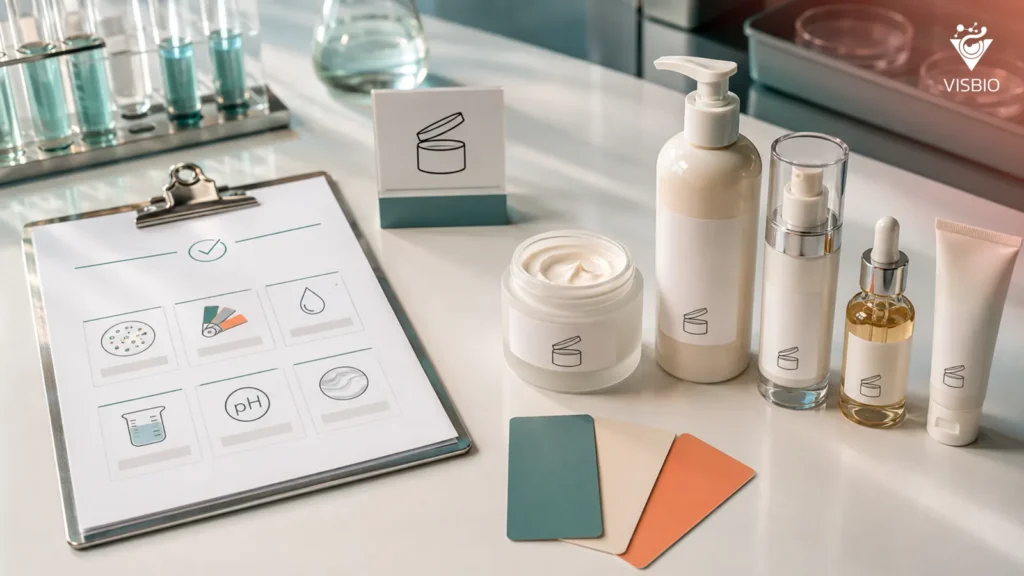
Packaging is a key factor in the PAO that can be claimed. For example, the same formula might support a PAO of 6 months in a jar, 12 months in a pump bottle and 24 months in an airless pump. These figures are examples only, to show the trend; the actual figure for each product must come from that product’s own data. The difference reflects how well each type of packaging protects against contamination and exposure to air.
In business terms, the choice of packaging is therefore a decision that the R&D, brand and QA teams must make together. Airless pumps cost more but allow a longer PAO; they suit large products that consumers use over a long time and help reduce complaints or returns when the product deteriorates before it is used up. Jars cost less and communicate texture well to consumers, but they limit the PAO that can be claimed.
PAO requirements in export markets
Article 19(1)(c) of the European Union cosmetics regulation (Regulation (EC) No 1223/2009) requires cosmetics with a minimum durability of no more than 30 months to show a date of minimum durability. Products with a minimum durability of more than 30 months must instead show the period after opening during which the product can be used safely, using the open-jar symbol in Annex VII followed by the number of months or years, except where the concept of durability after opening is not relevant, such as single-use products. Brands that export to Europe also need a Cosmetic Product Safety Report (CPSR), which includes data on product stability.
Other markets, such as the ASEAN countries, Japan and Korea, have their own national labeling requirements, and exporters should check the requirements of the destination market before designing the label. In Thailand, the Cosmetic Act B.E. 2558 (2015) aims to protect consumers from cosmetics that are unsafe to use, so manufacturers and importers should have data confirming that their products keep their quality throughout the period in which consumers use them; in-use stability test results are part of the data that can confirm this.
Scope of VISBIO Laboratory's in-use stability testing service
VISBIO Laboratory manages in-use stability testing from start to finish, as follows:
- Design a test plan that simulates real use of the product in the packaging in which it will be sold, including the frequency of opening and closing and the sampling points
- Receive and handle samples, recording receipt, transfer and storage at every step (chain of custody)
- Measure baseline values at T0 in every dimension in the plan
- Simulate opening and closing (open-close cycling) according to the set schedule
- Store samples during the test in VISBIO Laboratory’s temperature- and humidity-controlled chambers, under the same condition as the real-time stability test for the target market, such as 30 °C/75 %RH for Thailand and ASEAN, 30 °C/65 %RH for Zone IVa markets or 25 °C/60 %RH for Zone II markets
- Measure parameters at each sampling point, including microbial enumeration, physical parameters and active compound content, with the peroxide value measured in collaboration with partner laboratories
- Report results that link the scientific data to conclusions on the PAO that can be claimed and to recommendations on the choice of packaging
Frequently asked questions about the Period After Opening (PAO)
What is the Period After Opening (PAO)?
PAO is the period during which consumers can safely use a cosmetic after its packaging is first opened. It is shown on the label by an open-jar symbol with a number and the letter M; for example, 12M means the product can be used for 12 months after opening.
How does PAO differ from shelf life?
Shelf life is the life of an unopened product, set by real-time stability testing in tightly closed packaging. PAO is the period after opening, which relies on data from in-use stability testing that simulates opening and closing, contact with hands and exposure to air.
When must the PAO be shown on the label?
Under the European Union cosmetics regulation, cosmetics with a minimum durability of more than 30 months must show a PAO, except where the concept of durability after opening is not relevant. Other markets have their own labeling requirements, and exporters should check the requirements of the destination market.
How does packaging affect the PAO?
Packaging that reduces contact with air and hands allows a longer PAO to be claimed. For example, the same formula might support 6 months in a jar, 12 months in a pump bottle and 24 months in an airless pump. The actual figure must come from that product’s own data.
What does in-use stability testing measure?
It measures the microbiological dimension, such as TAMC and TYMC; the physical dimension, such as color, viscosity, pH, appearance and texture; and the chemical dimension, such as active compound content and, for oil-containing products, the peroxide value.
If a result fails the criteria at a time point, what will the PAO be?
The PAO that can be claimed is the preceding time point that still met the criteria in every dimension, and that figure becomes the number in the symbol on the label.
References:
- European Parliament & Council of the European Union. (2009). Regulation (EC) No 1223/2009 of the European Parliament and of the Council of 30 November 2009 on cosmetic products. Official Journal of the European Union, L 342, 59–209.
- International Organization for Standardization. (2018). Cosmetics — Guidelines on the stability testing of cosmetic products (ISO/TR 18811:2018). ISO.
- United States Pharmacopeial Convention. (2023). General chapter <61> Microbiological examination of nonsterile products: Microbial enumeration tests. In United States Pharmacopeia 46–National Formulary 41. USP.
- Royal Thai Government Gazette. (2015, September 8). Cosmetic Act B.E. 2558 (2015). Royal Thai Government Gazette, 132(86 Kor), 1–22.