

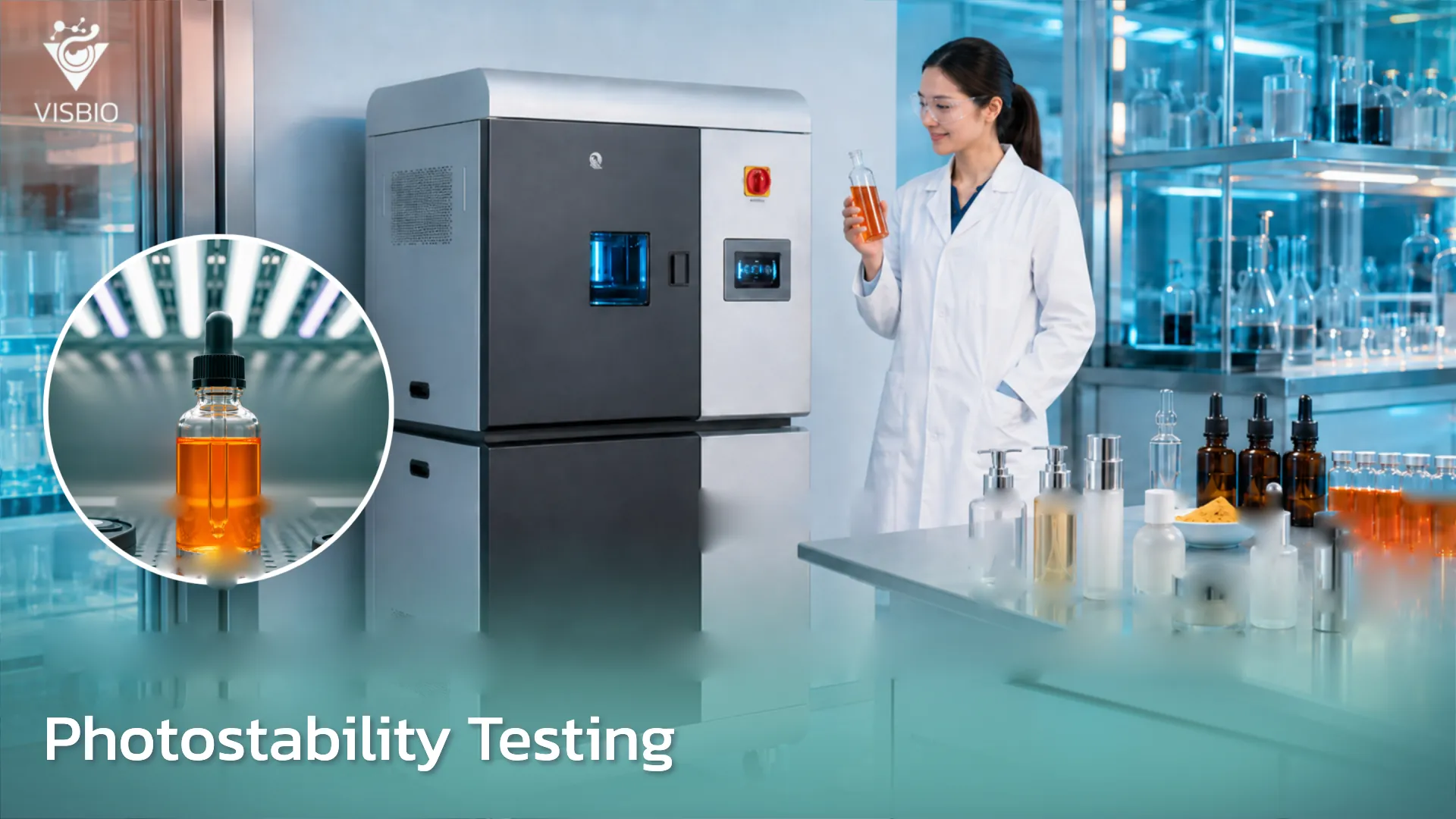
A photostability test exposes a product to defined amounts of visible and ultraviolet light and compares it with a control sample that is not exposed to light, to see whether light makes the product change color, develop an abnormal odor or lose active compounds. The results are used to make decisions on the formula, the packaging and the storage instructions on the label.
Light is one of the causes of visible deterioration in cosmetics and dietary supplements. Products on store shelves (point of sale), products in the glass cabinets of cosmetics counters, and products that consumers keep in the bathroom or on a dressing table near a window are all exposed to light continuously while they are on sale and in use. Color change, odors from oxidation, loss of light-sensitive active compounds such as retinol and vitamin C, and changes in texture are forms of deterioration that consumers notice immediately and that affect their decision to buy again.
VISBIO Laboratory provides photostability testing in collaboration with partner laboratories and evaluates the results with 4 main endpoints: color, odor, oil oxidation products and texture, together with measurement of active compound content when the product contains light-sensitive substances. This article summarizes what brand owners, quality assurance (QA) teams and research and development (R&D) teams should understand before submitting products for testing: the principles of the test, the endpoints used, the products that should be tested, and how to use the results to choose packaging.
Principles of photostability testing under ICH Q1B
The main guideline referenced for photostability testing is ICH Q1B, which specifies the light source, the total amount of light the sample must receive and how control samples are arranged. There are 2 options for the light source. Option 1 uses a light source designed to have a spectrum similar to the D65 standard (outdoor daylight) or ID65 (indoor daylight), such as a daylight fluorescent lamp that emits both visible and UV light, a xenon lamp or a metal halide lamp; if the source emits significant radiation below 320 nm, a filter may be used to remove it. Option 2 exposes the same sample to a cool white fluorescent lamp together with a near-UV fluorescent lamp that emits light from 320 to 400 nm with maximum energy at 350–370 nm.
For confirmatory testing, samples must receive a total visible light exposure of not less than 1.2 million lux hours (lux·h) and a total near-UV exposure of not less than 200 watt hours per square meter (W·h/m²). This amount of light is the standard for confirmatory testing, which makes results directly comparable; it is not equal to the amount of light that every product receives throughout its shelf life. To put it in perspective, a sample exposed to 1,000 lux at all times would need about 1,200 hours, or roughly 50 days, to reach 1.2 million lux hours. The amount of light actually received is confirmed by chemical actinometry or with calibrated light meters and radiometers.
Heat from the light source can also change the sample. ICH Q1B therefore calls for temperature control during exposure, or for a dark control to be placed in the same environment. The usual control is a sample wrapped in aluminum foil and placed beside the exposed sample. It receives the same heat but no light, so comparing the two samples separates the effect of light from the effect of temperature.
ICH Q1B was developed for drugs, but many manufacturers of cosmetics and dietary supplements apply its principles to design their tests, together with the cosmetics stability testing guideline ISO/TR 18811:2018. ICH Q1B also allows photostability testing during use for some products, such as skin creams, designed around the way the product is used.
Four endpoints for cosmetics and dietary supplements
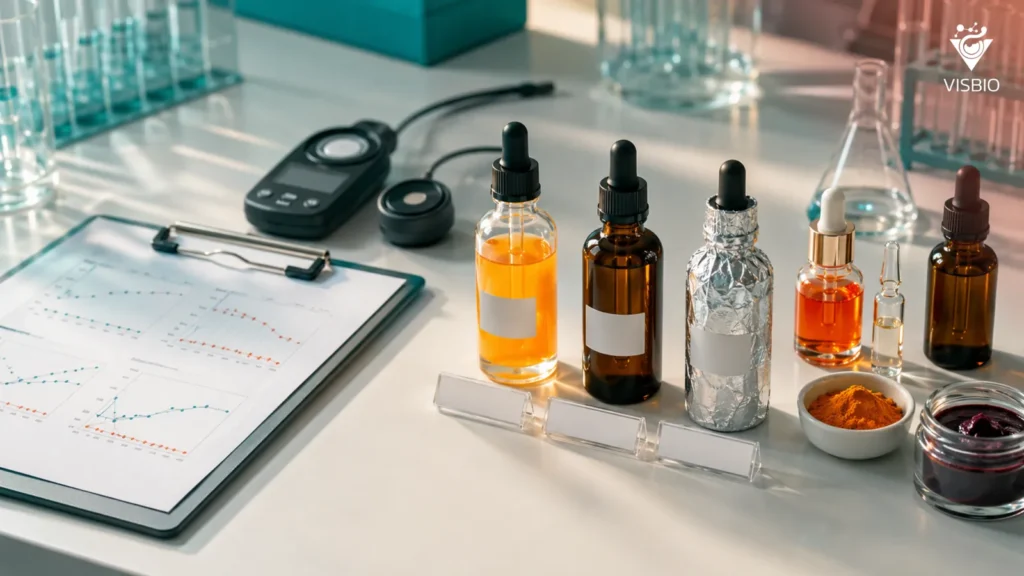
The photostability of cosmetics and dietary supplements is evaluated with 4 main endpoints that cover the deterioration that consumers can perceive.
Endpoint 1: Color. Measured quantitatively at VISBIO Laboratory as the color difference ΔE2000 in the CIE L*a*b* color space, against a dark control at the same temperature. Color change caused by light is something consumers see immediately. Products colored with natural pigments such as carotenoids, curcuminoids and anthocyanins are at high risk of fading. Research has found that high-intensity pulsed light reduces curcumin content in line with the light energy received (Zhang et al., 2023), and that anthocyanin stability depends on several factors, including light, pH and temperature (Enaru et al., 2021).
Endpoint 2: Odor. Evaluated by VISBIO Laboratory’s trained sensory panel to detect abnormal odors from oxidation (off-notes), which indicate deterioration of oils and light-sensitive substances. Odor evaluation provides information that no single instrumental measurement covers, and it helps catch deterioration at an early stage, before consumers notice it.
Endpoint 3: Oil oxidation products. Measured by the peroxide value (PV), a widely used indicator for monitoring the early oxidation of oils in products. VISBIO Laboratory measures this value in collaboration with partner laboratories.
Endpoint 4: Texture. Measured with a texture analyzer in collaboration with partner laboratories, for products whose texture may change when components of the formula degrade under light. This endpoint shows deterioration that color measurement and odor evaluation may miss.
Products that should undergo photostability testing
Products at risk of deterioration from light fall into 4 groups. The first group is products that use natural colors as a selling point (clean label), such as curcuminoids from turmeric, anthocyanins from purple and blue fruits, carotenoids from carrots, mangoes and tomatoes, and chlorophyll from green leaves. These pigments can degrade under both UV and visible light.
The second group is products whose main component is an oil high in unsaturated fatty acids, such as rice bran oil, sesame oil, argan oil, rosehip oil and oil-based serums. Oxidation triggered by light raises the PV and affects odor and quality.
The third group is products containing light-sensitive active compounds, such as retinol and retinyl esters, ascorbic acid (vitamin C), resveratrol, coenzyme Q10 in formulas without light protection, and some groups of polyphenol extracts. Products that state these compounds on the label should have data confirming that, after the specified light exposure, the active compound content remains within the acceptance criteria, measured by high-performance liquid chromatography (HPLC) at VISBIO Laboratory.
The fourth group is products in clear packaging sold in brightly lit stores. This group uses the test results directly to choose packaging, as described in the next section.
Using test results to choose packaging
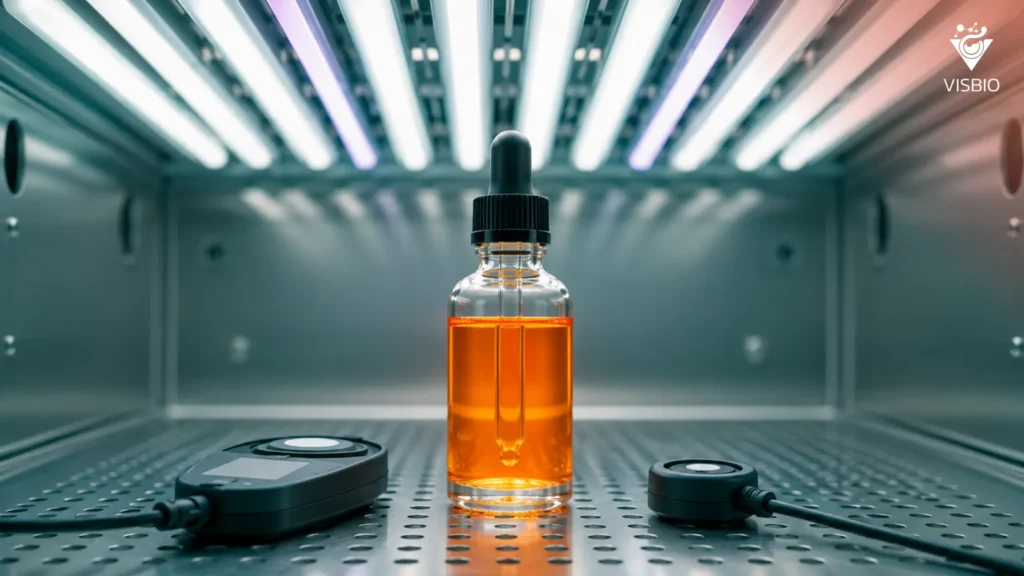
Packaging directly determines the outcome of photostability testing. Amber glass bottles, packaging with a UV-blocking coating and opaque packaging clearly reduce the effect of light. Testing to choose packaging therefore compares at least 3 types of sample in the same chamber:
- Product exposed directly, outside its packaging or in a clear container that lets light through; this is the worst case and shows how sensitive the product itself is to light
- Product in the packaging in which it will actually be sold, which shows whether the packaging protects adequately against light
- Foil-wrapped sample (dark control), which separates the effect of heat in the chamber from the effect of light
For drug products, ICH Q1B calls for testing in sequence: the directly exposed product first and, if unacceptable changes are found, the product in its immediate pack and then in its marketing pack, until a presentation with adequate light protection is found. If the immediate pack lets no light through at all, such as an aluminum tube or a can, only the directly exposed product is tested. The results also support storage instructions on the label, such as “Protect from light”, when the product relies on its packaging for protection from light.
Scope of VISBIO Laboratory's photostability testing service
VISBIO Laboratory manages photostability testing from start to finish in collaboration with partner laboratories, as follows:
- Design a test plan suited to the characteristics of the product, its packaging and its retail display conditions, including the choice of packaging comparisons
- Receive and handle samples, recording receipt, transfer and storage at every step (chain of custody)
- Measure baseline values for all 4 endpoints before light exposure, and active compound content when it is in the plan
- Expose samples in the light cabinets of partner laboratories according to ICH Q1B; the cabinets measure the cumulative dose of both visible and near-UV light, and a dark control is placed in the same cabinet
- Measure every parameter after exposure and compare it with the dark control
- Report results that link the scientific data to decisions on the formula, packaging and storage instructions
Frequently asked questions about photostability tests
What is a photostability test?
A photostability test exposes a product to defined amounts of visible and UV light and compares it with a control that is not exposed to light, to see whether light makes the product change color, develop an abnormal odor or lose active compounds.
How much light does ICH Q1B specify?
For confirmatory testing, samples must receive not less than 1.2 million lux hours of visible light and not less than 200 watt hours per square meter of near-UV light. This amount is a standard for comparing results, not the amount of light every product receives throughout its shelf life.
Why is a sample wrapped in aluminum foil needed?
The foil-wrapped sample is the dark control. It is placed beside the exposed sample and receives the same heat but no light, so the comparison separates the effect of light from the effect of heat. This sample is not the worst case; the worst case is the directly exposed product.
Which products should undergo photostability testing?
Products with natural colors, products containing oils high in unsaturated fatty acids, products with light-sensitive active compounds such as retinol, vitamin C and coenzyme Q10, and products in clear packaging sold in brightly lit stores.
How do the test results help choose packaging?
The test compares the directly exposed product, the product in its actual packaging and the dark control in the same chamber. If the directly exposed product changes beyond the criteria, the result for the actual packaging shows whether that packaging protects adequately against light or needs to be changed.
Which endpoints are used to evaluate the results?
Four main endpoints: color measured as ΔE2000, odor evaluated by a trained panel, the peroxide value of oils, and texture, together with measurement of active compound content by HPLC when the product contains light-sensitive substances.
References:
- Enaru, B., Drețcanu, G., Pop, T. D., Stǎnilǎ, A., & Diaconeasa, Z. (2021). Anthocyanins: Factors affecting their stability and degradation. Antioxidants, 10(12), 1967. https://doi.org/10.3390/antiox10121967
- International Conference on Harmonisation. (1996). ICH harmonised tripartite guideline Q1B: Stability testing: Photostability testing of new drug substances and products. ICH.
- International Organization for Standardization. (2018). Cosmetics — Guidelines on the stability testing of cosmetic products (ISO/TR 18811:2018). ISO.
- Zhang, H. A., Pratap-Singh, A., & Kitts, D. D. (2023). Effect of pulsed light on curcumin chemical stability and antioxidant capacity. PLOS ONE, 18(9), e0291000. https://doi.org/10.1371/journal.pone.0291000