

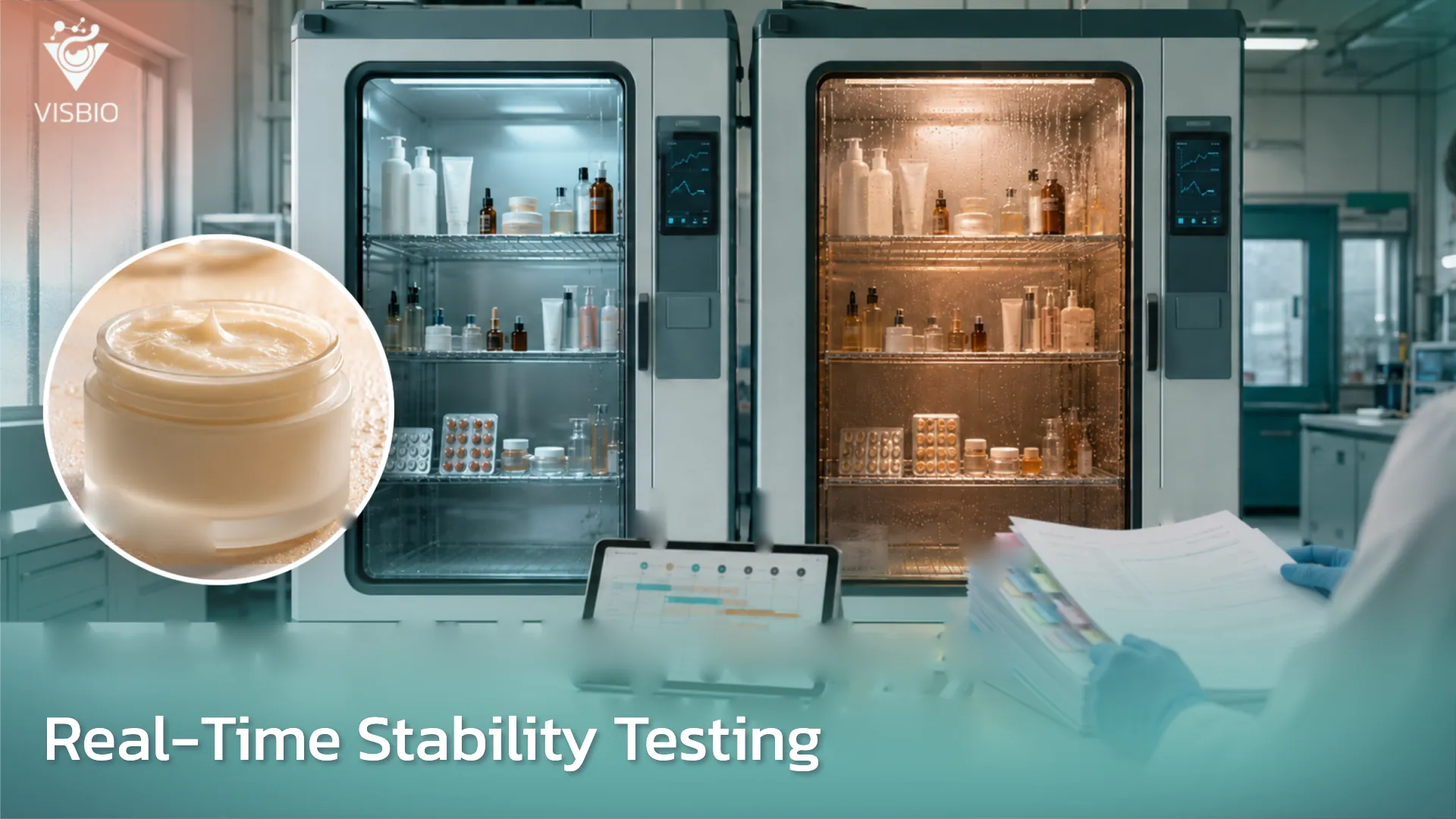
Real-time stability testing (also called long-term stability testing) is the storage of a product under conditions close to actual storage, with its quality checked at intervals until the end of the life to be stated on the label. The results are the main evidence used to set and confirm the shelf life, which is the period during which an unopened product, stored under the conditions stated on the label, still fully meets the specification set by the manufacturer.
The shelf life printed on the label of a cosmetic, dietary supplement or herbal product should not come from an estimate or a figure chosen for convenience, and it should not rely on accelerated stability testing alone. Accelerated testing stores the product under conditions hotter and more humid than normal, so it gives an early prediction during product development, but the evidence that confirms a product keeps its quality throughout the stated life is the result of long-term testing carried out in real time. Buyers, trading houses and key accounts in many markets, including ASEAN, Japan, Korea, Europe, China and North America, therefore often ask to see these results before placing orders.
VISBIO Laboratory provides real-time stability testing, from designing a test plan to match the target market, storing samples under controlled conditions and measuring parameters at each time point, through to trend analysis for setting the shelf life. This article summarizes what brand owners, quality assurance (QA) teams and research and development (R&D) teams should understand before submitting products for testing: the principles of the test, the choice of climatic conditions, the parameters measured and how results are interpreted, and the products that should have long-term stability data.
Principles of real-time stability testing
The most widely referenced guideline for designing stability tests is ICH Q1A(R2), developed for drugs by the ICH (International Council for Harmonisation). Many manufacturers of cosmetics and dietary supplements apply its principles on storage conditions, testing time points and evaluation. For dietary supplements, ASEAN has the ASEAN Guidelines on Stability Study and Shelf-Life of Health Supplements, while for cosmetics there is the technical report ISO/TR 18811:2018 from the International Organization for Standardization (ISO), which gives guidelines on the stability testing of cosmetic products.
The principle is to store the product in the packaging in which it will actually be sold, kept tightly closed throughout the study, in chambers where temperature and relative humidity are controlled 24 hours a day, and then to take samples out and measure quality parameters at defined time points. The first set of samples is measured at the start (Time Zero: T0) to provide a baseline for comparison throughout the study. Testing in the actual packaging matters because each type of packaging protects against moisture, air and light to a different degree.
ICH Q1A(R2) recommends testing every 3 months in the first year, every 6 months in the second year and once a year after that until the end of the proposed shelf life. For a product that needs a 24-month shelf life, the time points under this guideline are therefore months 0, 3, 6, 9, 12, 18 and 24 (T0, T3, T6, T9, T12, T18 and T24). For cosmetics and dietary supplements, the number of time points can be adjusted to the product type, the risk of the formula and the client’s policy, but confirming the full shelf life on the label requires long-term data covering at least the stated life; for example, a 24-month shelf life needs results at T24.
While the long-term data are still incomplete, a manufacturer may use the long-term data available together with accelerated test results to set a provisional shelf life, then continue the long-term study to completion to confirm it. The ASEAN guidelines for health supplements likewise state that the actual shelf life must ultimately be based on long-term data.
The shelf life on this page refers to unopened products. The Period After Opening (PAO) is assessed by in-use stability testing, which simulates consumers opening, closing and using the product.
Choosing climatic conditions to match the target market
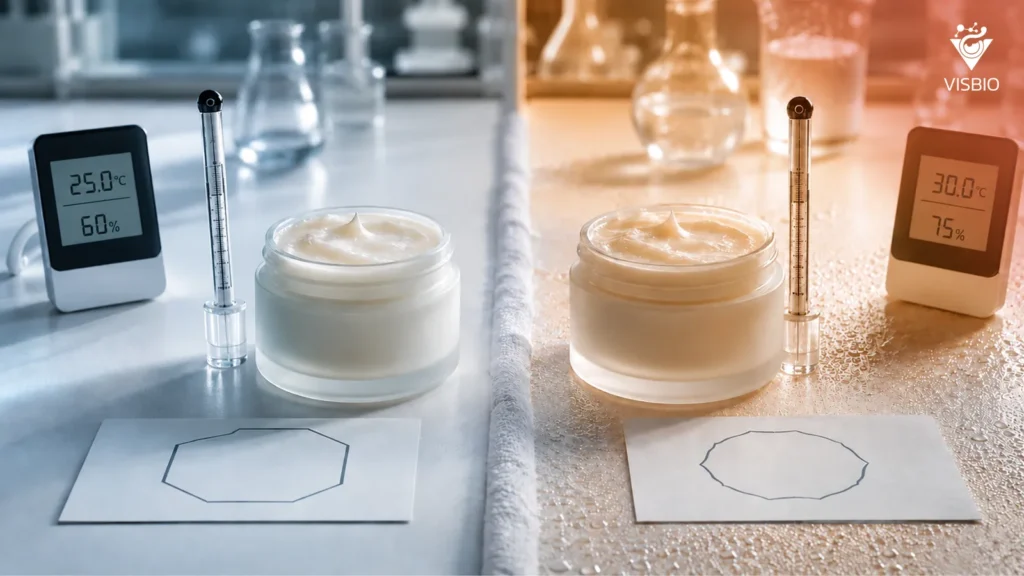
The conditions used for real-time stability testing should match the climatic zone of the market where the product will be sold. This system divides the world into 4 main zones according to average year-round climate, with Zone IV subdivided into IVa and IVb under the guidance of the World Health Organization (WHO). The long-term test conditions for each zone are as follows:
| Climatic zone | Climate | Long-term test condition |
|---|---|---|
| Zone I | Temperate | 21 °C/45 %RH |
| Zone II | Subtropical and Mediterranean | 25 °C/60 %RH |
| Zone III | Hot and Dry | 30 °C/35 %RH |
| Zone IVa | Hot and Humid | 30 °C/65 %RH |
| Zone IVb | Hot and Very Humid | 30 °C/75 %RH |
ICH Q1A(R2) uses long-term conditions of 25 °C/60 %RH or 30 °C/65 %RH. Thailand and most ASEAN markets are in Zone IVb because of their high average year-round relative humidity, so the ASEAN guideline on the stability of drug products sets the general long-term condition at 30 °C/75 %RH, and the ASEAN guidelines for health supplements use the same condition for products in packaging that water vapor can pass through. Products in packaging that water vapor cannot pass through, such as glass bottles or blister packs with aluminum on both sides, are tested at 30 °C without humidity control. Cosmetics and dietary supplements sold in Thailand or exported to ASEAN should therefore use 30 °C/75 %RH as the default condition, while markets in Europe, the United States, Japan and Korea mainly use 25 °C/60 %RH.
Brands that export to several markets have two options: test under several conditions in parallel, or test under a more severe condition to cover markets with milder conditions. WHO guidance states that testing under a more severe long-term condition can replace storage at 25 °C/60 %RH or 30 °C/65 %RH. Before planning, check the requirements of the destination country, because some countries set their own conditions. The choice of conditions at the outset therefore determines both the cost of testing and whether the results are accepted in the target market.
Parameters measured and interpretation of results
The parameters measured at each time point cover several dimensions of quality. The physical dimension includes appearance, color, pH, viscosity, phase stability for emulsion formulas, particle size for products that use delivery systems, and texture. Solid products such as powders, capsules and tablets should also be monitored for moisture content and water activity (aw), because the relative humidity of the test condition directly affects this group of products.
The microbiological dimension uses microbial enumeration by reference methods such as USP <61>, compared with the microbial limits for the product, such as ISO 17516:2014 for cosmetics, to confirm that microbiological quality stays within limits throughout the shelf life. Microbial counts show whether contamination exceeds the limits, but they do not prove that the preservative system still works. Confirming preservative efficacy requires a preservative efficacy test (PET), which is a separate test. VISBIO Laboratory performs microbial enumeration and PET in-house; see the microbial contamination and antimicrobial testing service page for details.
The chemical dimension includes measuring the content of active or marker compounds by high-performance liquid chromatography (HPLC), and monitoring oxidation in oil-containing products with the peroxide value (PV), which shows the amount of primary products of lipid oxidation. VISBIO Laboratory performs HPLC analysis in-house, while PV is measured in collaboration with partner laboratories.
Interpretation starts from the acceptance criteria for each parameter, which should be set in the test plan before the study begins, based on the T0 values and the product specification. A product that will claim a 24-month shelf life must have no parameter changing beyond its criteria up to T24. If a change is found at any time point, the R&D team should investigate the cause and may need to adjust the formula, change the packaging or shorten the shelf life to be claimed before launching the product.
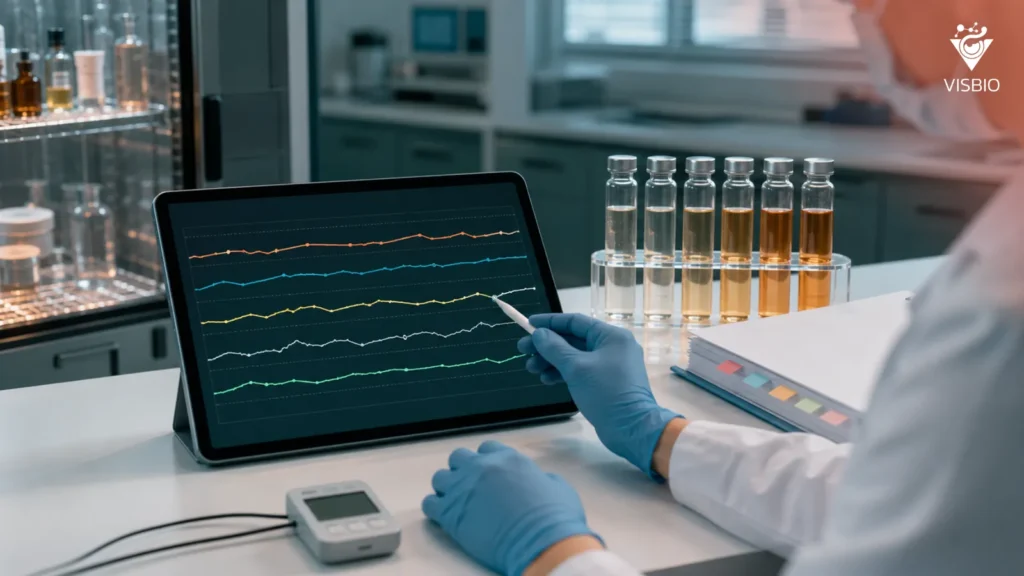
For quantitative parameters that change over time, such as active compound content, ICH Q1E uses regression analysis and sets the shelf life at the time point where the one-sided 95% confidence limit of the trend line meets the acceptance criterion. This approach bases the shelf life on the trend of the whole data set rather than on a single measured value.
Products that should have long-term stability data
Almost every type of cosmetic and dietary supplement should have long-term stability data to support the shelf life on the label, for example:
- Cosmetics: creams, lotions, serums, toners, masks, sunscreens, lipsticks, shampoos, hair conditioners, perfumes and body cleansers
- Dietary supplements: capsules, tablets, softgels, powdered drink mixes, functional drinks and jellies
- Herbal products: liquid preparations, powders, sprays and balms
- Products that use delivery systems: such as liposomes, niosomes and nanoemulsions, for which particle size should be monitored alongside active compound content throughout the study
Real-time stability results are useful throughout the supply chain: from setting the shelf life on the label, to compiling the Cosmetic Product Safety Report (CPSR) under the European Union cosmetics regulation (Regulation (EC) No 1223/2009), which requires data on product stability, to answering document requests from importers and key accounts. Brands without traceable long-term test results may face obstacles when opening export markets.
Scope of VISBIO Laboratory's real-time stability testing service
VISBIO Laboratory manages real-time stability testing from start to finish, as follows:
- Design a test plan to suit the target market, the required shelf life and the characteristics of the product, including the choice of climatic conditions, time points and parameters to measure
- Receive and handle samples, recording receipt, transfer and storage at every step (chain of custody)
- Store samples in VISBIO Laboratory’s temperature- and humidity-controlled chambers at 25 °C/60 %RH, 30 °C/65 %RH or 30 °C/75 %RH according to the target market, with continuous recording of temperature and humidity (continuous monitoring)
- Measure the planned parameters at each time point (peroxide value is measured in collaboration with partner laboratories) and record results so that they are traceable
- Analyze the trend of each parameter throughout the study (trend analysis)
- Report results that link the scientific data to the conclusions used to decide the shelf life on the label
Frequently asked questions about real-time stability and shelf life
What is real-time stability, and how does it relate to shelf life?
Real-time stability testing is the storage of a product, in the packaging in which it will be sold, under conditions close to actual storage, with its quality checked at defined time points until the end of the life to be claimed. The results are used to set and confirm the shelf life, which is the period during which an unopened product still fully meets its specification.
How does real-time stability differ from accelerated stability?
Real-time stability testing stores the product under conditions close to actual storage until the end of the life to be claimed, while accelerated testing stores it under conditions hotter and more humid than normal to predict results sooner. Accelerated results can be used with the long-term data available to set a provisional shelf life, but the shelf life on the label must be confirmed with long-term data.
Which conditions should be used for products sold in Thailand?
Thailand and most ASEAN markets are in climatic Zone IVb, so 30 °C/75 %RH should be the default condition. For export to markets that use 25 °C/60 %RH, such as Europe, the United States, Japan and Korea, a brand may test under several conditions in parallel or use the results from the more severe condition to cover those markets.
At which time points should samples be tested?
ICH Q1A(R2) recommends testing every 3 months in the first year, every 6 months in the second year and once a year after that. For a 24-month shelf life, this means T0, T3, T6, T9, T12, T18 and T24. The number of time points can be adjusted to the product type, but confirming a 24-month shelf life requires results at T24.
How does shelf life differ from the Period After Opening (PAO)?
Shelf life is the life of an unopened product, assessed by real-time stability testing in tightly closed packaging. PAO is the period during which a product can be used after opening, assessed by in-use stability testing, which simulates consumers opening, closing and using the product.
What should be done if a result exceeds the criteria at a time point?
The R&D team should investigate the cause of the change, then choose between adjusting the formula, changing the packaging or shortening the shelf life to be stated on the label before the product is launched.
References:
- ASEAN Consultative Committee for Standards and Quality – Pharmaceutical Product Working Group. (2018). ASEAN guideline on stability study of drug product (Revision 2). Association of Southeast Asian Nations.
- ASEAN Consultative Committee for Standards and Quality – Traditional Medicines and Health Supplements Product Working Group. (2013). ASEAN guidelines on stability study and shelf-life of health supplements (Version 1.0). Association of Southeast Asian Nations.
- European Parliament & Council of the European Union. (2009). Regulation (EC) No 1223/2009 of the European Parliament and of the Council of 30 November 2009 on cosmetic products. Official Journal of the European Union, L 342, 59–209.
- International Conference on Harmonisation. (2003a). ICH harmonised tripartite guideline Q1A(R2): Stability testing of new drug substances and products. ICH.
- International Conference on Harmonisation. (2003b). ICH harmonised tripartite guideline Q1E: Evaluation for stability data. ICH.
- International Organization for Standardization. (2014). Cosmetics — Microbiology — Microbiological limits (ISO 17516:2014). ISO.
- International Organization for Standardization. (2018). Cosmetics — Guidelines on the stability testing of cosmetic products (ISO/TR 18811:2018). ISO.
- United States Pharmacopeial Convention. (2023). General chapter <61> Microbiological examination of nonsterile products: Microbial enumeration tests. In United States Pharmacopeia 46–National Formulary 41. USP.
- World Health Organization. (2018). Annex 10: Stability testing of active pharmaceutical ingredients and finished pharmaceutical products. In WHO Expert Committee on Specifications for Pharmaceutical Preparations: Fifty-second report (WHO Technical Report Series, No. 1010, pp. 309–352). WHO.