

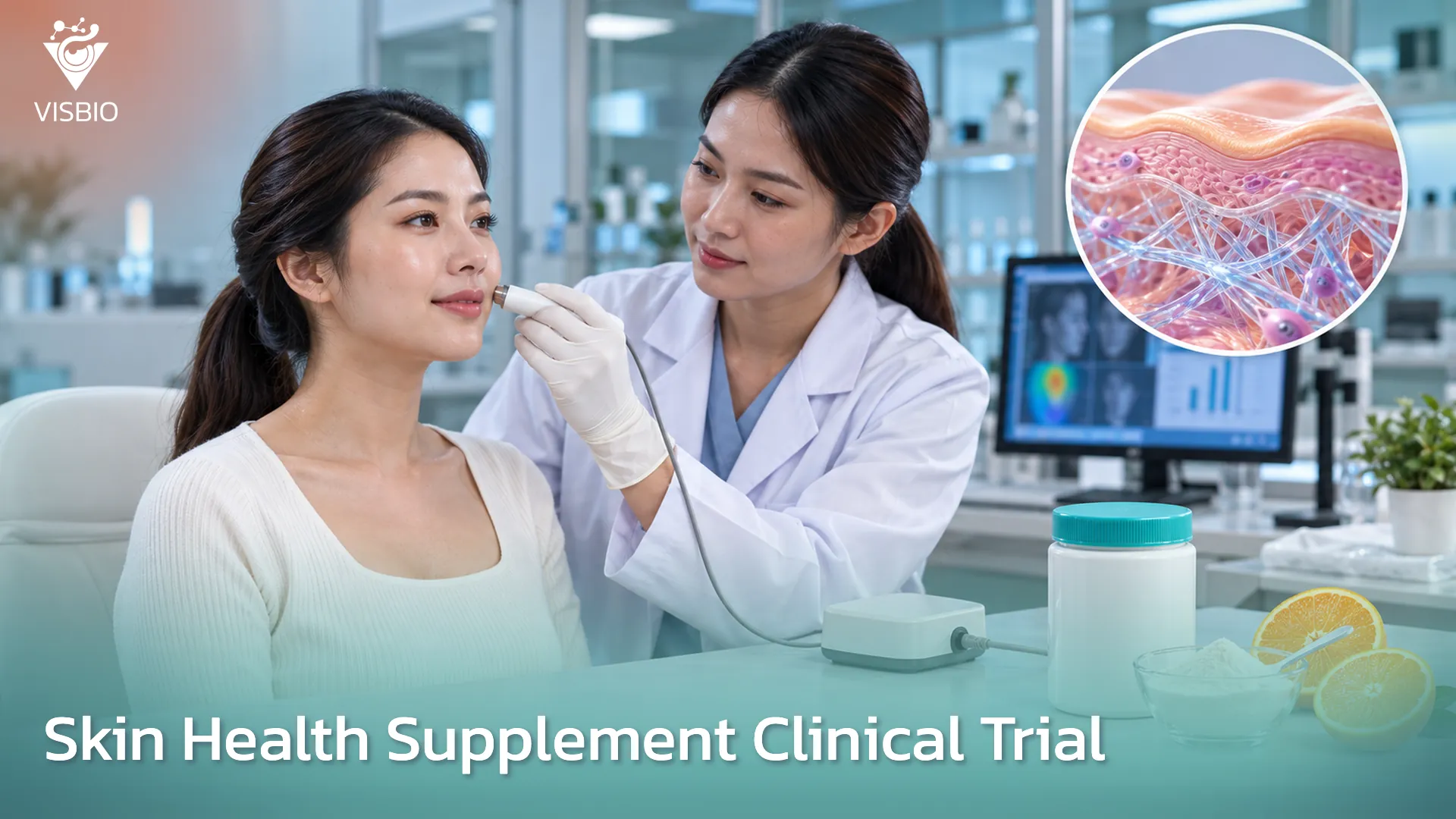
A skin health supplement is a dietary supplement taken by mouth to support skin health from within, a concept known as nutricosmetics. Common ingredients include collagen, peptides, vitamin C and ceramides. A skin supplement clinical trial measures skin parameters such as hydration, elasticity and skin color with standard instruments in volunteers who take the actual product, and compares them with a control group.
The skin supplement market in Thailand continues to grow, and many products communicate skin benefits in different ways. Those statements should be backed by evidence from studies in humans (human clinical trials) so that they can be verified, and food advertising must comply with the Food Act B.E. 2522 (1979), including advertising approval where the law requires it.
VISBIO Co., Ltd. provides study design, project management and project coordination for clinical studies of skin supplements, working with a network of partner clinical research sites and hospitals. Studies use standard skin measurement instruments together with validated questionnaires under Good Clinical Practice (GCP), for sponsors in Thailand and abroad.
Limits of the Thai FDA number: why skin supplement brands need further evidence of efficacy
Dietary supplements in Thailand are regulated under the Food Act B.E. 2522 (1979). The approval of dietary supplements by the Thai Food and Drug Administration (Thai FDA) focuses mainly on product safety and quality and does not confirm clinical efficacy. The food serial number (Thai FDA number) on the label therefore does not confirm that a product has the claimed effect on skin health.
This distinction matters to brand owners because consumers, modern trade retailers and export partners increasingly want evidence they can verify. The gap between “having a Thai FDA number” and “having evidence of efficacy” is therefore an issue that both marketing and legal teams need to watch, especially when a brand wants to make functional claims.
Clinical efficacy evaluation is designed to close this gap by measuring outcomes in volunteers who take the actual product, using instruments accepted in international dermatological research. The resulting data support product development and evidence-based communication.

Skin structure and age-related decline: what skin supplement manufacturers should know
The skin has two main layers: the epidermis and the dermis. The dermis contains two key structural proteins: collagen, which accounts for about 70% of the skin’s dry weight, and elastin, which allows the skin to stretch and recoil. The main collagen types in skin are type I and type III, which are produced by fibroblasts in the dermis.
Age-related decline reduces collagen production. Varani et al. (2006) found that fibroblasts isolated from the skin of people aged 80 years and over produced significantly less type I procollagen in culture than cells from people aged 18–29 years (56 ± 8 vs. 82 ± 16 ng/mL, p < 0.05). They concluded that reduced collagen production in aged skin results both from fibroblast deterioration and from reduced mechanical stimulation in the tissue.
Besides collagen, the outermost layer of the epidermis (stratum corneum) contains natural moisturizing factor (NMF), which helps maintain hydration within the skin. Understanding these processes helps product developers define clinical study endpoints that are targeted and scientifically sound.
The role of nutrition in skin health (nutricosmetics): from scientific evidence to product development
Nutricosmetics refers to taking nutrients or active compounds by mouth to influence skin health from within. The group with the most research support is hydrolyzed collagen, which is digested into small collagen peptides after ingestion and may stimulate collagen production in the dermis.
Asserin et al. (2015) carried out studies in an ex vivo skin model and in two placebo-controlled clinical trials. They found that daily intake of collagen peptides increased skin hydration after 8 weeks and, within 4 weeks, increased the density of dermal collagen measured by high-resolution ultrasound, while fragmentation of the collagen network assessed by reflectance confocal microscopy decreased, compared with the control group.
At the clinical trial level, Reilly et al. (2024) reported from a randomized, double-blind, placebo-controlled study that 12 weeks of a dietary supplement containing hydrolyzed collagen with vitamin C was associated with better skin hydration and elasticity and fewer wrinkles in the product group. Outcomes may vary with the characteristics of the product and of the population studied.
Standard instruments for assessing skin health in clinical research
Assessing skin supplements requires instruments that are accurate, reproducible and accepted in the international scientific literature. Skin measurements are carried out by the VISBIO Laboratory team, which already provides clinical skin testing for cosmetics, while volunteers are recruited and cared for by the research site responsible for the study. The main instruments used in clinical dermatological research are as follows.
Skin hydration measurement
This measures the water-holding capacity of the outermost skin layer using the capacitance principle, with results reported in instrument-specific units. The value is widely used as a primary endpoint in skin hydration research, including the study by Bolke et al. (2019).
Skin elasticity assessment
This measures how the skin stretches and recoils using the suction method. The main parameters are R2 (gross elasticity) and R5 (net elasticity), which reflect the condition of the collagen and elastin network in the dermis and are used as endpoints in studies of collagen supplements (Bolke et al., 2019).
Skin color measurement (melanin index and CIE L*a*b* color space)
This is used for products whose effect on skin color is to be studied, by measuring the melanin index or measuring color in the CIE L*a*b* color space, where L* indicates skin lightness. The change in L* (ΔL*) in the product group compared with the control group is used as a skin color endpoint in the study.
Validated questionnaire
This assesses subjective outcomes, such as how volunteers feel about their skin and their satisfaction. It is designed according to psychometric principles to add the consumer’s perspective to the scientific report.
The clinical study process with VISBIO and partner clinical research sites
Every study follows GCP. VISBIO designs the study and manages it from planning through to delivery of the report, and the VISBIO Laboratory team performs the skin measurements, while volunteers are recruited and cared for by the physicians and investigators of the research site responsible for the study.
Step 1: Consultation and protocol design
VISBIO analyzes the claim the brand owner wants to substantiate together with the investigators of the partner research site, in order to select a primary endpoint such as skin hydration or elasticity, set the volunteer inclusion/exclusion criteria and estimate a sample size that gives adequate statistical power.
Step 2: Approval from a human research ethics committee
The protocol and the informed consent documents must be approved by a human research ethics committee (Institutional Review Board, IRB) before any study starts, in every case. VISBIO coordinates the preparation of documents with the investigators and follows up on revisions until approval is granted.
Step 3: Volunteer recruitment and screening
The research site responsible for the study recruits and screens volunteers according to the criteria in the protocol. Every volunteer receives complete information and gives written informed consent before joining the study.
Step 4: Study conduct and data collection
Volunteers take the product or a comparator product according to the protocol. The VISBIO Laboratory team measures skin parameters with standard instruments at the time points set in the protocol, together with volunteer-completed assessments and adverse event recording throughout the study. VISBIO, as project manager, monitors progress and data completeness.
Step 5: Data analysis and reporting
Data are analyzed statistically according to a pre-specified statistical analysis plan (SAP) and summarized in a full scientific report. VISBIO coordinates the analysis and delivers the report to the sponsor for use in product development and evidence-based communication.
Dietary supplements suited to clinical evaluation of skin health
This service is designed for skin health supplements in capsule, powder and liquid form. Examples of suitable ingredient types include:
| Ingredient type | Product format |
|---|---|
| Hydrolyzed collagen | Capsules, powders, powdered drinks |
| Collagen peptides | Capsules, powders |
| Vitamin C with collagen | Capsules, effervescent tablets, powders |
| Ceramides | Capsules, softgels |
| Plant extracts with supporting scientific evidence | Capsules, powders |
| Combination formulas | Capsules, powders, liquids |
The examples in the table are ingredient types found in the dietary supplement market. Each ingredient used in products sold in Thailand must meet Thai FDA requirements, and some ingredients require a safety assessment before an application is filed.
Business benefits of clinical studies
Brand owners who invest in clinical studies gain several concrete strategic benefits.
Premium product positioning
Dietary supplements backed by clinical study data can be positioned in the premium segment on a reasoned and credible basis. Actual measured figures, such as skin hydration values in the product group compared with the control group, give premium pricing a factual basis.
Negotiating with modern trade and e-commerce channels
A clinical study report prepared under GCP is an important document that makes negotiations with modern trade retailers and e-commerce platforms smoother, and it gives an advantage over competitors without such data.
Reducing legal risk and expanding into export markets
Statements backed by clinical study evidence reduce the legal risk of advertising. In addition, many export markets, such as the European Union, Japan and ASEAN, require claim substantiation before a product goes on sale. A study designed and reported in line with international practice is therefore an important part of preparing to enter these markets, although each country has its own requirements.
Using scientific data in communication
Data actually measured in a clinical study can be used across several communication channels, including social media, labels, point-of-sale materials and digital media. Any use in advertising must first obtain advertising approval from the Thai FDA as required by law.
Conditions before a study starts
- Dietary supplements sold in Thailand must be approved by the Thai FDA and hold a food serial number (Thai FDA number) before the study starts. For products from international sponsors, VISBIO assesses the legal requirements with the research site on a project-by-project basis.
- VISBIO and the research site design the study plan specifically for each product and its claims.
- Every study must be approved by a human research ethics committee before it starts, without exception.
From laboratory testing to studies in volunteers
VISBIO supports several levels of evidence for skin supplements, from the laboratory (in vitro) skin supplement testing package, collagen production testing in fibroblasts and total collagen content analysis in products, to testing in ex vivo skin models and clinical studies in volunteers as described on this page. GCP applies to studies in humans, while cell-based and ex vivo work is carried out in the laboratory according to the test method of each assay. Planning every level of evidence with a single coordinator keeps the data at each stage consistent. For topical skin products, VISBIO offers separate clinical testing services for skin hydration, skin firming and the melanin index.
Frequently asked questions about skin supplement clinical trials
How are skin supplements measured in a clinical study?
The VISBIO Laboratory team measures skin parameters such as hydration, elasticity and skin color with standard instruments in volunteers who take the actual product, at the time points set in the protocol, and compares them with a control group, together with assessments that volunteers complete themselves.
Which instruments are used to measure the skin?
Hydration is measured using the capacitance principle, elasticity using the suction method with the R2 and R5 parameters, and skin color as the melanin index or the L* value in the CIE L*a*b* color space. A standard questionnaire is used for subjective outcomes.
Is there clinical evidence for oral collagen?
Placebo-controlled studies have reported that taking collagen peptides or hydrolyzed collagen was associated with better skin hydration, elasticity and dermal collagen density, for example Asserin et al. (2015) and Reilly et al. (2024). Outcomes vary, however, with the characteristics of the product and the population studied.
Does a product with a Thai FDA number still need clinical data?
The Thai FDA number for a dietary supplement is based mainly on an assessment of safety and quality. It does not confirm that the product has the claimed effect on skin health. If you want to communicate such benefits, clinical data provide supporting evidence, and advertising must still comply with food law.
What is VISBIO’s role, and who looks after the volunteers?
VISBIO designs the study and provides project management and coordination with a network of partner clinical research sites and hospitals, and the VISBIO Laboratory team performs the skin measurements. Volunteers are recruited and cared for by the physicians and investigators of the site responsible for the study.
Do study results guarantee advertising approval?
No. Study results support product development and evidence-based communication. Use on labels or in advertising must comply with the law and obtain approval from the relevant authorities where the law requires it. VISBIO does not guarantee study outcomes or regulatory decisions.
Talk to VISBIO about your clinical study
If you are interested in a clinical trial for your skin supplement, contact VISBIO for a free initial consultation through the following channels:
- Contact form: https://visbio.co.th/en/contact-us/
- LINE Official Account: @visbio
- Email: service@visbio.co.th
- Phone: 098-635-4197 (+66 98 635 4197)
- Timeline: please ask our team directly.
See all clinical trial services on VISBIO’s clinical trial page.
This article was prepared by VISBIO’s science and business development team to provide scientific information for businesses in the dietary supplement industry.
Important information about clinical studies
- VISBIO’s role: VISBIO designs studies and provides project management and project coordination with a network of partner clinical research sites and hospitals, for sponsors in Thailand and abroad. Volunteers are recruited and cared for by the physicians and investigators of the site responsible for the study.
- Research ethics: Every study in humans starts only after approval by a human research ethics committee and is conducted in line with Good Clinical Practice (GCP). All volunteers give informed consent after receiving complete information.
- Drugs and herbal medicines: Studies must follow the requirements of the Thai Food and Drug Administration (Thai FDA) that apply to the product. The sponsor, the research site and VISBIO plan these steps together from the start of the project.
- Use of results: Study results support product development and evidence-based communication. Use on labels or in advertising must comply with the law for each product type, with approval from the relevant authorities where the law requires it. VISBIO does not guarantee study outcomes or regulatory decisions.
- Foods and dietary supplements: Study results are not a claim that a product diagnoses, treats, cures, mitigates or prevents any disease.
- Timeline: This depends on the study design and the approval process. Please ask our team directly.
References:
- Asserin, J., Lati, E., Shioya, T., & Prawitt, J. (2015). The effect of oral collagen peptide supplementation on skin moisture and the dermal collagen network: Evidence from an ex vivo model and randomized, placebo-controlled clinical trials. Journal of Cosmetic Dermatology, 14(4), 291–301. https://doi.org/10.1111/jocd.12174
- Bolke, L., Schlippe, G., Gerß, J., & Voss, W. (2019). A collagen supplement improves skin hydration, elasticity, roughness, and density: Results of a randomized, placebo-controlled, blind study. Nutrients, 11(10), 2494. https://doi.org/10.3390/nu11102494
- Reilly, D. M., Kynaston, L., Naseem, S., Proudman, E., & Laceby, D. (2024). A clinical trial shows improvement in skin collagen, hydration, elasticity, wrinkles, scalp, and hair condition following 12-week oral intake of a supplement containing hydrolysed collagen. Dermatology Research and Practice, 2024, 8752787. https://doi.org/10.1155/2024/8752787
- Varani, J., Dame, M. K., Rittie, L., Fligiel, S. E. G., Kang, S., Fisher, G. J., & Voorhees, J. J. (2006). Decreased collagen production in chronologically aged skin: Roles of age-dependent alteration in fibroblast function and defective mechanical stimulation. The American Journal of Pathology, 168(6), 1861–1868. https://doi.org/10.2353/ajpath.2006.051302