

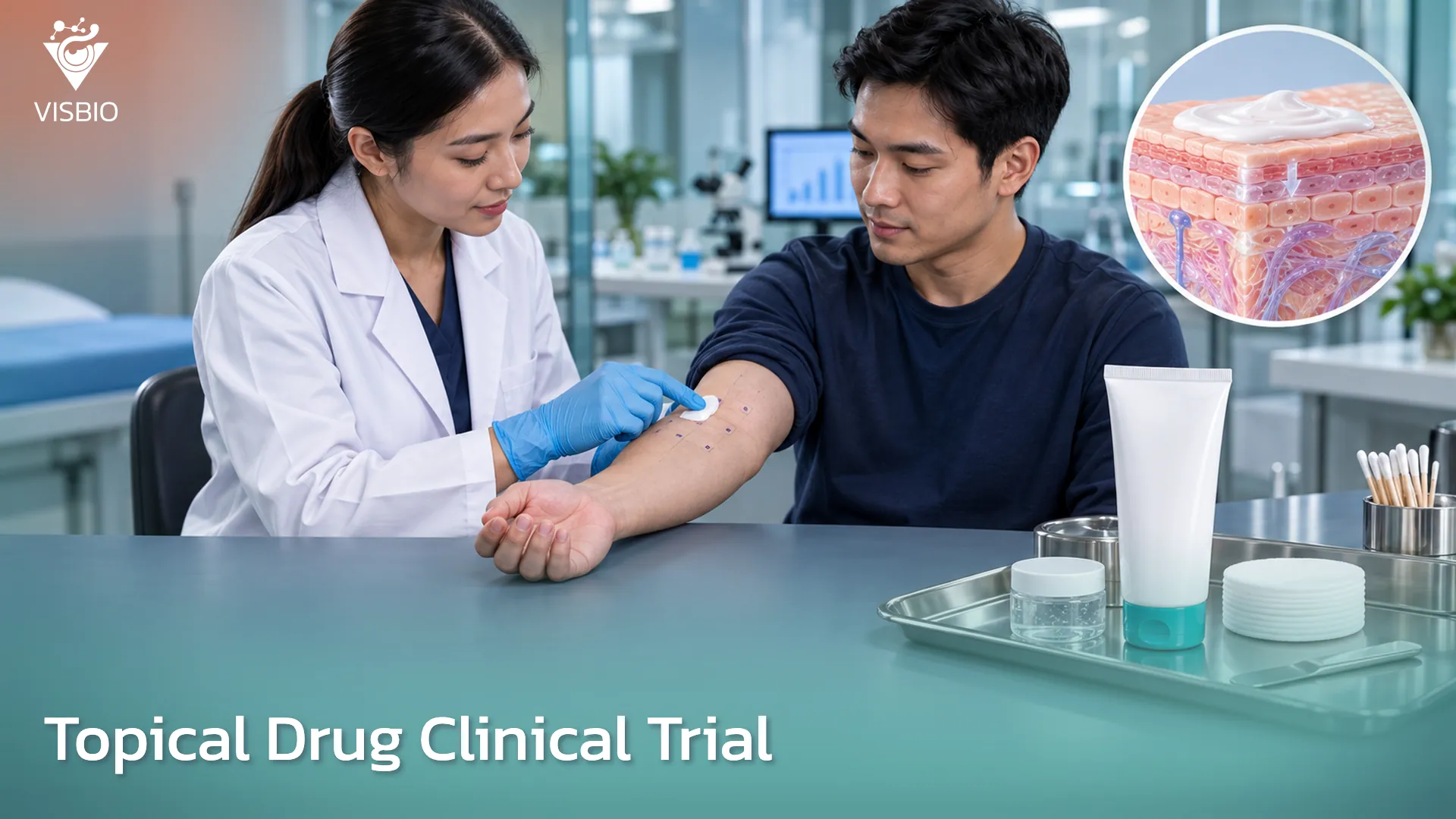
Topical drugs (drugs for external use) are drugs applied directly to the skin as gels, creams, ointments, lotions, solutions, sprays or powders, such as topical analgesics, topical antimicrobials for infection and wound care, topical dermatological drugs for skin conditions, and topical drugs that relieve itching and inflammation. A topical drug clinical trial is a study in volunteers under controlled conditions that compares outcomes between a group using the test drug and a control group, to measure the efficacy and safety of the formulation in actual use.
Topical drugs are a highly diverse group of pharmaceutical products in the Thai market. Although consumers can obtain them easily, every conventional (modern medicine) topical drug is legally governed by the Drug Act B.E. 2510 (1967) and must be registered with the Thai Food and Drug Administration (Thai FDA) before sale. Herbal topical products, such as herbal balms and plai cream, fall under the Herbal Products Act B.E. 2562 (2019) and are covered by VISBIO’s herbal medicine clinical research service.
VISBIO Co., Ltd. provides study design, project management and project coordination for clinical research on conventional topical drugs, in collaboration with a network of partner clinical research sites and hospitals. The service covers protocol design, approval from the human research ethics committee, coordination of participant recruitment and data collection with the research site, statistical analysis and the complete scientific report, under the internationally referenced principles of Good Clinical Practice (GCP), for sponsors in Thailand and abroad.
What drug registration covers, and when further clinical data are worthwhile
Drug registration with the Thai FDA under the Drug Act B.E. 2510 (1967) assesses the quality, safety and efficacy of a drug for the indication applied for. New drugs require supporting clinical study data, while generic drugs use data showing equivalence to the reference drug according to Thai FDA criteria. A registered topical drug therefore has the indications approved in its registration.
Manufacturers that want to communicate specific effects of their topical drug on labels or in advertising, such as “helps relieve pain” or “kills germs and helps the skin recover”, should have clinical data on their own formulation to support these statements, and the statements must fall within the indications approved in the drug registration. Adding a new indication requires an application to amend the drug registration, with supporting data, and approval from the Thai FDA beforehand. Drug advertising requires Thai FDA approval of the advertising text before publication, and some drug categories, such as dangerous drugs and specially controlled drugs, cannot be advertised to the general public.
In today’s market, more health-literate consumers have begun to ask whether the statements on topical drug labels are “actually measurable”, while pharmacies, modern trade channels and e-commerce platforms in the drug and health categories have begun to ask for supporting scientific documents. Clinical research conducted under GCP is a direct way to build empirical evidence, by comparing outcomes between a group using the test drug and a control group under controlled conditions.
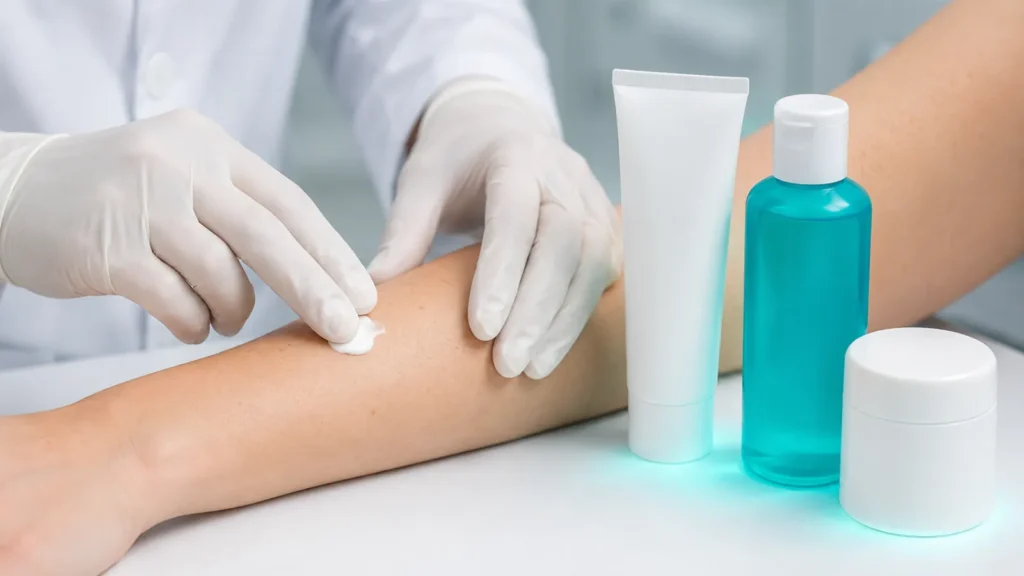
Topical drugs: the scientific basis product owners should know
Examples of topical drugs with an international body of clinical research include topical nonsteroidal anti-inflammatory drugs (topical NSAIDs) such as diclofenac gel. A meta-analysis of randomized trials in patients with knee osteoarthritis found that topical diclofenac relieved pain and improved joint function to a statistically significant degree compared with placebo (Chen et al., 2025). Clinical research on topical analgesics of this kind usually uses a parallel-group randomized controlled trial (parallel-group RCT). For topical treatments of skin conditions with several lesions on the same person, such as acne, psoriasis and atopic dermatitis, a within-person (split-body) design may be used, in which lesion sites are randomized to different treatments. This reduces between-person variability and needs fewer participants than a parallel design, but the study must be designed so that the drug applied at one site does not affect another site (carry-across effect), and the analysis must account for the correlation between lesions on the same person (Leducq et al., 2023).
For topical antimicrobials, clinical research uses endpoints that physicians can assess systematically, such as a wound infection severity score that rates redness, swelling, exudate and local warmth, together with microbiological confirmation of the pathogen (microbiological assessment) and monitoring of adverse effects (Rivera et al., 2025). Endpoints of this kind can serve as the basis of a clinical claim when the study is designed with an appropriate comparison group.
Choosing the right endpoint at the protocol design stage is at the heart of topical drug clinical research, because if the endpoint does not match the statement to be communicated, the results cannot be used even if the study is completed in full. VISBIO therefore designs the protocol with the investigators so that the endpoints match each product’s claim from the very first step.
The clinical research process with VISBIO and partner research sites
Every research project follows GCP and takes into account the particular characteristics of topical drugs, whose endpoints and measurement methods must be designed to match the clinical claim for each drug group. VISBIO designs the study and provides project management and coordination, while participant recruitment, clinical assessment and care are carried out by the physicians and investigators of the research site responsible for the study.
Step 1: Consultation and protocol design
Together with the investigators of the research site, VISBIO reviews the characteristics of the formulation, the effects the sponsor wants to claim and the purpose of the product, in order to define a suitable study plan, including the choice of study design (e.g., parallel-group RCT or within-person design), a primary endpoint that matches the claim, and internationally standard measurement tools. This step covers setting inclusion and exclusion criteria and estimating a sample size with adequate statistical power.
Step 2: Ethics approval and planning for Thai FDA requirements
Before any data are collected, the protocol and the informed consent documents must in every case be approved by a human research ethics committee (Institutional Review Board: IRB). VISBIO coordinates document preparation with the investigators and follows up on revisions requested by the committee until approval is granted. At this stage, the sponsor, the research site and VISBIO also check the Thai FDA requirements that apply to the drug used in the study and plan the necessary steps together from the start of the project.
Step 3: Participant recruitment and screening
Once approval is granted, the physicians and investigators of the research site responsible for the study recruit and screen volunteers or patients according to the criteria in the protocol. They make sure that every participant receives complete information, gives written consent and passes an initial health and skin screening before joining the study. VISBIO coordinates schedules and study readiness between the sponsor and the research site.
Step 4: Study conduct and data collection
Participants receive the test drug or the comparator, and data are collected at the time points set in the protocol, using standard assessment tools accepted in clinical research, such as a Visual Analog Scale (VAS) for symptom severity, the Investigator Global Assessment (IGA), patient-reported outcomes and skin assessment with standard instruments, together with recording of adverse events throughout the study. The site’s physician investigators carry out the clinical assessments and look after participant safety, while VISBIO, as project manager, monitors progress and the completeness of the data.
Step 5: Data analysis and reporting
All data are analyzed statistically according to a statistical analysis plan (SAP) set in advance and summarized in a complete scientific report in an internationally used format. VISBIO coordinates the analysis and delivers the report to the sponsor. The report provides clinical data that support product development and evidence-based communication, subject to the legal conditions described in the section on drug registration.
Topical drugs suited to this service
This service is designed for topical drugs that need clinical data to support their claims. Examples of suitable drug groups and product formats are shown below.
| Topical drug group | Product format |
|---|---|
| Topical analgesics and anti-inflammatories (topical analgesic/NSAID) | Gels, creams, sprays |
| Topical antimicrobials for infection and wound care | Creams, ointments, solutions |
| Topical dermatological drugs for skin conditions | Creams, lotions, ointments |
| Topical anti-itch and anti-rash drugs | Creams, gels, lotions |
| Topical antifungals | Creams, powders, sprays |
The service on this page covers conventional topical drugs governed by the Drug Act B.E. 2510 (1967). For herbal topical products, such as herbal balms and plai cream, see the herbal medicine clinical research service.
Business benefits of clinical data
Data from clinical research are not just a regulatory burden. They are a strategic asset that owners of topical drug products can use to create value in several ways, while all communication must still comply with drug law.
Premium product positioning
Topical drugs with clinical research data can be positioned in the premium segment on a sound basis. In a market with many low-priced competing products, outcomes measured by VAS or IGA scores in the group using the test drug, compared with a control group, help communicate value that sets the product apart from products without such data.
Negotiations with pharmacies, modern trade and e-commerce
Pharmacies, modern retailers and e-commerce platforms in the drug and health categories have begun to ask for supporting scientific documents. A clinical research report prepared under GCP makes negotiations and product listing in these channels smoother.
Lower legal risk and expansion into export markets
Statements about a drug’s effects that are supported by clinical data reduce the risk that advertising will be considered to overstate the drug’s properties under the Drug Act B.E. 2510 (1967), but they do not replace the step of obtaining Thai FDA approval of the advertising text. For export markets, clinical data designed and reported to international practice are part of the documents used to prepare registration or negotiations with trading partners, and each country in ASEAN and other regions has its own requirements.
Using scientific data in communication
Data actually measured in clinical research are empirical evidence that builds confidence among both consumers and healthcare professionals. Use in advertising requires Thai FDA approval of the advertising text before publication, and for some drug categories the indications can be communicated only to healthcare professionals.
Conditions before the research starts
- Topical drugs sold in Thailand must already be registered with the Thai FDA under the Drug Act B.E. 2510 (1967). For products of sponsors from abroad, VISBIO assesses the legal conditions together with the research site on a project-by-project basis.
- VISBIO and the research site design the study plan specifically for the drug group and the claim of each product.
- Every study must be approved by a human research ethics committee before it starts, without exception.
From laboratory testing to clinical research
For brands that want evidence at every level, VISBIO supports work from biological activity testing at the cellular level (In Vitro), such as anti-inflammatory activity, antimicrobial activity and wound healing at the cellular level, through to clinical research in humans. Laboratory results that show the mechanism of action can be used as a basis for choosing clinical research endpoints that are consistent with them. GCP applies to studies in humans, while laboratory work follows the test method for each assay.
Frequently asked questions about topical drug clinical research
Why does a registered topical drug still need further clinical data?
Drug registration assesses quality, safety and efficacy for the approved indications. Clinical data on your own formulation help you communicate its effects with evidence within the scope of the approved indications, and support negotiations with pharmacies, trading partners and healthcare professionals. Adding a new indication requires an application to amend the drug registration and Thai FDA approval beforehand.
Can clinical research results be used in drug advertising right away?
Not immediately. Drug advertising must stay within the indications approved in the drug registration, and the advertising text must be approved by the Thai FDA before publication. Some drug categories, such as dangerous drugs and specially controlled drugs, cannot be advertised to the general public, and VISBIO does not guarantee study outcomes or regulatory decisions.
What study designs can be used for topical drug research?
Examples include the parallel-group randomized controlled trial (parallel-group RCT) and the within-person (split-body) design, which suits skin conditions with several lesions on the same person and needs fewer participants. The design chosen depends on the drug group and the claim to be demonstrated.
Which tools are used to measure outcomes?
Standard assessment tools, such as a Visual Analog Scale (VAS) for symptom severity, the Investigator Global Assessment (IGA), patient-reported symptom questionnaires and skin assessment with standard instruments, together with recording of adverse events throughout the study. For topical antimicrobials, endpoints may include a physician-assessed wound infection severity score and microbiological testing for pathogens.
Who looks after the participants, and what is VISBIO’s role?
The physicians and investigators of the partner research site responsible for the study recruit, assess and look after the participants. VISBIO designs the study and provides project management and coordination between the sponsor and the research site, from planning to delivery of the report.
What needs to be prepared before a project starts?
Topical drugs sold in Thailand must already be registered with the Thai FDA. For products of sponsors from abroad, the legal conditions are assessed together with the research site on a project-by-project basis. The study plan is designed for the drug group and the claim of each product, and every project must be approved by a human research ethics committee before it starts.
Talk to VISBIO about topical drug clinical research
If you are interested in clinical research for your topical drug, contact VISBIO for a free initial consultation through any of these channels:
- Contact form: https://visbio.co.th/en/contact-us/
- LINE Official Account: @visbio
- Email: service@visbio.co.th
- Phone: 098-635-4197
- Timeline: please ask our team directly.
See all clinical trial services on VISBIO’s clinical trial service page.
Important information about clinical studies
- VISBIO’s role: VISBIO designs studies and provides project management and project coordination in collaboration with a network of partner clinical research sites and hospitals, for sponsors in Thailand and abroad. Volunteers are recruited and cared for by the physicians and investigators of the research site responsible for the study.
- Research ethics: Every study in humans starts only after approval by a human research ethics committee and is conducted under Good Clinical Practice (GCP). Every volunteer signs an informed consent form after receiving complete information.
- Drugs and herbal medicines: Studies must follow the Thai FDA requirements that apply to the product. The sponsor, the research site and VISBIO plan these steps together from the start of the project.
- Use of results: Study results support product development and evidence-based communication. Use on labels or in advertising must comply with the law for each product type, with approval from the relevant authorities where the law requires it. VISBIO does not guarantee study outcomes or regulatory decisions.
- Foods and dietary supplements: Study results are not a claim that a product diagnoses, treats, cures, mitigates or prevents any disease.
- Timeline: This depends on the study design and the approval process. Please ask our team directly.
References:
- Chen, Z.-R., Chen, B.-K., Li, P., & Feng, K. (2025). Efficacy and safety of different topical diclofenac formulations for the treatment of knee osteoarthritis: A meta-analysis of short-term and long-term treatment comparisons. BMC Musculoskeletal Disorders, 26, 230. https://doi.org/10.1186/s12891-025-08465-7
- Leducq, S., Dugard, A., Allemang-Trivalle, A., Giraudeau, B., & Maruani, A. (2023). Design and methodological issues of within-person (split-body) randomized controlled trials evaluating a topical treatment: A systematic review. Dermatology, 239(5), 720–731. https://doi.org/10.1159/000530149
- Rivera, P., Bello, M. B., Brito, G., Pichardo, G., Cruz, E., & Blanco, D. (2025). Therapeutic efficacy of 2% mupirocin in managing Staphylococcus aureus and Streptococcus pyogenes wound infections. Cureus, 17(4), e82366. https://doi.org/10.7759/cureus.82366