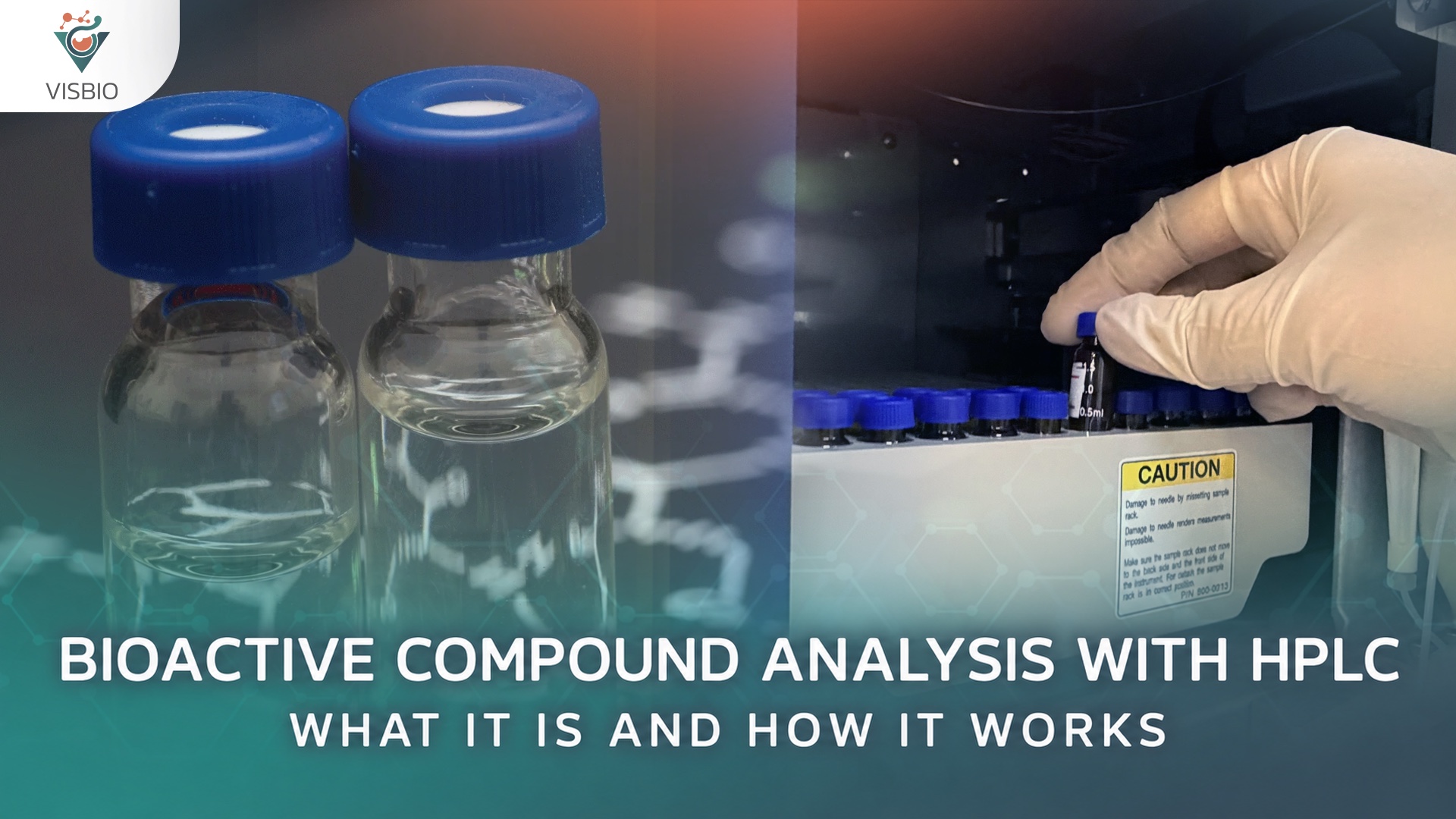
When a brand says its extract contains a certain percentage of curcuminoids, or a supplement lists its key compound content on the label, that value has to be measured. In most laboratories, it is measured with HPLC. This guide explains what HPLC is, how it works, what the instrument is made of and how the results are read, and how the technique is used to analyze bioactive compounds in raw materials, extracts and finished products.
What Is HPLC? Full Form and Definition
HPLC stands for High-Performance Liquid Chromatography (sometimes called high-pressure liquid chromatography). It is an analytical technique that separates the components of a liquid sample, identifies them and measures how much of each is present. A high-pressure pump pushes the sample, dissolved in a liquid called the mobile phase, through a column packed with fine particles that act as the stationary phase. Different compounds travel through the column at different speeds, so they leave it at different times and can be detected one by one.
HPLC supports both qualitative analysis (which compounds are present) and quantitative analysis (how much of each), needs only a small amount of sample and gives reproducible results. That combination is why it is one of the most widely used techniques in pharmaceutical, food, cosmetic and herbal product laboratories.
Chromatography in Brief
HPLC belongs to a family of separation techniques called chromatography. All of them work on the same idea: a mixture is carried by a moving phase past a stationary phase, and each component interacts with the stationary phase to a different degree, so the components travel at different speeds and separate.
Paper chromatography and thin-layer chromatography (TLC) use paper or a coated plate as the stationary phase. Gas chromatography (GC) uses a gas as the mobile phase. HPLC uses a liquid under high pressure together with a column of very fine particles, which makes it much faster and more precise than traditional column separation.
HPLC Principle: How Does HPLC Work?
The HPLC principle is the separation of the compounds in a liquid sample using two phases, the stationary phase and the mobile phase. An HPLC run follows these steps:
- Pumping the mobile phase: a high-pressure pump moves the solvent (the mobile phase) through the system at a constant flow rate.
- Injecting the sample: the prepared sample is injected into the flowing mobile phase by an autosampler.
- Separating in the column: the sample is carried into the column packed with the stationary phase. Compounds that interact more with the mobile phase leave the column first, while compounds that interact more with the stationary phase leave later.
- Detecting: the separated compounds pass through a detector, which records each one as a peak.
- Processing the data: software displays the result as a chart called a chromatogram, which is used to identify each compound and calculate how much of it is present.
The time a compound takes to travel from injection to the detector is its retention time. Under the same analytical conditions, a given compound always has the same retention time, which is how it is identified.
Parts of an HPLC Instrument
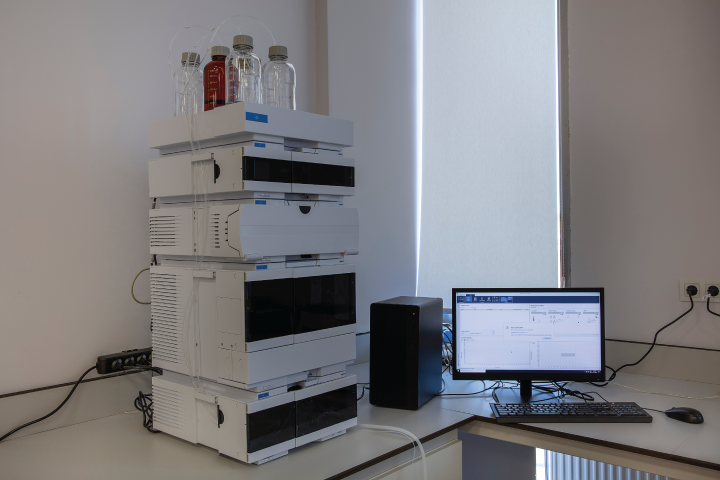
An HPLC system consists of these main parts:
- Solvent reservoirs: hold the mobile phase, usually connected to a degasser that removes air bubbles.
- Pump: delivers the mobile phase at high pressure and a constant flow rate.
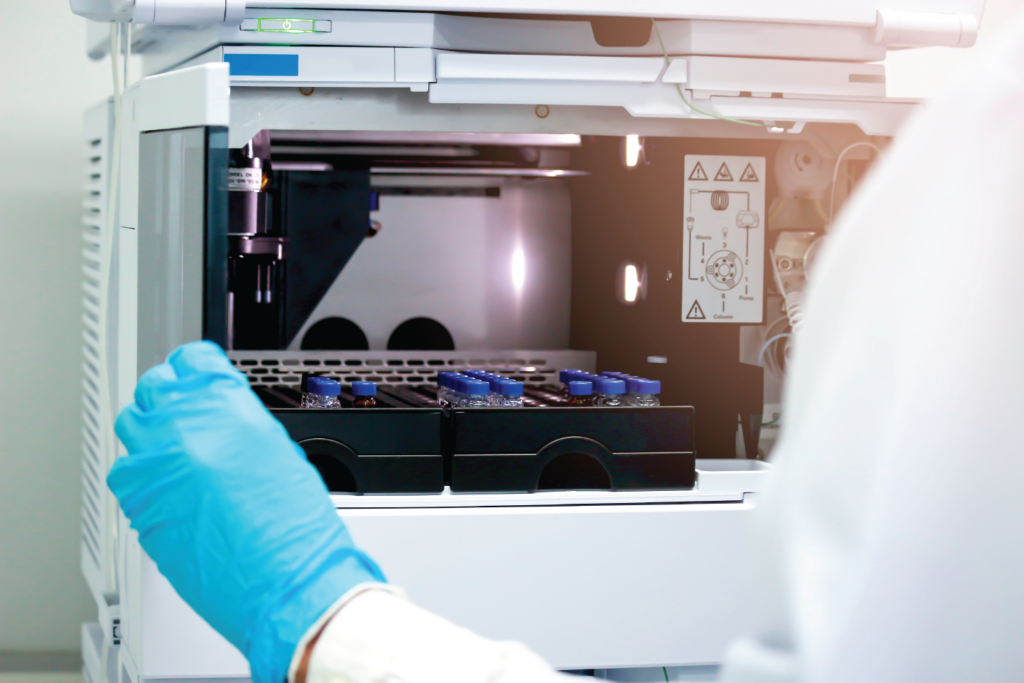
- Injector or autosampler: injects a precise volume of sample and can run many samples in sequence.
- Column and column oven: the heart of the separation. The most widely used column is the C18 column.
- Detector: turns the separated compounds into a signal.
- Data system: software that controls the instrument, records the chromatogram and calculates the results.

Mobile Phase and Stationary Phase
The mobile phase is the liquid that carries the sample through the system. It is usually a mixture of water (often with a buffer or acid) and an organic solvent such as methanol or acetonitrile. Its composition can stay constant throughout the run (isocratic elution) or change gradually (gradient elution) to separate compounds with very different properties.
The stationary phase is the material packed inside the column. The most common is silica bonded with 18-carbon chains, known as a C18 column, which is used in reversed-phase mode.
Reversed-Phase vs. Normal-Phase HPLC
In reversed-phase HPLC, by far the most common mode, the stationary phase is non-polar (such as C18) and the mobile phase is polar. Polar compounds leave the column first, and less polar compounds are retained longer. Normal-phase HPLC works the other way round, with a polar stationary phase and a less polar mobile phase. Most analyses of plant compounds, vitamins and cannabinoids use reversed-phase columns.
HPLC Detectors
The detector turns the separated compounds into a signal. The right choice depends on the compounds being measured:
- UV-Vis and diode-array (DAD/PDA) detectors: measure how much light a compound absorbs at a given wavelength. A DAD records the full spectrum, which helps confirm identity. Suitable for compounds that absorb UV or visible light, such as curcuminoids, flavonoids and many vitamins.
- Fluorescence detectors (FLD): highly sensitive for compounds that fluoresce, or that can be made to fluoresce.
- Refractive index (RI) and evaporative light-scattering (ELSD) detectors: used for compounds with little or no UV absorption, such as some sugars.
- Mass spectrometry (LC-MS): identifies compounds by their mass, used when very high specificity or sensitivity is needed.
How to Read an HPLC Chromatogram
The result of an HPLC analysis is a chromatogram: a graph of the detector signal against time. Each peak represents a compound, or a group of compounds, leaving the column:
- Retention time (the position of the peak on the time axis) identifies a compound by comparison with a reference standard run under the same conditions.
- Peak area is proportional to the amount of the compound and is used for quantification.
- Calibration curve: the laboratory runs the reference standard at several known concentrations, plots peak area against concentration, and uses the curve to calculate the amount in the sample.
- Resolution: well-separated peaks allow reliable measurement. Overlapping peaks call for method adjustments.
Before analyzing samples, laboratories usually run a system suitability test to confirm that the instrument and column are performing within their criteria on that day.
HPLC vs. UHPLC vs. GC
| Technique | Mobile phase | Key features | Best suited to |
|---|---|---|---|
| HPLC | Liquid | Columns with particles of about 3–5 µm; moderate to high pressure | Most non-volatile compounds, such as plant compounds, vitamins, cannabinoids and preservatives |
| UHPLC | Liquid | Particles smaller than 2 µm; very high pressure | The same compounds as HPLC, with faster runs and sharper peaks |
| GC | Gas | Capillary column in a heated oven | Volatile compounds, such as terpenes, essential oil components and residual solvents |
UHPLC is a version of HPLC that uses smaller particles and higher pressure. GC (gas chromatography) suits volatile compounds. Visbio, for example, uses GC for terpene testing in cannabis extracts and HPLC for compounds such as curcuminoids, andrographolide and mitragynine.
What Is Bioactive Compound Analysis, and Why Use HPLC?
Bioactive compound analysis identifies and measures the key compounds in a sample: compounds linked to its biological activity or used as indicators of its quality. It can be carried out on many types of samples, including plants, vegetables, fruits and herbs, extracts, dietary supplements, herbal products and cosmetics. The analysis shows which compounds are present and in what amounts.
A note on terms: in Thailand, this work is often called biomarker analysis. In international quality control, the compounds measured in herbal materials and products are usually called marker compounds, while the word biomarker more often refers to indicators measured in biological samples such as blood, urine and milk, which can also show exposure to chemicals from outside the body.
HPLC is the most widely used technique for this work, because it can separate compounds with very similar structures and quantify them accurately against reference standards.
What Is HPLC Used For?
HPLC is used whenever product quality depends on knowing exactly which compounds are present and in what amounts, for example:
- Quantifying key compounds in herbal extracts, such as curcuminoids in turmeric, andrographolide in Andrographis paniculata and mitragynine in kratom.
- Measuring vitamins and other key compounds in dietary supplements, such as vitamin C and vitamin B12.
- Checking cannabinoids such as CBD and related compounds in cannabis and hemp products.
- Verifying key ingredients in cosmetics.
- Supporting quality control and the Test Reports behind a Certificate of Analysis (COA).
- Stability studies that track the content of a key compound over time.
Beyond analysis, preparative HPLC, a larger-scale version of the technique, is used to separate and purify compounds, for example to isolate a target compound or remove contaminants from it.
What Makes HPLC Results Reliable?
HPLC results are only as reliable as the method behind them. Laboratories develop a method for each compound and sample type, then validate it, commonly following international guidance such as ICH Q2, by checking parameters such as:
- Specificity: the target compound is measured without interference from other substances.
- Linearity: the signal increases in proportion to concentration across the working range.
- Accuracy: measured values are close to the true value.
- Precision: repeated measurements give closely matching results.
- LOD and LOQ: the lowest amount that can be detected, and the lowest amount that can be reliably quantified.
Reference standards of known purity are essential: without the right standard, a compound cannot be identified or quantified with confidence. This is why laboratories ask for information about your product before testing. Read more in COA Testing: How a Third-Party Lab Verifies Your COA.
Advantages and Limitations of HPLC
Advantages
- Separates compounds with similar structures.
- Accurate, reproducible quantification.
- Needs only a small amount of sample.
- Works for a wide range of compounds, from plant compounds to vitamins.
- Automated runs of many samples in sequence.
Limitations
- A suitable reference standard is needed for each compound.
- Sample preparation can be complex, depending on the sample type, such as creams, gummies or oils.
- Not suited to highly volatile compounds, for which GC is used instead.
- Compounds that do not absorb UV light need other types of detector.
Sending Samples for HPLC Testing: What to Prepare
- The product or raw material in its actual form.
- The names of the compounds to be measured and, if available, the expected amounts.
- Composition documents, such as a COI, the supplier’s COA or a specification.
- The type of sample, such as a cream, capsule, powder or beverage.
- The purpose of the test, such as confirming a label value, verifying a supplier or a stability study.
The cost of HPLC testing depends on the number of compounds to be measured, whether a method is already available for that type of sample, the availability and price of reference standards, and the number of samples. Our team can assess your details before you send samples.
Frequently Asked Questions About HPLC
What is HPLC?
HPLC (High-Performance Liquid Chromatography) is a technique that separates, identifies and quantifies the compounds in a liquid sample.
What is the principle of HPLC?
Each compound interacts with the stationary phase and the mobile phase to a different degree, so compounds move through the column at different speeds and separate.
What is the difference between HPLC and GC?
HPLC uses a liquid mobile phase and suits non-volatile compounds. GC uses a gas and suits volatile compounds.
What is a chromatogram?
The graph produced by the analysis, showing each compound as a peak against time. It is used to identify compounds and calculate their amounts.
What is a C18 column?
A column packed with silica bonded with 18-carbon chains. It is the most widely used stationary phase in reversed-phase HPLC.
Why does HPLC need a reference standard?
To confirm each compound’s identity from its retention time and to build the calibration curve used to calculate amounts.
Related reading
Need to quantify marker compounds in your extract or product?
VISBIO quantifies bioactive and marker compounds by HPLC in raw materials, extracts and finished products.
Talk to our team before sending samples: LINE @visbio · Contact us