

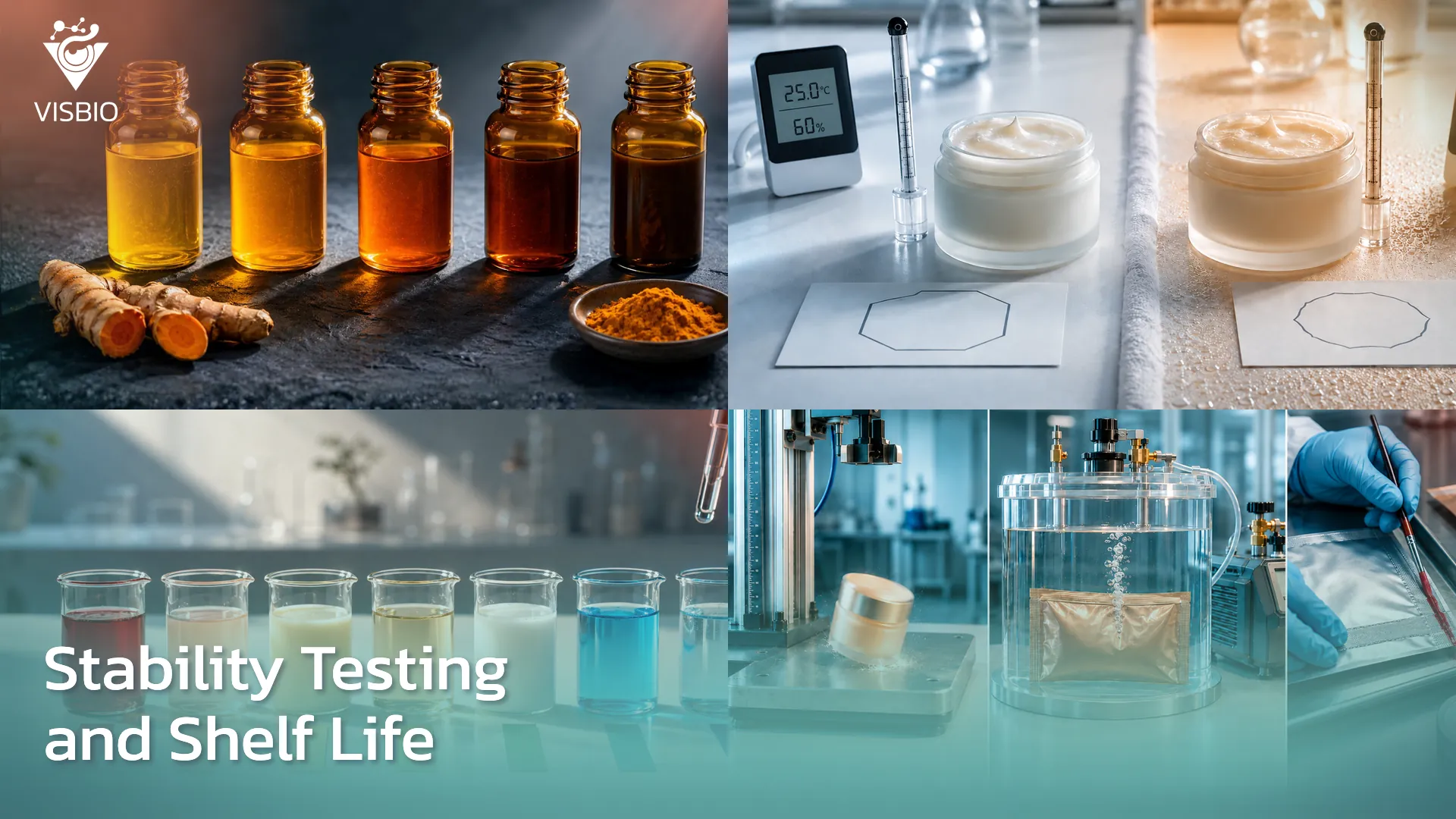
A stability test is the storage of a product under defined conditions, such as temperature, humidity and light, with its quality checked again at intervals to see how the product changes over time. Shelf life, also called storage life, is the period during which a product still meets its specification when stored under the conditions stated on the label. Stability test results are therefore the main evidence used to set an expiry date or a best-before date.
Cosmetics, dietary supplements, herbal products and beverages can all change during storage: color may darken, odor may change, creams may separate, powders may cake and active ingredients may decline. If these changes happen before the expiry date on the label, the brand has to deal with complaints or product recalls. Stability testing helps reveal these problems at the product development stage. VISBIO Laboratory provides services from study planning through to measuring the parameters used to monitor quality.
What does a stability test check?
A stability test tracks several aspects of quality at once: physical characteristics, chemical properties, microbiological quality, characteristics that consumers can perceive, and compatibility with the packaging. International guidance for cosmetics does not set a single set of conditions or criteria that applies to every product, so manufacturers must define their own test plan with a supporting rationale (International Organization for Standardization [ISO], 2018). VISBIO Laboratory tests microbiological quality in-house; see the microbial contamination and antimicrobial testing service page for details.
The parameters chosen depend on the type of product, for example:
- Cosmetics: color, odor, pH, viscosity and phase separation
- Dietary supplements: moisture, water activity (aw), caking and tablet friability
- Herbal products: color, odor, moisture and active compounds such as curcuminoids in turmeric
- Beverages: color, turbidity, pH, Brix and browning
When should a brand run a stability test?
- Before launching a new formula, to set its shelf life and, for cosmetics, to support setting the Period After Opening (PAO)
- When changing a raw material, raw-material supplier, manufacturing process or contract manufacturer
- When changing packaging, because the packaging determines how much moisture, oxygen and light can reach the product
- When exporting to a market that is hotter and more humid than before, or when a buyer asks for stability data
- When extending the shelf life on the label, or when investigating the cause of complaints about color, odor or separation
How is shelf life determined?
A reliable shelf life comes from a real-time stability study under conditions close to actual storage. Drug guidance sets conditions according to the climatic zone of the market, such as 25 °C and 60% relative humidity (Zone II) and 30 °C and 75% relative humidity (Zone IVb; World Health Organization, 2018); Zone IVb is the general long-term condition for the ASEAN region (ASEAN Consultative Committee for Standards and Quality – Pharmaceutical Product Working Group, 2018).
An accelerated stability study under ICH Q1A(R2) stores the product at 40 °C and 75% relative humidity for at least 6 months. It gives a quick preliminary estimate of shelf life but does not replace long-term data (International Conference on Harmonisation [ICH], 2003). The ICH guidelines were written for drugs, but many manufacturers of cosmetics, dietary supplements and herbal products use them as a reference framework. There are also specialized studies covering temperature cycling during transport, exposure to light (ICH, 1996) and repeated opening during use.
VISBIO Laboratory's stability testing services
The 29 services fall into 6 groups; see each service’s page for details. Some services are carried out in collaboration with partner laboratories, as stated on the page for that service.
Stability Studies
- Real-time Stability Testing — a study under conditions close to actual storage, and the main data for setting shelf life
- Accelerated Stability Testing — a study at higher temperature and humidity than normal, for a quick preliminary estimate of shelf life
- Freeze-Thaw / Temperature Cycling Stability Testing — alternating low and high temperatures in cycles to check tolerance to transport and warehouse storage
- Photostability Testing — shows how much light changes color, odor or active compounds and how well the packaging protects against light, with light exposure carried out in the chambers of partner laboratories
- In-Use Stability / Period After Opening (PAO) Testing — simulates repeated opening during use, to support setting the PAO on the label
Physical Properties
- Color Analysis — converts color into L*a*b* and ΔE2000 values to compare color between batches and over time
- Clarity / Turbidity Analysis — measures the turbidity of beverages and liquid extracts as a number
- Texture Profile Analysis (TPA) — measures the hardness, springiness and chewiness of confectionery, gummies and product textures
- Viscosity & Rheology Analysis — measures the viscosity and flow of creams, serums, lotions and syrups
- Particle Size Distribution (PSD) Analysis — shows aggregation or particle growth in extract powders, emulsions and liposomes
- BET Surface Area & Porosity Analysis — measures the surface area and porosity of powders, which relate to moisture uptake and dissolution
- Phase Separation & Sedimentation Analysis — checks phase separation and sedimentation in emulsions and suspensions
- Hardness Test — measures the force that breaks compressed tablets and the force that makes pressed cosmetics give way
- Foam Volume & Stability Analysis — measures foam volume and foam stability in shampoos and skin cleansers
- Caking Tendency Analysis — assesses how likely a powder is to cake when exposed to moisture
- Electronic Nose (E-nose) Pattern Analysis — compares the overall odor pattern with a reference sample to track odor change
Chemical Properties
- pH Measurement — measures the acidity or alkalinity of cosmetics, liquid products and beverages
- Titratable Acidity Analysis — measures total acid content by titration, used together with pH
- Moisture Content Analysis — measures the water content of extract powders, powdered dietary supplements and dried herbs
- Water Activity (aw) Measurement — measures how available the water in a product is for microbial growth
- Brix / Total Soluble Solids Analysis — measures soluble solids in beverages, fruit juices, syrups and honey
- Peroxide Value Analysis — measures the primary products of oxidation in oils and oil-containing products
- Browning Index Analysis — tracks browning of beverages, dried fruit and extract powders as a number
- Volatile Compound Profile Analysis by GC-MS — compares the profile of odor-giving volatile compounds before and after storage
Sensory Evaluation
- Trained Sensory Panel Evaluation — trained assessors systematically evaluate color, odor, taste and texture to detect changes that consumers can perceive
Encapsulation
- Encapsulation Efficiency (%EE) Measurement — measures the proportion of the active compound that remains inside liposomes, niosomes, lipid nanoparticles, nanoemulsions or microcapsules throughout storage
Packaging
- Packaging Leak Test and Drop Test — checks for leaks by vacuum and dye methods and tests the drop impact resistance of primary packaging
- Water Vapour and Oxygen Transmission Rate Testing (WVTR / OTR) — measures the rate at which water vapor and oxygen pass through material sheets and whole packages
- Friability Test — measures the weight tablets lose after tumbling in a test drum, to check how well they withstand packing and transport
How VISBIO Laboratory can help
- Study planning: choose the study design, conditions, time points and parameters to suit the product, packaging and target market, designed according to guidelines such as ICH Q1A(R2) and ISO/TR 18811
- Storage under defined conditions: samples are stored in VISBIO Laboratory’s temperature- and humidity-controlled chambers according to the study plan, with continuous recording of conditions; photostability testing is carried out in collaboration with partner laboratories
- The same method at every time point: results are compared with the initial value (T0) to give trends that can be compared
- Reporting and interpretation: trends are compared with the acceptance criteria in the product specification, to support setting the shelf life
As an external laboratory that neither makes nor sells clients’ products, VISBIO reports results impartially.
Frequently asked questions about stability tests and shelf life
What is shelf life, and how does it differ from PAO?
Shelf life is the period during which an unopened product keeps the quality set out in its specification. PAO (Period After Opening) is the period during which a cosmetic can be used after it is first opened, shown by an open-jar symbol with a number of months. In the European Union, cosmetics with a shelf life of more than 30 months generally must show a PAO instead of a date of minimum durability (European Parliament & Council of the European Union, 2009).
How long does a stability test take?
It depends on the shelf life to be claimed. ICH Q1A(R2) calls for the long-term study to continue until it covers the proposed shelf life, while an accelerated study takes at least 6 months. This study duration is different from the time needed to issue the report, which you can ask our team about directly.
Can accelerated testing replace long-term testing?
No, because some changes that happen at high temperature do not happen in the same way at normal temperature; for example, certain waxes melt. The shelf life on the label should therefore be confirmed with long-term data. The rule of thumb that passing 6 months under accelerated conditions supports a 2-year shelf life is not a requirement of the ICH guidelines.
Why test in the actual packaging?
Each material lets through different amounts of moisture, oxygen and light, and some materials can react with the ingredients. ICH Q1A(R2) therefore calls for studies in the same packaging as the product that will be marketed. If the packaging changes, earlier results may no longer be usable as a reference.
Does a change in formula or raw material require a new stability test?
Generally, a new test or a confirmatory test is advisable, with the scope depending on the risk of the change. A minor change may need only the relevant parameters to be measured, while a major formula change should start a new study.
References:
- ASEAN Consultative Committee for Standards and Quality – Pharmaceutical Product Working Group. (2018). ASEAN guideline on stability study of drug product (Revision 2).
- European Parliament & Council of the European Union. (2009). Regulation (EC) No 1223/2009 of the European Parliament and of the Council of 30 November 2009 on cosmetic products. Official Journal of the European Union, L 342, 59–209.
- International Conference on Harmonisation of Technical Requirements for Registration of Pharmaceuticals for Human Use. (1996). Stability testing: Photostability testing of new drug substances and products Q1B.
- International Conference on Harmonisation of Technical Requirements for Registration of Pharmaceuticals for Human Use. (2003). Stability testing of new drug substances and products Q1A(R2).
- International Organization for Standardization. (2018). Cosmetics — Guidelines on the stability testing of cosmetic products (ISO/TR 18811:2018).
- World Health Organization. (2018). Annex 10: Stability testing of active pharmaceutical ingredients and finished pharmaceutical products. In WHO Expert Committee on Specifications for Pharmaceutical Preparations: Fifty-second report (WHO Technical Report Series, No. 1010, pp. 309–352).